

A.7.3 Choice of axes
Spherical coordinates are also used with axes different from
the geographic ones. Because the physics of a problem does not
depend on the choice of coordinates, a set of coordinates that
simplifies the relevant expressions is used. For example, in
earthquake source studies, the x 3 axis can be chosen to go from
the center of the earth to the location of the earthquake. The
prime meridian, and hence x 1 , axis can be selected so that
the fault is oriented in the direction φ = 0. These axes simplify
the description of the seismic waves radiated by an earthquake,
because the distance ∆ from the source is now the colatitude.
Moreover, the radiation pattern generally has a high degree of
symmetry about the fault, so simple functions of φ appear. By
contrast, the radiation pattern need have no symmetry about
the North pole and Greenwich meridian, so a description in
those coordinates would usually be more complicated.
Fortunately, a coordinate system referred to the earthquake
location does not make describing the propagation of waves
from the source any more difficult. Because earth structure
varies primarily with depth, the spherical symmetry about
the center of the earth is independent of the axis orientation
chosen. The geographical convention in which the earth rotates
about the x 3 axis is helpful for navigation. In most seismological applications, however, the north direction has no particular
significance because the propagation of seismic waves is essentially unaffected by the earth’s rotation. The choice of a prime
meridian is arbitrary; in the early nineteenth century some
American maps had it through Washington DC, and some
French maps had it through Paris.
A.7.4 Vector operators in spherical coordinates
Because at a point on the sphere the unit spherical basis vectors
are oriented up, south, and east, the basis vectors at different
locations are generally not parallel. This makes the vector
differential operators more complicated, because these operators involve taking spatial derivatives of vectors. In Cartesian
coordinates the unit basis vectors are not affected by this
differentiation because they do not change orientation, so only
derivatives of the components need be taken. In spherical
coordinates, because a vector u is
u = u r ê r + u θ ê θ + u φ ê φ ,
(13)
differential operators acting on u must incorporate the derivatives of the basis vectors. Thus, in spherical coordinates, for a
scalar field ψ and a vector field u:
grad
sin
ψ
ψ
ψ
θ
θ
ψ
φ
θ
φ
=
+
+
ê
ê
ê
r r
r
r
∂
∂
∂
∂
∂
∂
1
1
(14)
div
(
)
sin
(sin
)
sin
u =
+
+
1
1
1
2
2
r
r
r u
r
u
r
u
r
∂
∂
∂
∂
∂
∂
θ θ
θ
θ φ
θ
φ
(15)
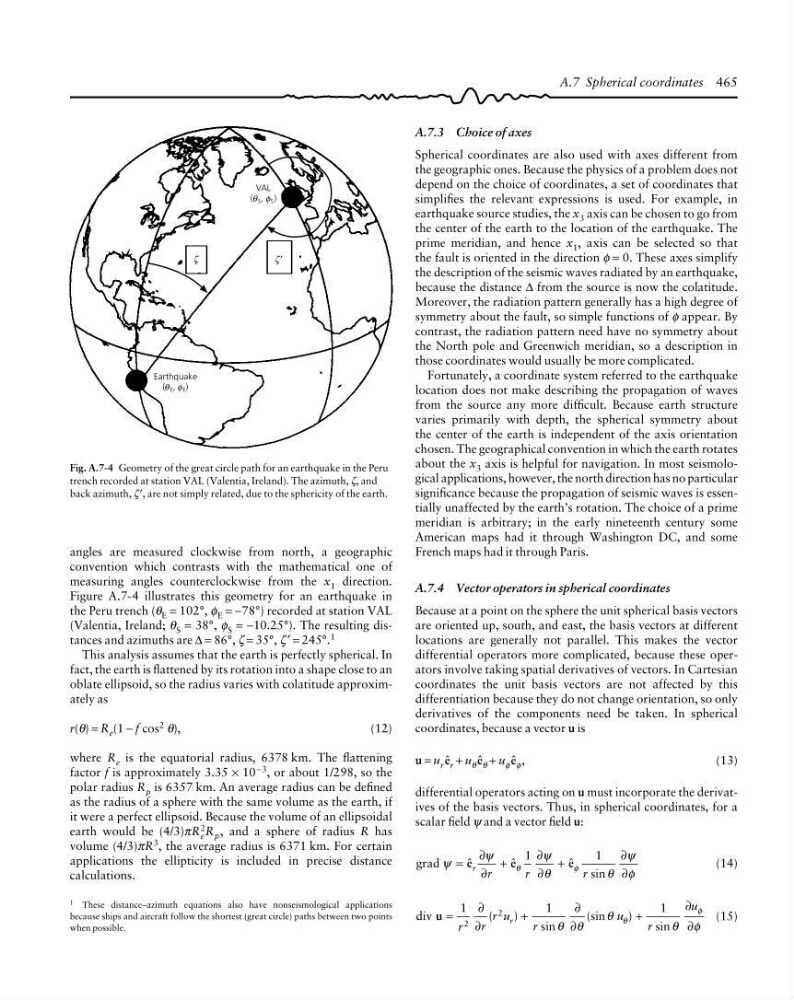
VAL
( S , S )
θ φ
Earthquake
( E , E )
θ φ
ζ
ζ ′
Fig. A.7-4 Geometry of the great circle path for an earthquake in the Peru
trench recorded at station VAL (Valentia, Ireland). The azimuth, ζ, and
back azimuth, ζ ′, are not simply related, due to the sphericity of the earth.
1 These distance–azimuth equations also have nonseismological applications
because ships and aircraft follow the shortest (great circle) paths between two points
when possible.
angles are measured clockwise from north, a geographic
convention which contrasts with the mathematical one of
measuring angles counterclockwise from the x 1 direction.
Figure A.7-4 illustrates this geometry for an earthquake in
the Peru trench (θ E = 102°, φ E = −78°) recorded at station VAL
(Valentia, Ireland; θ S = 38°, φ S = −10.25°). The resulting distances and azimuths are ∆ = 86°, ζ = 35°, ζ ′ = 245°. 1
This analysis assumes that the earth is perfectly spherical. In
fact, the earth is flattened by its rotation into a shape close to an
oblate ellipsoid, so the radius varies with colatitude approximately as
r(θ) = R e (1 − f cos 2 θ),
(12)
where R e is the equatorial radius, 6378 km. The flattening
factor f is approximately 3.35 × 10 −3 , or about 1/298, so the
polar radius R p is 6357 km. An average radius can be defined
as the radius of a sphere with the same volume as the earth, if
it were a perfect ellipsoid. Because the volume of an ellipsoidal
earth would be (4/3)πR 2
e R p , and a sphere of radius R has
volume (4/3)πR
3 , the average radius is 6371 km. For certain
applications the ellipticity is included in precise distance
calculations.
A.7 Spherical coordinates 465
Spherical coordinates are also used with axes different from
the geographic ones. Because the physics of a problem does not
depend on the choice of coordinates, a set of coordinates that
simplifies the relevant expressions is used. For example, in
earthquake source studies, the x 3 axis can be chosen to go from
the center of the earth to the location of the earthquake. The
prime meridian, and hence x 1 , axis can be selected so that
the fault is oriented in the direction φ = 0. These axes simplify
the description of the seismic waves radiated by an earthquake,
because the distance ∆ from the source is now the colatitude.
Moreover, the radiation pattern generally has a high degree of
symmetry about the fault, so simple functions of φ appear. By
contrast, the radiation pattern need have no symmetry about
the North pole and Greenwich meridian, so a description in
those coordinates would usually be more complicated.
Fortunately, a coordinate system referred to the earthquake
location does not make describing the propagation of waves
from the source any more difficult. Because earth structure
varies primarily with depth, the spherical symmetry about
the center of the earth is independent of the axis orientation
chosen. The geographical convention in which the earth rotates
about the x 3 axis is helpful for navigation. In most seismological applications, however, the north direction has no particular
significance because the propagation of seismic waves is essentially unaffected by the earth’s rotation. The choice of a prime
meridian is arbitrary; in the early nineteenth century some
American maps had it through Washington DC, and some
French maps had it through Paris.
A.7.4 Vector operators in spherical coordinates
Because at a point on the sphere the unit spherical basis vectors
are oriented up, south, and east, the basis vectors at different
locations are generally not parallel. This makes the vector
differential operators more complicated, because these operators involve taking spatial derivatives of vectors. In Cartesian
coordinates the unit basis vectors are not affected by this
differentiation because they do not change orientation, so only
derivatives of the components need be taken. In spherical
coordinates, because a vector u is
u = u r ê r + u θ ê θ + u φ ê φ ,
(13)
differential operators acting on u must incorporate the derivatives of the basis vectors. Thus, in spherical coordinates, for a
scalar field ψ and a vector field u:
grad
sin
ψ
ψ
ψ
θ
θ
ψ
φ
θ
φ
=
+
+
ê
ê
ê
r r
r
r
∂
∂
∂
∂
∂
∂
1
1
(14)
div
(
)
sin
(sin
)
sin
u =
+
+
1
1
1
2
2
r
r
r u
r
u
r
u
r
∂
∂
∂
∂
∂
∂
θ θ
θ
θ φ
θ
φ
(15)
VAL
( S , S )
θ φ
Earthquake
( E , E )
θ φ
ζ
ζ ′
Fig. A.7-4 Geometry of the great circle path for an earthquake in the Peru
trench recorded at station VAL (Valentia, Ireland). The azimuth, ζ, and
back azimuth, ζ ′, are not simply related, due to the sphericity of the earth.
1 These distance–azimuth equations also have nonseismological applications
because ships and aircraft follow the shortest (great circle) paths between two points
when possible.
angles are measured clockwise from north, a geographic
convention which contrasts with the mathematical one of
measuring angles counterclockwise from the x 1 direction.
Figure A.7-4 illustrates this geometry for an earthquake in
the Peru trench (θ E = 102°, φ E = −78°) recorded at station VAL
(Valentia, Ireland; θ S = 38°, φ S = −10.25°). The resulting distances and azimuths are ∆ = 86°, ζ = 35°, ζ ′ = 245°. 1
This analysis assumes that the earth is perfectly spherical. In
fact, the earth is flattened by its rotation into a shape close to an
oblate ellipsoid, so the radius varies with colatitude approximately as
r(θ) = R e (1 − f cos 2 θ),
(12)
where R e is the equatorial radius, 6378 km. The flattening
factor f is approximately 3.35 × 10 −3 , or about 1/298, so the
polar radius R p is 6357 km. An average radius can be defined
as the radius of a sphere with the same volume as the earth, if
it were a perfect ellipsoid. Because the volume of an ellipsoidal
earth would be (4/3)πR 2
e R p , and a sphere of radius R has
volume (4/3)πR
3 , the average radius is 6371 km. For certain
applications the ellipticity is included in precise distance
calculations.
A.7 Spherical coordinates 465