

448 Appendix
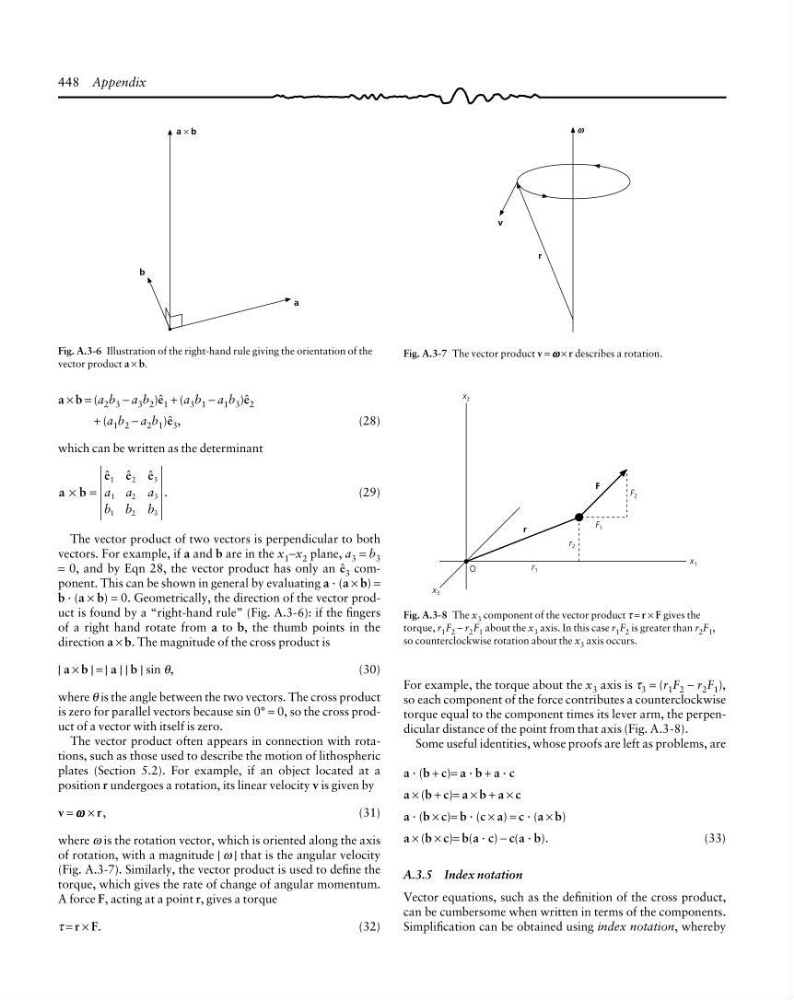
Fig. A.3-6 Illustration of the right-hand rule giving the orientation of the
vector product a × b.
b
a
a × b
r
v
ω
Fig. A.3-7 The vector product v = ω
ω ω
ω ω × r describes a rotation.
For example, the torque about the x 3 axis is τ 3 = (r 1 F 2 − r 2 F 1 ),
so each component of the force contributes a counterclockwise
torque equal to the component times its lever arm, the perpendicular distance of the point from that axis (Fig. A.3-8).
Some useful identities, whose proofs are left as problems, are
a · (b + c)= a · b + a · c
a × (b + c)= a × b + a × c
a · (b × c)= b · (c × a) = c · (a × b)
a × (b × c)= b(a · c) − c(a · b).
(33)
A.3.5 Index notation
Vector equations, such as the definition of the cross product,
can be cumbersome when written in terms of the components.
Simplification can be obtained using index notation, whereby
Fig. A.3-8 The x 3 component of the vector product τ = r × F gives the
torque, r 1 F 2 − r 2 F 1 about the x 3 axis. In this case r 1 F 2 is greater than r 2 F 1 ,
so counterclockwise rotation about the x 3 axis occurs.
O
x 3
x 2
x 1
r 1
r 2
F 2
F 1
F
r
a × b = (a 2 b 3 − a 3 b 2 )ê 1 + (a 3 b 1 − a 1 b 3 )ê 2
+ (a 1 b 2 − a 2 b 1 )ê 3 ,
(28)
which can be written as the determinant
a b
ê ê ê
× =
1
2
3
1
2
3
1
2
3
a a a
b b b
.
(29)
The vector product of two vectors is perpendicular to both
vectors. For example, if a and b are in the x 1 −x 2 plane, a 3 = b 3
= 0, and by Eqn 28, the vector product has only an ê 3 component. This can be shown in general by evaluating a · (a × b) =
b · (a × b) = 0. Geometrically, the direction of the vector product is found by a “right-hand rule” (Fig. A.3-6): if the fingers
of a right hand rotate from a to b, the thumb points in the
direction a × b. The magnitude of the cross product is
| a × b | = | a | | b | sin θ,
(30)
where θ is the angle between the two vectors. The cross product
is zero for parallel vectors because sin 0° = 0, so the cross product of a vector with itself is zero.
The vector product often appears in connection with rotations, such as those used to describe the motion of lithospheric
plates (Section 5.2). For example, if an object located at a
position r undergoes a rotation, its linear velocity v is given by
v = ω
ω ω
ω ω × r,
(31)
where ω is the rotation vector, which is oriented along the axis
of rotation, with a magnitude | ω | that is the angular velocity
(Fig. A.3-7). Similarly, the vector product is used to define the
torque, which gives the rate of change of angular momentum.
A force F, acting at a point r, gives a torque
τ = r × F.
(32)
Fig. A.3-6 Illustration of the right-hand rule giving the orientation of the
vector product a × b.
b
a
a × b
r
v
ω
Fig. A.3-7 The vector product v = ω
ω ω
ω ω × r describes a rotation.
For example, the torque about the x 3 axis is τ 3 = (r 1 F 2 − r 2 F 1 ),
so each component of the force contributes a counterclockwise
torque equal to the component times its lever arm, the perpendicular distance of the point from that axis (Fig. A.3-8).
Some useful identities, whose proofs are left as problems, are
a · (b + c)= a · b + a · c
a × (b + c)= a × b + a × c
a · (b × c)= b · (c × a) = c · (a × b)
a × (b × c)= b(a · c) − c(a · b).
(33)
A.3.5 Index notation
Vector equations, such as the definition of the cross product,
can be cumbersome when written in terms of the components.
Simplification can be obtained using index notation, whereby
Fig. A.3-8 The x 3 component of the vector product τ = r × F gives the
torque, r 1 F 2 − r 2 F 1 about the x 3 axis. In this case r 1 F 2 is greater than r 2 F 1 ,
so counterclockwise rotation about the x 3 axis occurs.
O
x 3
x 2
x 1
r 1
r 2
F 2
F 1
F
r
a × b = (a 2 b 3 − a 3 b 2 )ê 1 + (a 3 b 1 − a 1 b 3 )ê 2
+ (a 1 b 2 − a 2 b 1 )ê 3 ,
(28)
which can be written as the determinant
a b
ê ê ê
× =
1
2
3
1
2
3
1
2
3
a a a
b b b
.
(29)
The vector product of two vectors is perpendicular to both
vectors. For example, if a and b are in the x 1 −x 2 plane, a 3 = b 3
= 0, and by Eqn 28, the vector product has only an ê 3 component. This can be shown in general by evaluating a · (a × b) =
b · (a × b) = 0. Geometrically, the direction of the vector product is found by a “right-hand rule” (Fig. A.3-6): if the fingers
of a right hand rotate from a to b, the thumb points in the
direction a × b. The magnitude of the cross product is
| a × b | = | a | | b | sin θ,
(30)
where θ is the angle between the two vectors. The cross product
is zero for parallel vectors because sin 0° = 0, so the cross product of a vector with itself is zero.
The vector product often appears in connection with rotations, such as those used to describe the motion of lithospheric
plates (Section 5.2). For example, if an object located at a
position r undergoes a rotation, its linear velocity v is given by
v = ω
ω ω
ω ω × r,
(31)
where ω is the rotation vector, which is oriented along the axis
of rotation, with a magnitude | ω | that is the angular velocity
(Fig. A.3-7). Similarly, the vector product is used to define the
torque, which gives the rate of change of angular momentum.
A force F, acting at a point r, gives a torque
τ = r × F.
(32)