

Equation 17 shows several features of the scalar product:
• The scalar product commutes: a · b = b · a.
• The scalar product of two perpendicular vectors is zero,
because cos 90° = 0.
• The scalar product of a vector with itself is its magnitude
squared:
a · a = a 1 a 1 + a 2 a 2 + a 3 a 3 = | a | 2 .
(22)
The definition of the scalar product is generalized for vectors
with complex components. To see why, note that for a vector
a = (i, 1, 0), where i = −1, Eqn 22 would give a squared magnitude of zero. Because we would like only the zero vector, all
of whose elements are zero, to have zero magnitude, Eqn 17 is
generalized to
a · b = a 1
*b 1 + a 2
*b 2 + a 3
*b 3
(23)
where * indicates the complex conjugate. Thus the definition of
the squared magnitude (Eqn 22) becomes
a · a = a 1
*a 1 + a 2
*a 2 + a 3
*a 3 = | a | 2 .
(24)
For example, the squared magnitude of | (i, 1, 0) | 2 = (i)(−i) +
(1)(1) = 2. These complex definitions reduce to the familiar
cases, (Eqns 17 and 22), for vectors with real components.
The relations between the unit basis vectors for a Cartesian
coordinate system, ê 1 , ê 2 , and ê 3 , are easily stated using their
scalar products. Because each is perpendicular to the other two,
the scalar product of any two different ones is zero,
ê 1 · ê 2 = ê 1 · ê 3 = ê 2 · ê 3 = 0,
(25)
and the scalar product of each with itself is its squared
magnitude
ê 1 · ê 1 = ê 2 · ê 2 = ê 3 · ê 3 = 1.
(26)
The unit basis set of vectors is orthonormal; each is orthogonal (perpendicular) to the others and normalized to unit
magnitude.
The projection, or component of a vector in a direction given
by a unit vector, is the scalar product of a vector with the unit
vector. Using this idea, a component of a vector can be found
from its projection on the unit basis vector along the corresponding axis. Thus the x 1 component of u is
u · ê 1 = (u 1 ê 1 + u 2 ê 2 + u 3 ê 3 ) · ê 1 = u 1 ,
(27)
with the other components defined similarly.
A.3.4 Vector products
A second form of multiplication, the vector or cross product,
forms a third vector from two vectors by
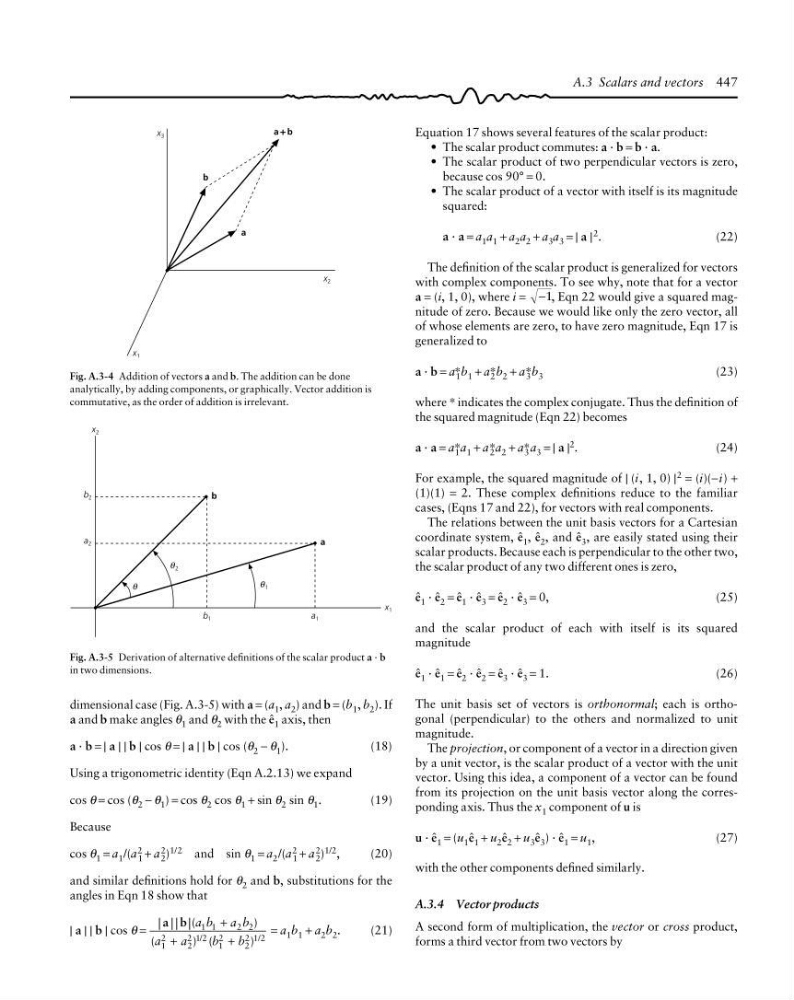
Fig. A.3-4 Addition of vectors a and b. The addition can be done
analytically, by adding components, or graphically. Vector addition is
commutative, as the order of addition is irrelevant.
x 3
x 1
x 2
a
b
a + b
A.3 Scalars and vectors 447
θ
θ 2
θ 1
a 2
b 2
x 2
a 1
b 1
a
b
x 1
Fig. A.3-5 Derivation of alternative definitions of the scalar product a · b
in two dimensions.
dimensional case (Fig. A.3-5) with a = (a 1 , a 2 ) and b = (b 1 , b 2 ). If
a and b make angles θ 1 and θ 2 with the ê 1 axis, then
a · b = | a | | b | cos θ = | a | | b | cos (θ 2 − θ 1 ).
(18)
Using a trigonometric identity (Eqn A.2.13) we expand
cos θ = cos (θ 2 − θ 1 ) = cos θ 2 cos θ 1 + sin θ 2 sin θ 1 .
(19)
Because
cos θ 1 = a 1 /(a 1
2 + a 2
2 ) 1/2 and sin θ 1 = a 2 /(a 1
2 + a 2
2 ) 1/2 ,
(20)
and similar definitions hold for θ 2 and b, substitutions for the
angles in Eqn 18 show that
| a | | b | cos θ =
| || |
a b (
)
(
) (
)
/
/
a b a b
a
a
b
b
1 1
2 2
1
2
2
2 1 2
1
2
2
2 1 2
+
+
+
= a 1 b 1 + a 2 b 2 .
(21)
• The scalar product commutes: a · b = b · a.
• The scalar product of two perpendicular vectors is zero,
because cos 90° = 0.
• The scalar product of a vector with itself is its magnitude
squared:
a · a = a 1 a 1 + a 2 a 2 + a 3 a 3 = | a | 2 .
(22)
The definition of the scalar product is generalized for vectors
with complex components. To see why, note that for a vector
a = (i, 1, 0), where i = −1, Eqn 22 would give a squared magnitude of zero. Because we would like only the zero vector, all
of whose elements are zero, to have zero magnitude, Eqn 17 is
generalized to
a · b = a 1
*b 1 + a 2
*b 2 + a 3
*b 3
(23)
where * indicates the complex conjugate. Thus the definition of
the squared magnitude (Eqn 22) becomes
a · a = a 1
*a 1 + a 2
*a 2 + a 3
*a 3 = | a | 2 .
(24)
For example, the squared magnitude of | (i, 1, 0) | 2 = (i)(−i) +
(1)(1) = 2. These complex definitions reduce to the familiar
cases, (Eqns 17 and 22), for vectors with real components.
The relations between the unit basis vectors for a Cartesian
coordinate system, ê 1 , ê 2 , and ê 3 , are easily stated using their
scalar products. Because each is perpendicular to the other two,
the scalar product of any two different ones is zero,
ê 1 · ê 2 = ê 1 · ê 3 = ê 2 · ê 3 = 0,
(25)
and the scalar product of each with itself is its squared
magnitude
ê 1 · ê 1 = ê 2 · ê 2 = ê 3 · ê 3 = 1.
(26)
The unit basis set of vectors is orthonormal; each is orthogonal (perpendicular) to the others and normalized to unit
magnitude.
The projection, or component of a vector in a direction given
by a unit vector, is the scalar product of a vector with the unit
vector. Using this idea, a component of a vector can be found
from its projection on the unit basis vector along the corresponding axis. Thus the x 1 component of u is
u · ê 1 = (u 1 ê 1 + u 2 ê 2 + u 3 ê 3 ) · ê 1 = u 1 ,
(27)
with the other components defined similarly.
A.3.4 Vector products
A second form of multiplication, the vector or cross product,
forms a third vector from two vectors by
Fig. A.3-4 Addition of vectors a and b. The addition can be done
analytically, by adding components, or graphically. Vector addition is
commutative, as the order of addition is irrelevant.
x 3
x 1
x 2
a
b
a + b
A.3 Scalars and vectors 447
θ
θ 2
θ 1
a 2
b 2
x 2
a 1
b 1
a
b
x 1
Fig. A.3-5 Derivation of alternative definitions of the scalar product a · b
in two dimensions.
dimensional case (Fig. A.3-5) with a = (a 1 , a 2 ) and b = (b 1 , b 2 ). If
a and b make angles θ 1 and θ 2 with the ê 1 axis, then
a · b = | a | | b | cos θ = | a | | b | cos (θ 2 − θ 1 ).
(18)
Using a trigonometric identity (Eqn A.2.13) we expand
cos θ = cos (θ 2 − θ 1 ) = cos θ 2 cos θ 1 + sin θ 2 sin θ 1 .
(19)
Because
cos θ 1 = a 1 /(a 1
2 + a 2
2 ) 1/2 and sin θ 1 = a 2 /(a 1
2 + a 2
2 ) 1/2 ,
(20)
and similar definitions hold for θ 2 and b, substitutions for the
angles in Eqn 18 show that
| a | | b | cos θ =
| || |
a b (
)
(
) (
)
/
/
a b a b
a
a
b
b
1 1
2 2
1
2
2
2 1 2
1
2
2
2 1 2
+
+
+
= a 1 b 1 + a 2 b 2 .
(21)