

446 Appendix
mathematical convention of defining angles counterclockwise
from x 1 differs from the geographical convention of defining
angles clockwise from North (x 2 ), so conversions are often
needed.
A.3.2 Elementary vector operations
The simplest vector operation is multiplication of a vector by a
scalar
αu = (αu 1 , αu 2 , αu 3 ).
(11)
For example, in two dimensions,
αv = (αv 1 , α v 2 )
(12)
yields a vector with magnitude
((α v 1 ) 2 + (αv 2 ) 2 ) 1/2 = | α | (v 1
2 + v 2
2 ) 1/2 = | α | | v |
(13)
whose direction is given by
tan θ = αv 2 /αv 1 = v 2 /v 1 .
(14)
Multiplication by a positive scalar thus changes the magnitude
of a vector but preserves its direction. Similarly, multiplication
by a negative scalar changes the magnitude of a vector and reverses its direction. û, a unit vector in the direction of u is
formed by dividing u by its magnitude
û = u / | u |.
(15)
The sum of two vectors is another vector whose components
are the sums of the corresponding components, so if
a = a 1 ê 1 + a 2 ê 2 + a 3 ê 3 and b = b 1 ê 1 + b 2 ê 2 + b 3 ê 3 ,
a + b = (a 1 + b 1 )ê 1 + (a 2 + b 2 )ê 2 + (a 3 + b 3 )ê 3 = b + a.
(16)
Addition can be done graphically (Fig. A.3-4) by shifting one
vector, while preserving its orientation, so that its “tail” is at
the “head” of the other, and forming the vector sum. For example, the total force vector acting on an object is the vector
sum of the individual force vectors. Equation 16 and Fig. A.3-4
show that vector addition is commutative; it does not matter in
which order the vectors are added.
A.3.3 Scalar products
There are two methods of multiplying vectors. The first, the
scalar product (also called the dot product or inner product),
yields a scalar:
a · b = a 1 b 1 + a 2 b 2 + a 3 b 3 = | a | | b | cos θ,
(17)
where θ is the angle between two vectors. To see that the two
definitions of the scalar product are equivalent, consider a twoFig. A.3-3 A vector in two dimensions making an angle θ with the x 1 axis.
x 2
v 2
θ
v
v 1
x 1
Thus the same physical vector is represented in a different
coordinate system, described by a different set of basis vectors,
using different components. The essential idea is that the
vector remains the same, or invariant, regardless of the coordinate system, although the numerical values of its components
change. Physical laws, like Newton’s law stating that the force
vector equals the product of the mass and the acceleration
vector (the second derivative with respect to time of the displacement vector), are written in vector form because the physical phenomenon does not depend on the coordinate system
used to describe it.
The length or magnitude of a vector, | u |, is a scalar, and thus
the same in different coordinate systems. By the Pythagorean
theorem, the length is
| u | = (u 1
2 + u 2
2 + u 3
2 ) 1/2 = (u′ 1
2 + u′ 2
2 + u′ 3
2 ) 1/ 2 .
(6)
The zero vector, 0, all of whose components are zero in any
coordinate system, has zero magnitude.
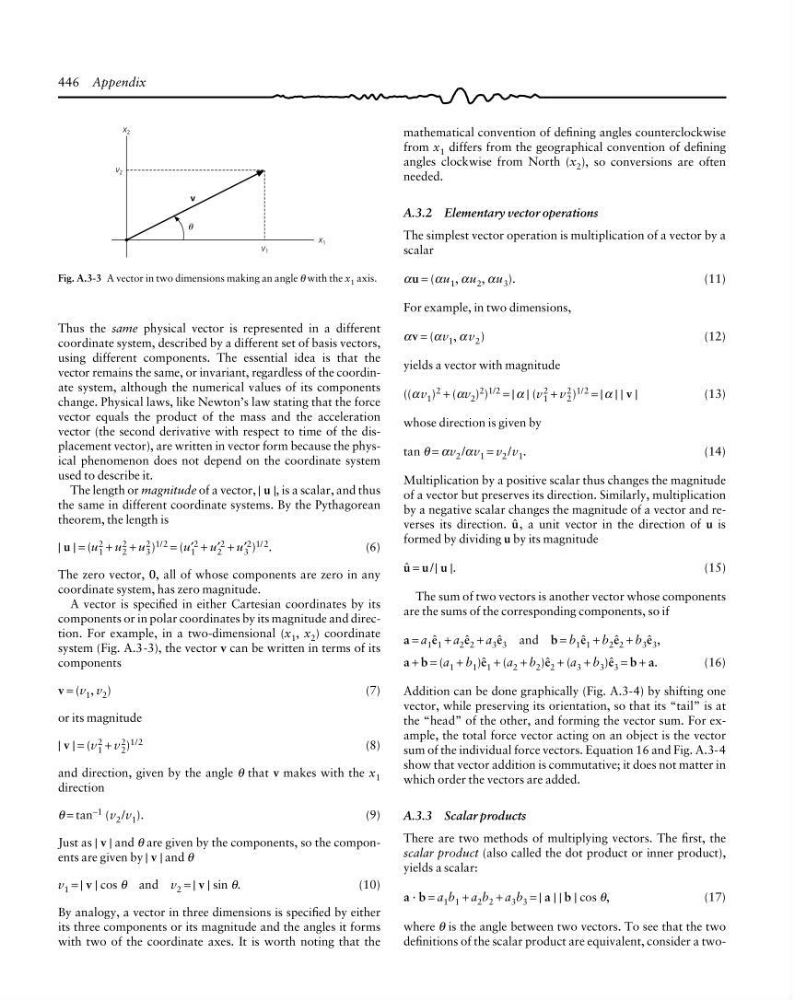
A vector is specified in either Cartesian coordinates by its
components or in polar coordinates by its magnitude and direction. For example, in a two-dimensional (x 1 , x 2 ) coordinate
system (Fig. A.3-3), the vector v can be written in terms of its
components
v = (v 1 , v 2 )
(7)
or its magnitude
| v | = (v 1
2 + v 2
2 ) 1/2
(8)
and direction, given by the angle θ that v makes with the x 1
direction
θ = tan −1 (v 2 /v 1 ).
(9)
Just as | v | and θ are given by the components, so the components are given by | v | and θ
v 1 = | v | cos θ and v 2 = | v | sin θ.
(10)
By analogy, a vector in three dimensions is specified by either
its three components or its magnitude and the angles it forms
with two of the coordinate axes. It is worth noting that the
mathematical convention of defining angles counterclockwise
from x 1 differs from the geographical convention of defining
angles clockwise from North (x 2 ), so conversions are often
needed.
A.3.2 Elementary vector operations
The simplest vector operation is multiplication of a vector by a
scalar
αu = (αu 1 , αu 2 , αu 3 ).
(11)
For example, in two dimensions,
αv = (αv 1 , α v 2 )
(12)
yields a vector with magnitude
((α v 1 ) 2 + (αv 2 ) 2 ) 1/2 = | α | (v 1
2 + v 2
2 ) 1/2 = | α | | v |
(13)
whose direction is given by
tan θ = αv 2 /αv 1 = v 2 /v 1 .
(14)
Multiplication by a positive scalar thus changes the magnitude
of a vector but preserves its direction. Similarly, multiplication
by a negative scalar changes the magnitude of a vector and reverses its direction. û, a unit vector in the direction of u is
formed by dividing u by its magnitude
û = u / | u |.
(15)
The sum of two vectors is another vector whose components
are the sums of the corresponding components, so if
a = a 1 ê 1 + a 2 ê 2 + a 3 ê 3 and b = b 1 ê 1 + b 2 ê 2 + b 3 ê 3 ,
a + b = (a 1 + b 1 )ê 1 + (a 2 + b 2 )ê 2 + (a 3 + b 3 )ê 3 = b + a.
(16)
Addition can be done graphically (Fig. A.3-4) by shifting one
vector, while preserving its orientation, so that its “tail” is at
the “head” of the other, and forming the vector sum. For example, the total force vector acting on an object is the vector
sum of the individual force vectors. Equation 16 and Fig. A.3-4
show that vector addition is commutative; it does not matter in
which order the vectors are added.
A.3.3 Scalar products
There are two methods of multiplying vectors. The first, the
scalar product (also called the dot product or inner product),
yields a scalar:
a · b = a 1 b 1 + a 2 b 2 + a 3 b 3 = | a | | b | cos θ,
(17)
where θ is the angle between two vectors. To see that the two
definitions of the scalar product are equivalent, consider a twoFig. A.3-3 A vector in two dimensions making an angle θ with the x 1 axis.
x 2
v 2
θ
v
v 1
x 1
Thus the same physical vector is represented in a different
coordinate system, described by a different set of basis vectors,
using different components. The essential idea is that the
vector remains the same, or invariant, regardless of the coordinate system, although the numerical values of its components
change. Physical laws, like Newton’s law stating that the force
vector equals the product of the mass and the acceleration
vector (the second derivative with respect to time of the displacement vector), are written in vector form because the physical phenomenon does not depend on the coordinate system
used to describe it.
The length or magnitude of a vector, | u |, is a scalar, and thus
the same in different coordinate systems. By the Pythagorean
theorem, the length is
| u | = (u 1
2 + u 2
2 + u 3
2 ) 1/2 = (u′ 1
2 + u′ 2
2 + u′ 3
2 ) 1/ 2 .
(6)
The zero vector, 0, all of whose components are zero in any
coordinate system, has zero magnitude.
A vector is specified in either Cartesian coordinates by its
components or in polar coordinates by its magnitude and direction. For example, in a two-dimensional (x 1 , x 2 ) coordinate
system (Fig. A.3-3), the vector v can be written in terms of its
components
v = (v 1 , v 2 )
(7)
or its magnitude
| v | = (v 1
2 + v 2
2 ) 1/2
(8)
and direction, given by the angle θ that v makes with the x 1
direction
θ = tan −1 (v 2 /v 1 ).
(9)
Just as | v | and θ are given by the components, so the components are given by | v | and θ
v 1 = | v | cos θ and v 2 = | v | sin θ.
(10)
By analogy, a vector in three dimensions is specified by either
its three components or its magnitude and the angles it forms
with two of the coordinate axes. It is worth noting that the