

A.3 Scalars and vectors 445
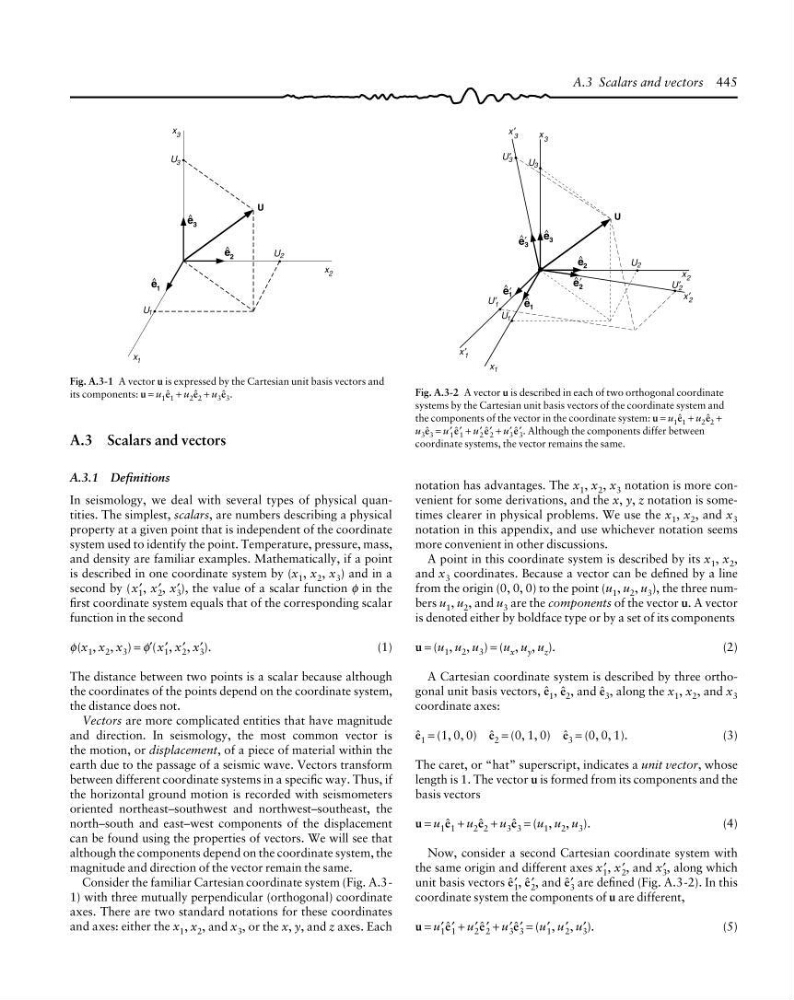
Fig. A.3-1 A vector u is expressed by the Cartesian unit basis vectors and
its components: u = u 1 ê 1 + u 2 ê 2 + u 3 ê 3 .
notation has advantages. The x 1 , x 2 , x 3 notation is more convenient for some derivations, and the x, y, z notation is sometimes clearer in physical problems. We use the x 1 , x 2 , and x 3
notation in this appendix, and use whichever notation seems
more convenient in other discussions.
A point in this coordinate system is described by its x 1 , x 2 ,
and x 3 coordinates. Because a vector can be defined by a line
from the origin (0, 0, 0) to the point (u 1 , u 2 , u 3 ), the three numbers u 1 , u 2 , and u 3 are the components of the vector u. A vector
is denoted either by boldface type or by a set of its components
u = (u 1 , u 2 , u 3 ) = (u x , u y , u z ).
(2)
A Cartesian coordinate system is described by three orthogonal unit basis vectors, ê 1 , ê 2 , and ê 3 , along the x 1 , x 2 , and x 3
coordinate axes:
ê 1 = (1, 0, 0) ê 2 = (0, 1, 0) ê 3 = (0, 0, 1).
(3)
The caret, or “hat” superscript, indicates a unit vector, whose
length is 1. The vector u is formed from its components and the
basis vectors
u = u 1 ê 1 + u 2 ê 2 + u 3 ê 3 = (u 1 , u 2 , u 3 ).
(4)
Now, consider a second Cartesian coordinate system with
the same origin and different axes x 1 ′, x 2 ′, and x 3 ′, along which
unit basis vectors ê 1 ′, ê 2 ′, and ê 3 ′ are defined (Fig. A.3-2). In this
coordinate system the components of u are different,
u = u 1 ′ ê 1 ′ + u 2 ′ ê 2 ′ + u 3 ′ê 3 ′ = (u 1 ′ , u 2 ′ , u 3 ′).
(5)
Fig. A.3-2 A vector u is described in each of two orthogonal coordinate
systems by the Cartesian unit basis vectors of the coordinate system and
the components of the vector in the coordinate system: u = u 1 ê 1 + u 2 ê 2 +
u 3 ê 3 = u′ 1 ê′ 1 + u′ 2 ê′ 2 + u′ 3 ê′ 3 . Although the components differ between
coordinate systems, the vector remains the same.
A.3 Scalars and vectors
A.3.1 Definitions
In seismology, we deal with several types of physical quantities. The simplest, scalars, are numbers describing a physical
property at a given point that is independent of the coordinate
system used to identify the point. Temperature, pressure, mass,
and density are familiar examples. Mathematically, if a point
is described in one coordinate system by (x 1 , x 2 , x 3 ) and in a
second by (x 1 ′, x 2 ′, x 3 ′), the value of a scalar function φ in the
first coordinate system equals that of the corresponding scalar
function in the second
φ(x 1 , x 2 , x 3 ) = φ′(x 1 ′, x 2 ′ , x 3 ′).
(1)
The distance between two points is a scalar because although
the coordinates of the points depend on the coordinate system,
the distance does not.
Vectors are more complicated entities that have magnitude
and direction. In seismology, the most common vector is
the motion, or displacement, of a piece of material within the
earth due to the passage of a seismic wave. Vectors transform
between different coordinate systems in a specific way. Thus, if
the horizontal ground motion is recorded with seismometers
oriented northeast–southwest and northwest–southeast, the
north–south and east–west components of the displacement
can be found using the properties of vectors. We will see that
although the components depend on the coordinate system, the
magnitude and direction of the vector remain the same.
Consider the familiar Cartesian coordinate system (Fig. A.31) with three mutually perpendicular (orthogonal) coordinate
axes. There are two standard notations for these coordinates
and axes: either the x 1 , x 2 , and x 3 , or the x, y, and z axes. Each
U
U
x
x
U
x 1
2
2
1
3
3
1
U 2
3
e ^
e ^
e ^
U
U
x
U
1
1
U′ 1
′
1
1
2
x ′
2
x 2
2
U′ 2
′
2
U′ 3
3
′ 3
x ′ 3
x 3
U 3
x ′
1
e
e
e
e
e
e ^
^
^
^
^
^
Fig. A.3-1 A vector u is expressed by the Cartesian unit basis vectors and
its components: u = u 1 ê 1 + u 2 ê 2 + u 3 ê 3 .
notation has advantages. The x 1 , x 2 , x 3 notation is more convenient for some derivations, and the x, y, z notation is sometimes clearer in physical problems. We use the x 1 , x 2 , and x 3
notation in this appendix, and use whichever notation seems
more convenient in other discussions.
A point in this coordinate system is described by its x 1 , x 2 ,
and x 3 coordinates. Because a vector can be defined by a line
from the origin (0, 0, 0) to the point (u 1 , u 2 , u 3 ), the three numbers u 1 , u 2 , and u 3 are the components of the vector u. A vector
is denoted either by boldface type or by a set of its components
u = (u 1 , u 2 , u 3 ) = (u x , u y , u z ).
(2)
A Cartesian coordinate system is described by three orthogonal unit basis vectors, ê 1 , ê 2 , and ê 3 , along the x 1 , x 2 , and x 3
coordinate axes:
ê 1 = (1, 0, 0) ê 2 = (0, 1, 0) ê 3 = (0, 0, 1).
(3)
The caret, or “hat” superscript, indicates a unit vector, whose
length is 1. The vector u is formed from its components and the
basis vectors
u = u 1 ê 1 + u 2 ê 2 + u 3 ê 3 = (u 1 , u 2 , u 3 ).
(4)
Now, consider a second Cartesian coordinate system with
the same origin and different axes x 1 ′, x 2 ′, and x 3 ′, along which
unit basis vectors ê 1 ′, ê 2 ′, and ê 3 ′ are defined (Fig. A.3-2). In this
coordinate system the components of u are different,
u = u 1 ′ ê 1 ′ + u 2 ′ ê 2 ′ + u 3 ′ê 3 ′ = (u 1 ′ , u 2 ′ , u 3 ′).
(5)
Fig. A.3-2 A vector u is described in each of two orthogonal coordinate
systems by the Cartesian unit basis vectors of the coordinate system and
the components of the vector in the coordinate system: u = u 1 ê 1 + u 2 ê 2 +
u 3 ê 3 = u′ 1 ê′ 1 + u′ 2 ê′ 2 + u′ 3 ê′ 3 . Although the components differ between
coordinate systems, the vector remains the same.
A.3 Scalars and vectors
A.3.1 Definitions
In seismology, we deal with several types of physical quantities. The simplest, scalars, are numbers describing a physical
property at a given point that is independent of the coordinate
system used to identify the point. Temperature, pressure, mass,
and density are familiar examples. Mathematically, if a point
is described in one coordinate system by (x 1 , x 2 , x 3 ) and in a
second by (x 1 ′, x 2 ′, x 3 ′), the value of a scalar function φ in the
first coordinate system equals that of the corresponding scalar
function in the second
φ(x 1 , x 2 , x 3 ) = φ′(x 1 ′, x 2 ′ , x 3 ′).
(1)
The distance between two points is a scalar because although
the coordinates of the points depend on the coordinate system,
the distance does not.
Vectors are more complicated entities that have magnitude
and direction. In seismology, the most common vector is
the motion, or displacement, of a piece of material within the
earth due to the passage of a seismic wave. Vectors transform
between different coordinate systems in a specific way. Thus, if
the horizontal ground motion is recorded with seismometers
oriented northeast–southwest and northwest–southeast, the
north–south and east–west components of the displacement
can be found using the properties of vectors. We will see that
although the components depend on the coordinate system, the
magnitude and direction of the vector remain the same.
Consider the familiar Cartesian coordinate system (Fig. A.31) with three mutually perpendicular (orthogonal) coordinate
axes. There are two standard notations for these coordinates
and axes: either the x 1 , x 2 , and x 3 , or the x, y, and z axes. Each
U
U
x
x
U
x 1
2
2
1
3
3
1
U 2
3
e ^
e ^
e ^
U
U
x
U
1
1
U′ 1
′
1
1
2
x ′
2
x 2
2
U′ 2
′
2
U′ 3
3
′ 3
x ′ 3
x 3
U 3
x ′
1
e
e
e
e
e
e ^
^
^
^
^
^