

The fact that the velocity depends on the density illustrates
one of the reasons why the string is a useful analogy for seismic
waves in the earth. One goal of seismology is to study the composition of the earth. For this purpose, we measure the time
that waves take to travel between sources and receivers, find
the velocity at which the waves propagated, and thus learn
about the properties of the earth.
2.2.2 Harmonic wave solution
Any function of the form f(x ± vt) describes a propagating wave
as a function of time and distance. A particularly useful form is
a harmonic or sinusoidal wave 2
u(x, t) = Ae i(ωt ± kx ) = A cos (ωt ± kx) + Ai sin (ωt ± kx).
(6)
A harmonic wave is characterized by its amplitude A and two
parameters, ω and k, which we will discuss shortly. Substituting into the wave equation (4) and canceling the exponential
and constant show that the wave velocity is the ratio
v = ω /k.
(7)
Although the exponential function u(x, t) in Eqn 6 is
complex, the physical displacement must be real. We thus
describe the displacement as the real part of u(x, t). The complex exponential form can be used for most purposes, because
when a complex exponential appears in the solution of a
physical problem, its conjugate also appears, so their sum
yields a real displacement.
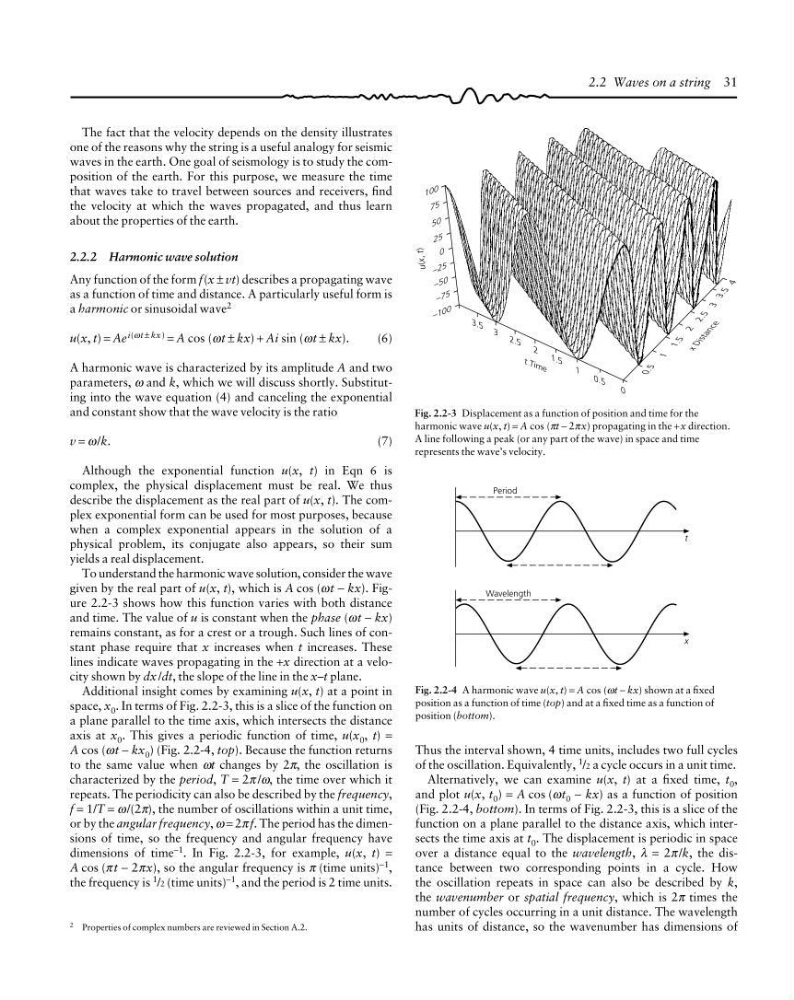
To understand the harmonic wave solution, consider the wave
given by the real part of u(x, t), which is A cos (ωt − kx). Figure 2.2-3 shows how this function varies with both distance
and time. The value of u is constant when the phase (ωt − kx)
remains constant, as for a crest or a trough. Such lines of constant phase require that x increases when t increases. These
lines indicate waves propagating in the +x direction at a velocity shown by dx /dt, the slope of the line in the x–t plane.
Additional insight comes by examining u(x, t) at a point in
space, x 0 . In terms of Fig. 2.2-3, this is a slice of the function on
a plane parallel to the time axis, which intersects the distance
axis at x 0 . This gives a periodic function of time, u(x 0 , t) =
A cos (ωt − kx 0 ) (Fig. 2.2-4, top). Because the function returns
to the same value when ωt changes by 2π, the oscillation is
characterized by the period, T = 2π /ω, the time over which it
repeats. The periodicity can also be described by the frequency,
f = 1/T = ω /(2π), the number of oscillations within a unit time,
or by the angular frequency, ω = 2π f. The period has the dimensions of time, so the frequency and angular frequency have
dimensions of time
−1
. In Fig. 2.2-3, for example, u(x, t) =
A cos (π t − 2πx), so the angular frequency is π (time units) −1 ,
the frequency is 1 /2 (time units) −1 , and the period is 2 time units.
2 Properties of complex numbers are reviewed in Section A.2.
− 2 5
3
3 .5
2 .5
2
1 .5
1
0 .5
t T im e
0
1 0 0
7 5
5 0
2 5
0
− 5 0
− 7 5
− 1 0 0
u(x
,
t)
0 . 5 1 1 . 5 2 2 . 5 3
3 . 5
4
x D i s t a n c e
Fig. 2.2-3 Displacement as a function of position and time for the
harmonic wave u(x, t) = A cos (πt − 2πx) propagating in the +x direction.
A line following a peak (or any part of the wave) in space and time
represents the wave’s velocity.
Fig. 2.2-4 A harmonic wave u(x, t) = A cos (ωt − kx) shown at a fixed
position as a function of time (top) and at a fixed time as a function of
position (bottom).
Period
t
Wavelength
x
Thus the interval shown, 4 time units, includes two full cycles
of the oscillation. Equivalently, 1 /2 a cycle occurs in a unit time.
Alternatively, we can examine u(x, t) at a fixed time, t 0 ,
and plot u(x, t 0 ) = A cos (ωt 0 − kx) as a function of position
(Fig. 2.2-4, bottom). In terms of Fig. 2.2-3, this is a slice of the
function on a plane parallel to the distance axis, which intersects the time axis at t 0 . The displacement is periodic in space
over a distance equal to the wavelength, λ = 2π /k, the distance between two corresponding points in a cycle. How
the oscillation repeats in space can also be described by k,
the wavenumber or spatial frequency, which is 2π times the
number of cycles occurring in a unit distance. The wavelength
has units of distance, so the wavenumber has dimensions of
2.2 Waves on a string 31
one of the reasons why the string is a useful analogy for seismic
waves in the earth. One goal of seismology is to study the composition of the earth. For this purpose, we measure the time
that waves take to travel between sources and receivers, find
the velocity at which the waves propagated, and thus learn
about the properties of the earth.
2.2.2 Harmonic wave solution
Any function of the form f(x ± vt) describes a propagating wave
as a function of time and distance. A particularly useful form is
a harmonic or sinusoidal wave 2
u(x, t) = Ae i(ωt ± kx ) = A cos (ωt ± kx) + Ai sin (ωt ± kx).
(6)
A harmonic wave is characterized by its amplitude A and two
parameters, ω and k, which we will discuss shortly. Substituting into the wave equation (4) and canceling the exponential
and constant show that the wave velocity is the ratio
v = ω /k.
(7)
Although the exponential function u(x, t) in Eqn 6 is
complex, the physical displacement must be real. We thus
describe the displacement as the real part of u(x, t). The complex exponential form can be used for most purposes, because
when a complex exponential appears in the solution of a
physical problem, its conjugate also appears, so their sum
yields a real displacement.
To understand the harmonic wave solution, consider the wave
given by the real part of u(x, t), which is A cos (ωt − kx). Figure 2.2-3 shows how this function varies with both distance
and time. The value of u is constant when the phase (ωt − kx)
remains constant, as for a crest or a trough. Such lines of constant phase require that x increases when t increases. These
lines indicate waves propagating in the +x direction at a velocity shown by dx /dt, the slope of the line in the x–t plane.
Additional insight comes by examining u(x, t) at a point in
space, x 0 . In terms of Fig. 2.2-3, this is a slice of the function on
a plane parallel to the time axis, which intersects the distance
axis at x 0 . This gives a periodic function of time, u(x 0 , t) =
A cos (ωt − kx 0 ) (Fig. 2.2-4, top). Because the function returns
to the same value when ωt changes by 2π, the oscillation is
characterized by the period, T = 2π /ω, the time over which it
repeats. The periodicity can also be described by the frequency,
f = 1/T = ω /(2π), the number of oscillations within a unit time,
or by the angular frequency, ω = 2π f. The period has the dimensions of time, so the frequency and angular frequency have
dimensions of time
−1
. In Fig. 2.2-3, for example, u(x, t) =
A cos (π t − 2πx), so the angular frequency is π (time units) −1 ,
the frequency is 1 /2 (time units) −1 , and the period is 2 time units.
2 Properties of complex numbers are reviewed in Section A.2.
− 2 5
3
3 .5
2 .5
2
1 .5
1
0 .5
t T im e
0
1 0 0
7 5
5 0
2 5
0
− 5 0
− 7 5
− 1 0 0
u(x
,
t)
0 . 5 1 1 . 5 2 2 . 5 3
3 . 5
4
x D i s t a n c e
Fig. 2.2-3 Displacement as a function of position and time for the
harmonic wave u(x, t) = A cos (πt − 2πx) propagating in the +x direction.
A line following a peak (or any part of the wave) in space and time
represents the wave’s velocity.
Fig. 2.2-4 A harmonic wave u(x, t) = A cos (ωt − kx) shown at a fixed
position as a function of time (top) and at a fixed time as a function of
position (bottom).
Period
t
Wavelength
x
Thus the interval shown, 4 time units, includes two full cycles
of the oscillation. Equivalently, 1 /2 a cycle occurs in a unit time.
Alternatively, we can examine u(x, t) at a fixed time, t 0 ,
and plot u(x, t 0 ) = A cos (ωt 0 − kx) as a function of position
(Fig. 2.2-4, bottom). In terms of Fig. 2.2-3, this is a slice of the
function on a plane parallel to the distance axis, which intersects the time axis at t 0 . The displacement is periodic in space
over a distance equal to the wavelength, λ = 2π /k, the distance between two corresponding points in a cycle. How
the oscillation repeats in space can also be described by k,
the wavenumber or spatial frequency, which is 2π times the
number of cycles occurring in a unit distance. The wavelength
has units of distance, so the wavenumber has dimensions of
2.2 Waves on a string 31