

0.0
0.5
1.0
1.5
2.0
2.5
3.0
3.5
Time (s)
(d)
FIR-corrected filter
applied
0.0 0.2
1.6 1.8 2.0
Time (s)
(b)
FIR-corrected filter
(c)
FIR filter
applied
0.4 0.6 0.8 1.0 1.2 1.4
(a)
FIR filter
Seismometer
Sampling
Decimation
DAA filter
AAA filter
Amplifier
Analog system
Digital system
Fig. 6.6-12 Diagram showing the analog-to-digital
(ADC) process. The analog part of the system consists of
the generation of a seismic signal by the seismometer, its
amplification, and analog anti-aliasing (AAA) filtering.
The digital part of the system consists of sampling the
AAA-filtered signal, filtering the signal further with a
digital anti-aliasing (DAA) filter, and then decimating
the signal to achieve the desired sampling rate.
(Scherbaum, 1996, with kind permission from Kluwer
Academic Publishers.)
give a response curve that is flat and directly proportional to
ground acceleration from periods of zero to the natural period
of the seismometer.
A major advance in seismometry has been in timing, which
has long been a difficulty. In the early days of seismology,
timing errors played a large part in the mislocation of earthquakes. However, seismometers now receive time signals from
GPS satellites, whose atomic clocks are accurate to a billionth
of a second. Similarly, although ocean bottom seismometers
cannot receive GPS signals, accurate clocks for them are now
available.
6.6.5 Digital recording
Although digital seismic data are easier to use than analog data,
the conversion of continuous ground motion into a digital
seismogram is not a trivial matter. Figure 6.6-12 shows how
this is done. Ground motion, represented by the waveform at
the left, is detected by the seismometer through the motion
of the mass. This motion is converted into an analog electrical
signal and then amplified. To avoid a spurious signal due to
aliasing (Fig. 6.4-3), a combination of anti-aliasing filters is
used. Many seismometers use an initial frequency domain lowpass filter as an analog anti-aliasing (AAA) filter. The filtered
signal is then oversampled at a rate that is at least twice the
frequency of the AAA filter in order to avoid aliasing. This
signal is then convolved with a digital anti-aliasing (DAA)
filter, often called a finite impulse response (FIR) filter, and
finally resampled at twice the desired Nyquist frequency.
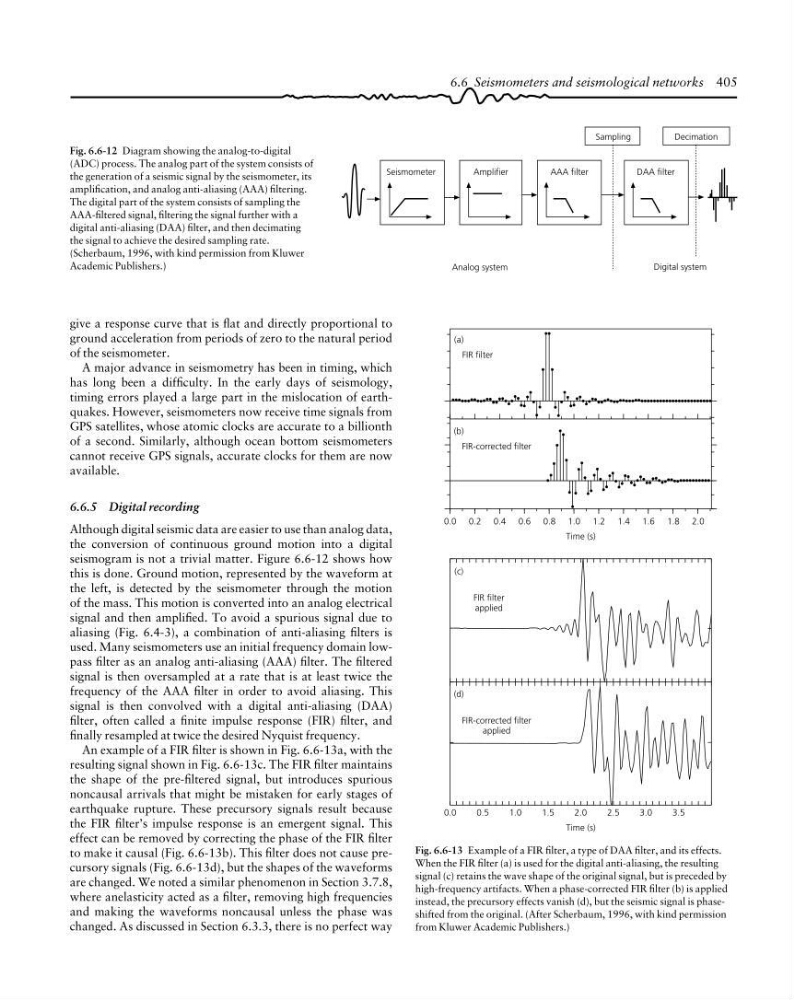
An example of a FIR filter is shown in Fig. 6.6-13a, with the
resulting signal shown in Fig. 6.6-13c. The FIR filter maintains
the shape of the pre-filtered signal, but introduces spurious
noncausal arrivals that might be mistaken for early stages of
earthquake rupture. These precursory signals result because
the FIR filter’s impulse response is an emergent signal. This
effect can be removed by correcting the phase of the FIR filter
to make it causal (Fig. 6.6-13b). This filter does not cause precursory signals (Fig. 6.6-13d), but the shapes of the waveforms
are changed. We noted a similar phenomenon in Section 3.7.8,
where anelasticity acted as a filter, removing high frequencies
and making the waveforms noncausal unless the phase was
changed. As discussed in Section 6.3.3, there is no perfect way
6.6 Seismometers and seismological networks 405
Fig. 6.6-13 Example of a FIR filter, a type of DAA filter, and its effects.
When the FIR filter (a) is used for the digital anti-aliasing, the resulting
signal (c) retains the wave shape of the original signal, but is preceded by
high-frequency artifacts. When a phase-corrected FIR filter (b) is applied
instead, the precursory effects vanish (d), but the seismic signal is phaseshifted from the original. (After Scherbaum, 1996, with kind permission
from Kluwer Academic Publishers.)
0.5
1.0
1.5
2.0
2.5
3.0
3.5
Time (s)
(d)
FIR-corrected filter
applied
0.0 0.2
1.6 1.8 2.0
Time (s)
(b)
FIR-corrected filter
(c)
FIR filter
applied
0.4 0.6 0.8 1.0 1.2 1.4
(a)
FIR filter
Seismometer
Sampling
Decimation
DAA filter
AAA filter
Amplifier
Analog system
Digital system
Fig. 6.6-12 Diagram showing the analog-to-digital
(ADC) process. The analog part of the system consists of
the generation of a seismic signal by the seismometer, its
amplification, and analog anti-aliasing (AAA) filtering.
The digital part of the system consists of sampling the
AAA-filtered signal, filtering the signal further with a
digital anti-aliasing (DAA) filter, and then decimating
the signal to achieve the desired sampling rate.
(Scherbaum, 1996, with kind permission from Kluwer
Academic Publishers.)
give a response curve that is flat and directly proportional to
ground acceleration from periods of zero to the natural period
of the seismometer.
A major advance in seismometry has been in timing, which
has long been a difficulty. In the early days of seismology,
timing errors played a large part in the mislocation of earthquakes. However, seismometers now receive time signals from
GPS satellites, whose atomic clocks are accurate to a billionth
of a second. Similarly, although ocean bottom seismometers
cannot receive GPS signals, accurate clocks for them are now
available.
6.6.5 Digital recording
Although digital seismic data are easier to use than analog data,
the conversion of continuous ground motion into a digital
seismogram is not a trivial matter. Figure 6.6-12 shows how
this is done. Ground motion, represented by the waveform at
the left, is detected by the seismometer through the motion
of the mass. This motion is converted into an analog electrical
signal and then amplified. To avoid a spurious signal due to
aliasing (Fig. 6.4-3), a combination of anti-aliasing filters is
used. Many seismometers use an initial frequency domain lowpass filter as an analog anti-aliasing (AAA) filter. The filtered
signal is then oversampled at a rate that is at least twice the
frequency of the AAA filter in order to avoid aliasing. This
signal is then convolved with a digital anti-aliasing (DAA)
filter, often called a finite impulse response (FIR) filter, and
finally resampled at twice the desired Nyquist frequency.
An example of a FIR filter is shown in Fig. 6.6-13a, with the
resulting signal shown in Fig. 6.6-13c. The FIR filter maintains
the shape of the pre-filtered signal, but introduces spurious
noncausal arrivals that might be mistaken for early stages of
earthquake rupture. These precursory signals result because
the FIR filter’s impulse response is an emergent signal. This
effect can be removed by correcting the phase of the FIR filter
to make it causal (Fig. 6.6-13b). This filter does not cause precursory signals (Fig. 6.6-13d), but the shapes of the waveforms
are changed. We noted a similar phenomenon in Section 3.7.8,
where anelasticity acted as a filter, removing high frequencies
and making the waveforms noncausal unless the phase was
changed. As discussed in Section 6.3.3, there is no perfect way
6.6 Seismometers and seismological networks 405
Fig. 6.6-13 Example of a FIR filter, a type of DAA filter, and its effects.
When the FIR filter (a) is used for the digital anti-aliasing, the resulting
signal (c) retains the wave shape of the original signal, but is preceded by
high-frequency artifacts. When a phase-corrected FIR filter (b) is applied
instead, the precursory effects vanish (d), but the seismic signal is phaseshifted from the original. (After Scherbaum, 1996, with kind permission
from Kluwer Academic Publishers.)