

398 Seismograms as Signals
6.6 Seismometers and seismological networks
6.6.1 Introduction
Given what we have discussed about signal processing, we now
introduce some ideas about seismometry, the design and development of seismic instrumentation. Although we informally
call such systems seismometers, the seismometer is actually the
sensor recording ground motion, and thus a key component of
the entire seismograph system, which also contains amplifying,
timing, and recording components. The product, a record of
ground motion as a function of time, is a seismogram.
Following linear system theory, we note that a seismogram is
not an exact representation of the ground motion. Seismograms
depend upon the seismometer and the rest of the seismograph
system, because the sensitivities of seismometers vary with the
frequency of the motion recorded. Moreover, seismometers
record ground motion as displacement, velocity, acceleration,
or various combinations of these. 1
Once recorded, distributing seismic data is crucial, because
the data are of no use until they are available for study. Hence
seismology has long been a leader among the sciences in
developing public data distribution. This tradition began a
century ago out of necessity. Unlike a geological field observation or a geochemical experiment, observations at many sites
are needed to locate and study earthquakes, with the more data
the better. Soon after seismometers became sensitive enough to
teleseismically record earthquakes, arrival times were shared.
The first major attempt to gather and publish seismically
recorded arrival times was the bulletin of the Bureau Central
International de Séismologie (BCIS), which began in 1904. The
International Seismological Summary (ISS) began publication
in 1913, 2 and eventually became the Bulletin of the International Seismological Centre (ISC), now an authoritative
source of earthquake locations. Not only arrival times but also
polarities and amplitudes were disseminated, enabling the
study of magnitudes and focal mechanisms.
This sharing of data has been crucial to seismology’s growth.
In the modern era, the World Wide Standardized Seismograph
Network (WWSSN), which started in 1962, was the first means
of globally sharing full seismic waveform data. Today, highquality digital global seismic data are available through the
Federation of Digital Broad-Band Seismographic Networks
(FDSN), of which the stations of the US-sponsored Incorporated Research Institutions for Seismology (IRIS) are a part.
Data and results such as earthquake locations are also provided
by national and regional data centers. Seismologists anywhere
in the world need only a computer and access to the Internet
to freely and conveniently obtain terabytes 3 of digital seismic
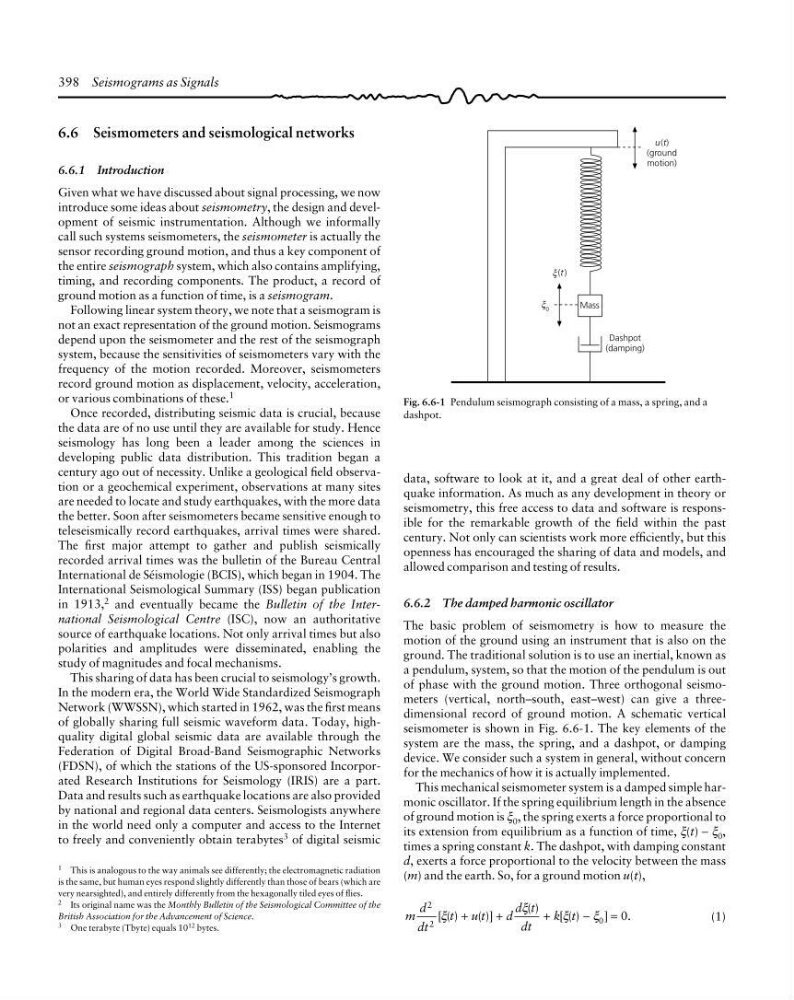
Fig. 6.6-1 Pendulum seismograph consisting of a mass, a spring, and a
dashpot.
Dashpot
(damping)
Mass
u(t)
(ground
motion)
(t)
ξ
0
ξ
1 This is analogous to the way animals see differently; the electromagnetic radiation
is the same, but human eyes respond slightly differently than those of bears (which are
very nearsighted), and entirely differently from the hexagonally tiled eyes of flies.
2 Its original name was the Monthly Bulletin of the Seismological Committee of the
British Association for the Advancement of Science.
3 One terabyte (Tbyte) equals 10 12 bytes.
data, software to look at it, and a great deal of other earthquake information. As much as any development in theory or
seismometry, this free access to data and software is responsible for the remarkable growth of the field within the past
century. Not only can scientists work more efficiently, but this
openness has encouraged the sharing of data and models, and
allowed comparison and testing of results.
6.6.2 The damped harmonic oscillator
The basic problem of seismometry is how to measure the
motion of the ground using an instrument that is also on the
ground. The traditional solution is to use an inertial, known as
a pendulum, system, so that the motion of the pendulum is out
of phase with the ground motion. Three orthogonal seismometers (vertical, north–south, east–west) can give a threedimensional record of ground motion. A schematic vertical
seismometer is shown in Fig. 6.6-1. The key elements of the
system are the mass, the spring, and a dashpot, or damping
device. We consider such a system in general, without concern
for the mechanics of how it is actually implemented.
This mechanical seismometer system is a damped simple harmonic oscillator. If the spring equilibrium length in the absence
of ground motion is ξ 0 , the spring exerts a force proportional to
its extension from equilibrium as a function of time, ξ(t) − ξ 0 ,
times a spring constant k. The dashpot, with damping constant
d, exerts a force proportional to the velocity between the mass
(m) and the earth. So, for a ground motion u(t),
m
d
dt
t ut
d
d t
dt
k t
2
2
0
0
[ ( )
( )]
( )
[ ( )
]
.
ξ
ξ
ξ
ξ
+
+
+
−
=
(1)
6.6 Seismometers and seismological networks
6.6.1 Introduction
Given what we have discussed about signal processing, we now
introduce some ideas about seismometry, the design and development of seismic instrumentation. Although we informally
call such systems seismometers, the seismometer is actually the
sensor recording ground motion, and thus a key component of
the entire seismograph system, which also contains amplifying,
timing, and recording components. The product, a record of
ground motion as a function of time, is a seismogram.
Following linear system theory, we note that a seismogram is
not an exact representation of the ground motion. Seismograms
depend upon the seismometer and the rest of the seismograph
system, because the sensitivities of seismometers vary with the
frequency of the motion recorded. Moreover, seismometers
record ground motion as displacement, velocity, acceleration,
or various combinations of these. 1
Once recorded, distributing seismic data is crucial, because
the data are of no use until they are available for study. Hence
seismology has long been a leader among the sciences in
developing public data distribution. This tradition began a
century ago out of necessity. Unlike a geological field observation or a geochemical experiment, observations at many sites
are needed to locate and study earthquakes, with the more data
the better. Soon after seismometers became sensitive enough to
teleseismically record earthquakes, arrival times were shared.
The first major attempt to gather and publish seismically
recorded arrival times was the bulletin of the Bureau Central
International de Séismologie (BCIS), which began in 1904. The
International Seismological Summary (ISS) began publication
in 1913, 2 and eventually became the Bulletin of the International Seismological Centre (ISC), now an authoritative
source of earthquake locations. Not only arrival times but also
polarities and amplitudes were disseminated, enabling the
study of magnitudes and focal mechanisms.
This sharing of data has been crucial to seismology’s growth.
In the modern era, the World Wide Standardized Seismograph
Network (WWSSN), which started in 1962, was the first means
of globally sharing full seismic waveform data. Today, highquality digital global seismic data are available through the
Federation of Digital Broad-Band Seismographic Networks
(FDSN), of which the stations of the US-sponsored Incorporated Research Institutions for Seismology (IRIS) are a part.
Data and results such as earthquake locations are also provided
by national and regional data centers. Seismologists anywhere
in the world need only a computer and access to the Internet
to freely and conveniently obtain terabytes 3 of digital seismic
Fig. 6.6-1 Pendulum seismograph consisting of a mass, a spring, and a
dashpot.
Dashpot
(damping)
Mass
u(t)
(ground
motion)
(t)
ξ
0
ξ
1 This is analogous to the way animals see differently; the electromagnetic radiation
is the same, but human eyes respond slightly differently than those of bears (which are
very nearsighted), and entirely differently from the hexagonally tiled eyes of flies.
2 Its original name was the Monthly Bulletin of the Seismological Committee of the
British Association for the Advancement of Science.
3 One terabyte (Tbyte) equals 10 12 bytes.
data, software to look at it, and a great deal of other earthquake information. As much as any development in theory or
seismometry, this free access to data and software is responsible for the remarkable growth of the field within the past
century. Not only can scientists work more efficiently, but this
openness has encouraged the sharing of data and models, and
allowed comparison and testing of results.
6.6.2 The damped harmonic oscillator
The basic problem of seismometry is how to measure the
motion of the ground using an instrument that is also on the
ground. The traditional solution is to use an inertial, known as
a pendulum, system, so that the motion of the pendulum is out
of phase with the ground motion. Three orthogonal seismometers (vertical, north–south, east–west) can give a threedimensional record of ground motion. A schematic vertical
seismometer is shown in Fig. 6.6-1. The key elements of the
system are the mass, the spring, and a dashpot, or damping
device. We consider such a system in general, without concern
for the mechanics of how it is actually implemented.
This mechanical seismometer system is a damped simple harmonic oscillator. If the spring equilibrium length in the absence
of ground motion is ξ 0 , the spring exerts a force proportional to
its extension from equilibrium as a function of time, ξ(t) − ξ 0 ,
times a spring constant k. The dashpot, with damping constant
d, exerts a force proportional to the velocity between the mass
(m) and the earth. So, for a ground motion u(t),
m
d
dt
t ut
d
d t
dt
k t
2
2
0
0
[ ( )
( )]
( )
[ ( )
]
.
ξ
ξ
ξ
ξ
+
+
+
−
=
(1)