

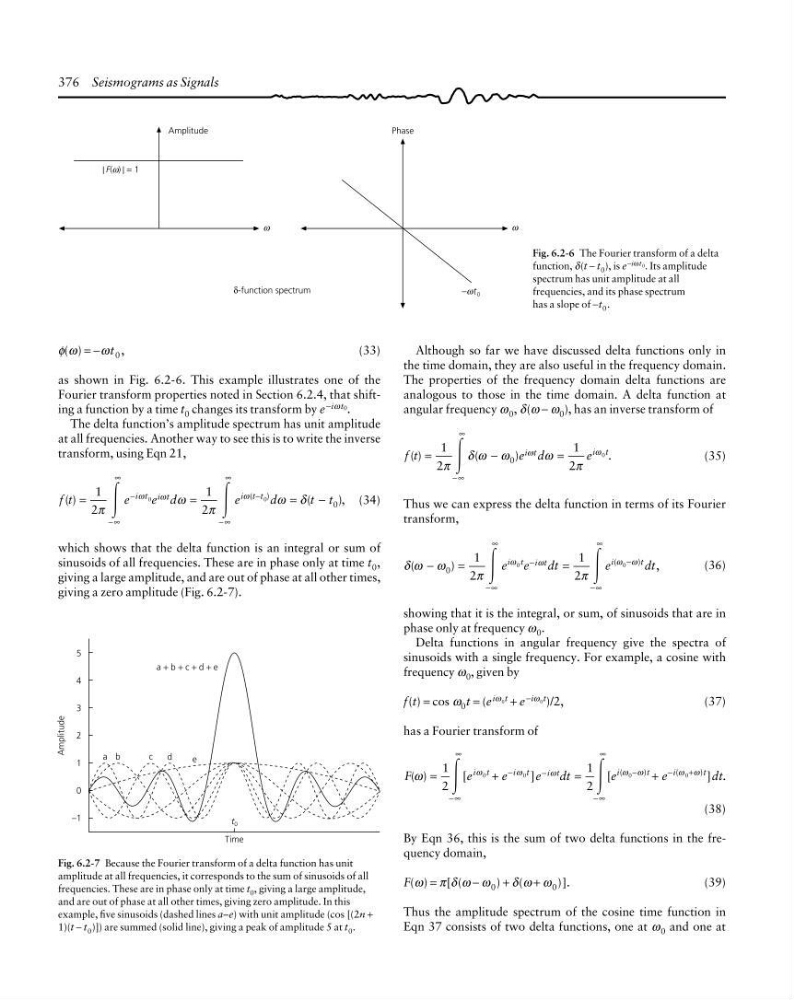
376 Seismograms as Signals
Amplitude
δ-function spectrum
Phase
ω
− t 0
ω
| F( ) | = 1
ω
ω
φ(ω) = −ωt 0 ,
(33)
as shown in Fig. 6.2-6. This example illustrates one of the
Fourier transform properties noted in Section 6.2.4, that shifting a function by a time t 0 changes its transform by e −iω t0 .
The delta function’s amplitude spectrum has unit amplitude
at all frequencies. Another way to see this is to write the inverse
transform, using Eqn 21,
f t
e
e d
e
d
t t
i t i t
i t t
( )
(
),
(
)
=
=
=
−
−∞
∞
−
−∞
∞
−
1
2
1
2
0
0
0
π
ω
π
ω δ
ω
ω
ω
Ύ
Ύ
(34)
which shows that the delta function is an integral or sum of
sinusoids of all frequencies. These are in phase only at time t 0 ,
giving a large amplitude, and are out of phase at all other times,
giving a zero amplitude (Fig. 6.2-7).
Although so far we have discussed delta functions only in
the time domain, they are also useful in the frequency domain.
The properties of the frequency domain delta functions are
analogous to those in the time domain. A delta function at
angular frequency ω 0 , δ(ω − ω 0 ), has an inverse transform of
f t
e d
e
i t
i t
( )
(
)
.
=
−
=
−∞
∞
1
2
1
2
0
0
π
δ ω ω
ω
π
ω
ω
Ύ
(35)
Thus we can express the delta function in terms of its Fourier
transform,
δ ω ω
π
π
ω
ω
ω ω
(
)
,
(
)
−
=
=
−∞
∞
−
−∞
∞
−
0
1
2
1
2
0
0
Ύ
Ύ
e e
dt
e
dt
i t i t
i
t
(36)
showing that it is the integral, or sum, of sinusoids that are in
phase only at frequency ω 0 .
Delta functions in angular frequency give the spectra of
sinusoids with a single frequency. For example, a cosine with
frequency ω 0 , given by
f(t) = cos ω 0 t = (e iω 0 t + e −iω 0 t )/2,
(37)
has a Fourier transform of
F
e
e
e
dt
e
e
dt
i t
i t
i t
i
t
i
t
( )
[
]
[
] .
(
)
(
)
ω
ω
ω
ω
ω ω
ω ω
=
+
=
+
−∞
∞
−
−
−∞
∞
−
−
+
1
2
1
2
0
0
0
0
Ύ
Ύ
(38)
By Eqn 36, this is the sum of two delta functions in the frequency domain,
F(ω) = π[δ(ω − ω 0 ) + δ(ω + ω 0 )].
(39)
Thus the amplitude spectrum of the cosine time function in
Eqn 37 consists of two delta functions, one at ω 0 and one at
Fig. 6.2-6 The Fourier transform of a delta
function, δ(t − t 0 ), is e
−iωt 0 . Its amplitude
spectrum has unit amplitude at all
frequencies, and its phase spectrum
has a slope of −t 0 .
Amplitude
5
4
3
2
1
0
–1
Time
t 0
a + b + c + d + e
a b
c
d
e
Fig. 6.2-7 Because the Fourier transform of a delta function has unit
amplitude at all frequencies, it corresponds to the sum of sinusoids of all
frequencies. These are in phase only at time t 0 , giving a large amplitude,
and are out of phase at all other times, giving zero amplitude. In this
example, five sinusoids (dashed lines a–e) with unit amplitude (cos [(2n +
1)(t − t 0 )]) are summed (solid line), giving a peak of amplitude 5 at t 0 .
Amplitude
δ-function spectrum
Phase
ω
− t 0
ω
| F( ) | = 1
ω
ω
φ(ω) = −ωt 0 ,
(33)
as shown in Fig. 6.2-6. This example illustrates one of the
Fourier transform properties noted in Section 6.2.4, that shifting a function by a time t 0 changes its transform by e −iω t0 .
The delta function’s amplitude spectrum has unit amplitude
at all frequencies. Another way to see this is to write the inverse
transform, using Eqn 21,
f t
e
e d
e
d
t t
i t i t
i t t
( )
(
),
(
)
=
=
=
−
−∞
∞
−
−∞
∞
−
1
2
1
2
0
0
0
π
ω
π
ω δ
ω
ω
ω
Ύ
Ύ
(34)
which shows that the delta function is an integral or sum of
sinusoids of all frequencies. These are in phase only at time t 0 ,
giving a large amplitude, and are out of phase at all other times,
giving a zero amplitude (Fig. 6.2-7).
Although so far we have discussed delta functions only in
the time domain, they are also useful in the frequency domain.
The properties of the frequency domain delta functions are
analogous to those in the time domain. A delta function at
angular frequency ω 0 , δ(ω − ω 0 ), has an inverse transform of
f t
e d
e
i t
i t
( )
(
)
.
=
−
=
−∞
∞
1
2
1
2
0
0
π
δ ω ω
ω
π
ω
ω
Ύ
(35)
Thus we can express the delta function in terms of its Fourier
transform,
δ ω ω
π
π
ω
ω
ω ω
(
)
,
(
)
−
=
=
−∞
∞
−
−∞
∞
−
0
1
2
1
2
0
0
Ύ
Ύ
e e
dt
e
dt
i t i t
i
t
(36)
showing that it is the integral, or sum, of sinusoids that are in
phase only at frequency ω 0 .
Delta functions in angular frequency give the spectra of
sinusoids with a single frequency. For example, a cosine with
frequency ω 0 , given by
f(t) = cos ω 0 t = (e iω 0 t + e −iω 0 t )/2,
(37)
has a Fourier transform of
F
e
e
e
dt
e
e
dt
i t
i t
i t
i
t
i
t
( )
[
]
[
] .
(
)
(
)
ω
ω
ω
ω
ω ω
ω ω
=
+
=
+
−∞
∞
−
−
−∞
∞
−
−
+
1
2
1
2
0
0
0
0
Ύ
Ύ
(38)
By Eqn 36, this is the sum of two delta functions in the frequency domain,
F(ω) = π[δ(ω − ω 0 ) + δ(ω + ω 0 )].
(39)
Thus the amplitude spectrum of the cosine time function in
Eqn 37 consists of two delta functions, one at ω 0 and one at
Fig. 6.2-6 The Fourier transform of a delta
function, δ(t − t 0 ), is e
−iωt 0 . Its amplitude
spectrum has unit amplitude at all
frequencies, and its phase spectrum
has a slope of −t 0 .
Amplitude
5
4
3
2
1
0
–1
Time
t 0
a + b + c + d + e
a b
c
d
e
Fig. 6.2-7 Because the Fourier transform of a delta function has unit
amplitude at all frequencies, it corresponds to the sum of sinusoids of all
frequencies. These are in phase only at time t 0 , giving a large amplitude,
and are out of phase at all other times, giving zero amplitude. In this
example, five sinusoids (dashed lines a–e) with unit amplitude (cos [(2n +
1)(t − t 0 )]) are summed (solid line), giving a peak of amplitude 5 at t 0 .