

24 Introduction
San Francisco
gap
0
5
10
15
Depth (miles)
San
Francisco
Portola
Valley
Loma
Prieta
Loma Prieta
gap
San Juan
Bautista
Parkfield
Parkfield
gap
the process is complex. Earthquakes are at best only crudely
periodic, and sometimes appear instead to cluster in time.
Faults display a continuum of behavior from locking, to slow
aseismic creep, to earthquakes. Thus the theoretical and experimental study of rock deformation and its application to
earthquake faulting is an active field of research (Section 5.7).
1.2.6 Earthquake prediction
Earthquake prediction is defined as specifying within certain
ranges the location, time, and size of an earthquake a few years
to days before it occurs. Prediction is an even more difficult
problem than long-term forecasting. A common analogy is that
although a bending stick will eventually snap, it is hard to predict exactly when. To do so requires either a theoretical basis
for knowing when the stick will break, given a history of the
applied force, or observing some change in physical properties
that immediately precedes the stick’s failure.
Because little is known about the fundamental physics of
faulting, many attempts to predict earthquakes have searched
for precursors, observable behavior that precedes earthquakes.
To date, as discussed next, this search has proved generally unsuccessful. As a result, it is unclear whether earthquake prediction is even possible. In one hypothesis, all earthquakes start off
as tiny earthquakes, which happen frequently, but only a few
cascade via a random failure process into large earthquakes. 11
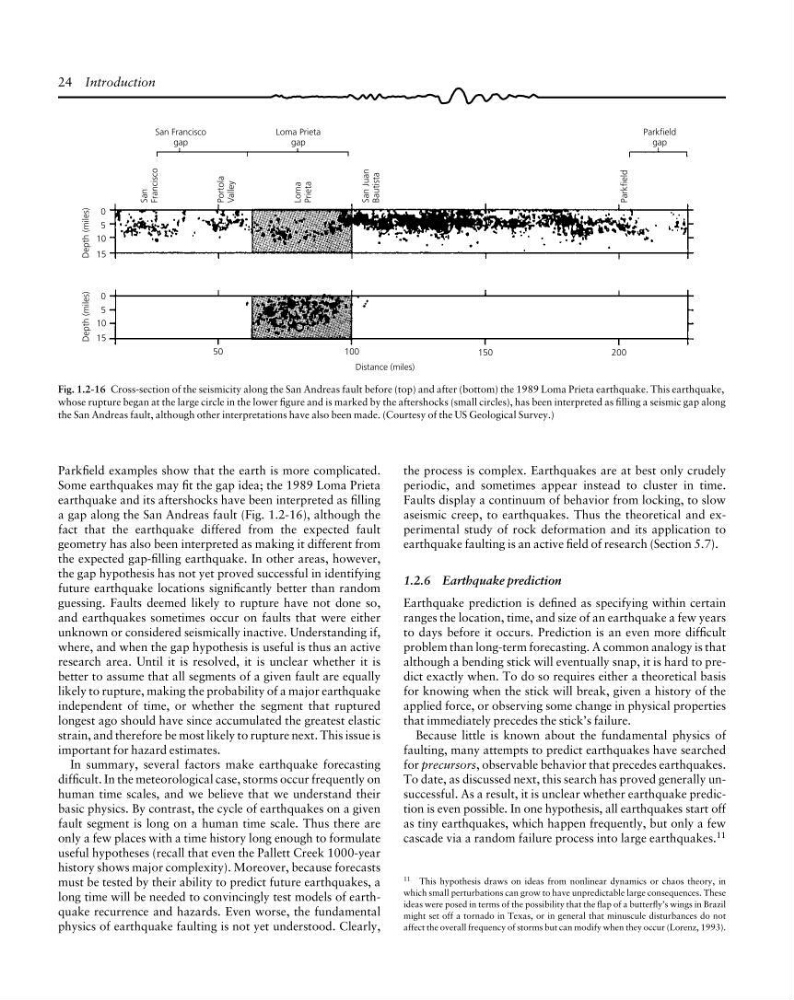
Parkfield examples show that the earth is more complicated.
Some earthquakes may fit the gap idea; the 1989 Loma Prieta
earthquake and its aftershocks have been interpreted as filling
a gap along the San Andreas fault (Fig. 1.2-16), although the
fact that the earthquake differed from the expected fault
geometry has also been interpreted as making it different from
the expected gap-filling earthquake. In other areas, however,
the gap hypothesis has not yet proved successful in identifying
future earthquake locations significantly better than random
guessing. Faults deemed likely to rupture have not done so,
and earthquakes sometimes occur on faults that were either
unknown or considered seismically inactive. Understanding if,
where, and when the gap hypothesis is useful is thus an active
research area. Until it is resolved, it is unclear whether it is
better to assume that all segments of a given fault are equally
likely to rupture, making the probability of a major earthquake
independent of time, or whether the segment that ruptured
longest ago should have since accumulated the greatest elastic
strain, and therefore be most likely to rupture next. This issue is
important for hazard estimates.
In summary, several factors make earthquake forecasting
difficult. In the meteorological case, storms occur frequently on
human time scales, and we believe that we understand their
basic physics. By contrast, the cycle of earthquakes on a given
fault segment is long on a human time scale. Thus there are
only a few places with a time history long enough to formulate
useful hypotheses (recall that even the Pallett Creek 1000-year
history shows major complexity). Moreover, because forecasts
must be tested by their ability to predict future earthquakes, a
long time will be needed to convincingly test models of earthquake recurrence and hazards. Even worse, the fundamental
physics of earthquake faulting is not yet understood. Clearly,
11 This hypothesis draws on ideas from nonlinear dynamics or chaos theory, in
which small perturbations can grow to have unpredictable large consequences. These
ideas were posed in terms of the possibility that the flap of a butterfly’s wings in Brazil
might set off a tornado in Texas, or in general that minuscule disturbances do not
affect the overall frequency of storms but can modify when they occur (Lorenz, 1993).
Fig. 1.2-16 Cross-section of the seismicity along the San Andreas fault before (top) and after (bottom) the 1989 Loma Prieta earthquake. This earthquake,
whose rupture began at the large circle in the lower figure and is marked by the aftershocks (small circles), has been interpreted as filling a seismic gap along
the San Andreas fault, although other interpretations have also been made. (Courtesy of the US Geological Survey.)
Distance (miles)
100
150
200
50
0
5
10
15
Depth (miles)
San Francisco
gap
0
5
10
15
Depth (miles)
San
Francisco
Portola
Valley
Loma
Prieta
Loma Prieta
gap
San Juan
Bautista
Parkfield
Parkfield
gap
the process is complex. Earthquakes are at best only crudely
periodic, and sometimes appear instead to cluster in time.
Faults display a continuum of behavior from locking, to slow
aseismic creep, to earthquakes. Thus the theoretical and experimental study of rock deformation and its application to
earthquake faulting is an active field of research (Section 5.7).
1.2.6 Earthquake prediction
Earthquake prediction is defined as specifying within certain
ranges the location, time, and size of an earthquake a few years
to days before it occurs. Prediction is an even more difficult
problem than long-term forecasting. A common analogy is that
although a bending stick will eventually snap, it is hard to predict exactly when. To do so requires either a theoretical basis
for knowing when the stick will break, given a history of the
applied force, or observing some change in physical properties
that immediately precedes the stick’s failure.
Because little is known about the fundamental physics of
faulting, many attempts to predict earthquakes have searched
for precursors, observable behavior that precedes earthquakes.
To date, as discussed next, this search has proved generally unsuccessful. As a result, it is unclear whether earthquake prediction is even possible. In one hypothesis, all earthquakes start off
as tiny earthquakes, which happen frequently, but only a few
cascade via a random failure process into large earthquakes. 11
Parkfield examples show that the earth is more complicated.
Some earthquakes may fit the gap idea; the 1989 Loma Prieta
earthquake and its aftershocks have been interpreted as filling
a gap along the San Andreas fault (Fig. 1.2-16), although the
fact that the earthquake differed from the expected fault
geometry has also been interpreted as making it different from
the expected gap-filling earthquake. In other areas, however,
the gap hypothesis has not yet proved successful in identifying
future earthquake locations significantly better than random
guessing. Faults deemed likely to rupture have not done so,
and earthquakes sometimes occur on faults that were either
unknown or considered seismically inactive. Understanding if,
where, and when the gap hypothesis is useful is thus an active
research area. Until it is resolved, it is unclear whether it is
better to assume that all segments of a given fault are equally
likely to rupture, making the probability of a major earthquake
independent of time, or whether the segment that ruptured
longest ago should have since accumulated the greatest elastic
strain, and therefore be most likely to rupture next. This issue is
important for hazard estimates.
In summary, several factors make earthquake forecasting
difficult. In the meteorological case, storms occur frequently on
human time scales, and we believe that we understand their
basic physics. By contrast, the cycle of earthquakes on a given
fault segment is long on a human time scale. Thus there are
only a few places with a time history long enough to formulate
useful hypotheses (recall that even the Pallett Creek 1000-year
history shows major complexity). Moreover, because forecasts
must be tested by their ability to predict future earthquakes, a
long time will be needed to convincingly test models of earthquake recurrence and hazards. Even worse, the fundamental
physics of earthquake faulting is not yet understood. Clearly,
11 This hypothesis draws on ideas from nonlinear dynamics or chaos theory, in
which small perturbations can grow to have unpredictable large consequences. These
ideas were posed in terms of the possibility that the flap of a butterfly’s wings in Brazil
might set off a tornado in Texas, or in general that minuscule disturbances do not
affect the overall frequency of storms but can modify when they occur (Lorenz, 1993).
Fig. 1.2-16 Cross-section of the seismicity along the San Andreas fault before (top) and after (bottom) the 1989 Loma Prieta earthquake. This earthquake,
whose rupture began at the large circle in the lower figure and is marked by the aftershocks (small circles), has been interpreted as filling a seismic gap along
the San Andreas fault, although other interpretations have also been made. (Courtesy of the US Geological Survey.)
Distance (miles)
100
150
200
50
0
5
10
15
Depth (miles)