

In this view, because there is nothing special about those tiny
earthquakes that happen to grow into large ones, the interval
between large earthquakes is highly variable, and no observable precursors should occur before them. If so, earthquake
prediction is either impossible or nearly so.
Support for this view comes from the failure to observe a
compelling pattern of precursory behavior before earthquakes.
Various possible precursors have been suggested, and some
may have been real in certain cases, but none have yet proved to
be a general feature preceding all earthquakes, or to stand out
convincingly from the normal range of the earth’s variable
behavior. Although it is tempting to note a precursory pattern
after an earthquake based on a small set of data and to suggest
that the earthquake might have been predicted, rigorous tests
with large sets of data are needed to tell whether a possible
precursory behavior is real and correlates with earthquakes
more frequently than expected purely by chance. Most crucially, any such pattern needs to be tested by predicting future
earthquakes.
One class of precursors involves foreshocks, earthquakes
that occur before a main shock. Many earthquakes, in hindsight, have followed periods of anomalous seismicity. In some
cases, there is a flurry of microseismicity: very small earthquakes like the cracking that precedes a bent stick’s snapping.
In other cases, there is no preceding seismicity. However, faults
often show periods of either elevated or nonexistent microseismicity that are not followed by a large earthquake. Alternatively, the level of microseismicity before a large event can
be unremarkable, occurring at a normal low level. The lack of
a pattern highlights the problem with possible earthquake precursors: to date, no changes that might be associated with an
upcoming earthquake are consistently distinguishable from the
normal variations in seismicity that are not followed by a large
earthquake.
Another class of possible precursors involves changes in the
properties of rock within a fault zone preceding a large earthquake. It has been suggested that as a region experiences a
buildup of elastic stress and strain, microcracks may form and
fill with water, lowering the strength of the rock and eventually
leading to an earthquake. This effect has been advocated based
on data showing changes in the level of radon gas, presumably
reflecting the development of microcracks that allow radon
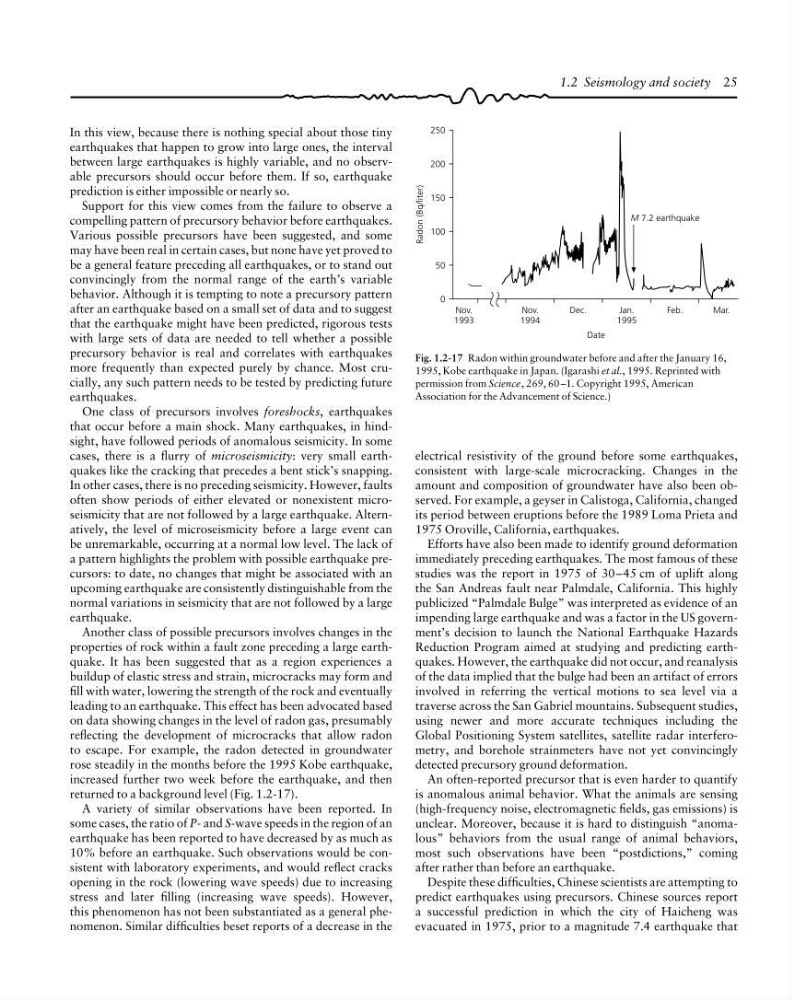
to escape. For example, the radon detected in groundwater
rose steadily in the months before the 1995 Kobe earthquake,
increased further two week before the earthquake, and then
returned to a background level (Fig. 1.2-17).
A variety of similar observations have been reported. In
some cases, the ratio of P- and S-wave speeds in the region of an
earthquake has been reported to have decreased by as much as
10% before an earthquake. Such observations would be consistent with laboratory experiments, and would reflect cracks
opening in the rock (lowering wave speeds) due to increasing
stress and later filling (increasing wave speeds). However,
this phenomenon has not been substantiated as a general phenomenon. Similar difficulties beset reports of a decrease in the
Fig. 1.2-17 Radon within groundwater before and after the January 16,
1995, Kobe earthquake in Japan. (Igarashi et al., 1995. Reprinted with
permission from Science, 269, 60 –1. Copyright 1995, American
Association for the Advancement of Science.)
electrical resistivity of the ground before some earthquakes,
consistent with large-scale microcracking. Changes in the
amount and composition of groundwater have also been observed. For example, a geyser in Calistoga, California, changed
its period between eruptions before the 1989 Loma Prieta and
1975 Oroville, California, earthquakes.
Efforts have also been made to identify ground deformation
immediately preceding earthquakes. The most famous of these
studies was the report in 1975 of 30–45 cm of uplift along
the San Andreas fault near Palmdale, California. This highly
publicized “Palmdale Bulge” was interpreted as evidence of an
impending large earthquake and was a factor in the US government’s decision to launch the National Earthquake Hazards
Reduction Program aimed at studying and predicting earthquakes. However, the earthquake did not occur, and reanalysis
of the data implied that the bulge had been an artifact of errors
involved in referring the vertical motions to sea level via a
traverse across the San Gabriel mountains. Subsequent studies,
using newer and more accurate techniques including the
Global Positioning System satellites, satellite radar interferometry, and borehole strainmeters have not yet convincingly
detected precursory ground deformation.
An often-reported precursor that is even harder to quantify
is anomalous animal behavior. What the animals are sensing
(high-frequency noise, electromagnetic fields, gas emissions) is
unclear. Moreover, because it is hard to distinguish “anomalous” behaviors from the usual range of animal behaviors,
most such observations have been “postdictions,” coming
after rather than before an earthquake.
Despite these difficulties, Chinese scientists are attempting to
predict earthquakes using precursors. Chinese sources report
a successful prediction in which the city of Haicheng was
evacuated in 1975, prior to a magnitude 7.4 earthquake that
Radon (Bq/liter)
250
200
150
100
50
0
Nov.
1994
Dec.
Jan.
1995
Feb.
Mar.
Nov.
1993
M 7.2 earthquake
Date
1.2 Seismology and society 25
earthquakes that happen to grow into large ones, the interval
between large earthquakes is highly variable, and no observable precursors should occur before them. If so, earthquake
prediction is either impossible or nearly so.
Support for this view comes from the failure to observe a
compelling pattern of precursory behavior before earthquakes.
Various possible precursors have been suggested, and some
may have been real in certain cases, but none have yet proved to
be a general feature preceding all earthquakes, or to stand out
convincingly from the normal range of the earth’s variable
behavior. Although it is tempting to note a precursory pattern
after an earthquake based on a small set of data and to suggest
that the earthquake might have been predicted, rigorous tests
with large sets of data are needed to tell whether a possible
precursory behavior is real and correlates with earthquakes
more frequently than expected purely by chance. Most crucially, any such pattern needs to be tested by predicting future
earthquakes.
One class of precursors involves foreshocks, earthquakes
that occur before a main shock. Many earthquakes, in hindsight, have followed periods of anomalous seismicity. In some
cases, there is a flurry of microseismicity: very small earthquakes like the cracking that precedes a bent stick’s snapping.
In other cases, there is no preceding seismicity. However, faults
often show periods of either elevated or nonexistent microseismicity that are not followed by a large earthquake. Alternatively, the level of microseismicity before a large event can
be unremarkable, occurring at a normal low level. The lack of
a pattern highlights the problem with possible earthquake precursors: to date, no changes that might be associated with an
upcoming earthquake are consistently distinguishable from the
normal variations in seismicity that are not followed by a large
earthquake.
Another class of possible precursors involves changes in the
properties of rock within a fault zone preceding a large earthquake. It has been suggested that as a region experiences a
buildup of elastic stress and strain, microcracks may form and
fill with water, lowering the strength of the rock and eventually
leading to an earthquake. This effect has been advocated based
on data showing changes in the level of radon gas, presumably
reflecting the development of microcracks that allow radon
to escape. For example, the radon detected in groundwater
rose steadily in the months before the 1995 Kobe earthquake,
increased further two week before the earthquake, and then
returned to a background level (Fig. 1.2-17).
A variety of similar observations have been reported. In
some cases, the ratio of P- and S-wave speeds in the region of an
earthquake has been reported to have decreased by as much as
10% before an earthquake. Such observations would be consistent with laboratory experiments, and would reflect cracks
opening in the rock (lowering wave speeds) due to increasing
stress and later filling (increasing wave speeds). However,
this phenomenon has not been substantiated as a general phenomenon. Similar difficulties beset reports of a decrease in the
Fig. 1.2-17 Radon within groundwater before and after the January 16,
1995, Kobe earthquake in Japan. (Igarashi et al., 1995. Reprinted with
permission from Science, 269, 60 –1. Copyright 1995, American
Association for the Advancement of Science.)
electrical resistivity of the ground before some earthquakes,
consistent with large-scale microcracking. Changes in the
amount and composition of groundwater have also been observed. For example, a geyser in Calistoga, California, changed
its period between eruptions before the 1989 Loma Prieta and
1975 Oroville, California, earthquakes.
Efforts have also been made to identify ground deformation
immediately preceding earthquakes. The most famous of these
studies was the report in 1975 of 30–45 cm of uplift along
the San Andreas fault near Palmdale, California. This highly
publicized “Palmdale Bulge” was interpreted as evidence of an
impending large earthquake and was a factor in the US government’s decision to launch the National Earthquake Hazards
Reduction Program aimed at studying and predicting earthquakes. However, the earthquake did not occur, and reanalysis
of the data implied that the bulge had been an artifact of errors
involved in referring the vertical motions to sea level via a
traverse across the San Gabriel mountains. Subsequent studies,
using newer and more accurate techniques including the
Global Positioning System satellites, satellite radar interferometry, and borehole strainmeters have not yet convincingly
detected precursory ground deformation.
An often-reported precursor that is even harder to quantify
is anomalous animal behavior. What the animals are sensing
(high-frequency noise, electromagnetic fields, gas emissions) is
unclear. Moreover, because it is hard to distinguish “anomalous” behaviors from the usual range of animal behaviors,
most such observations have been “postdictions,” coming
after rather than before an earthquake.
Despite these difficulties, Chinese scientists are attempting to
predict earthquakes using precursors. Chinese sources report
a successful prediction in which the city of Haicheng was
evacuated in 1975, prior to a magnitude 7.4 earthquake that
Radon (Bq/liter)
250
200
150
100
50
0
Nov.
1994
Dec.
Jan.
1995
Feb.
Mar.
Nov.
1993
M 7.2 earthquake
Date
1.2 Seismology and society 25