

364 Seismology and Plate Tectonics
P a c i f i c p l a t e
CP
B&R
40 mm/yr
U S A
M e x ic o
North American plate
Wasatch
G V
236°
238°
240°
242°
244°
246°
248°
250°
44°
42°
40°
38°
36°
34°
32°
30°
42°
40°
38°
36°
34°
32°
0.1 0.5 1 5 10 50 100
× 10
21 Pa-s
U S A
M e x ic o
236°
240°
244°
248°
Fig. 5.7-26 Observed (squares) heat flow across the San Andreas fault.
The elevated heat flow predicted by shear heating (solid line) is not
observed, except for one point (CJON, Cajon pass), where alternative
interpretations are possible, implying that the fault is weak. (Lachenbruch
and Sass, 1988. Geophys. Res. Lett., 15, 981– 4, copyright by the
American Geophysical Union.)
Heat flow (mW/m
2
)
125
100
75
50
25
Anomaly for
friction of 50 MPa
Mean
60
40
20
0
20
40
Distance from San Andreas fault (km)
San Andreas
fault
CJON
(uncorrected)
SW
NE
5.7.6 Earthquakes and regional deformation
The large, rapid deformation in earthquakes is often part of a
slow deformation process occurring over a broader region. As
discussed in Section 5.6.2, there often appear to be differences
between the seismic, aseismic, transient, and permanent
deformations sampled by different techniques on different time
scales. Experimental and theoretical ideas about rheology and
lithospheric dynamics are being used to investigate the relation
between earthquakes and the regional deformations that produce them.
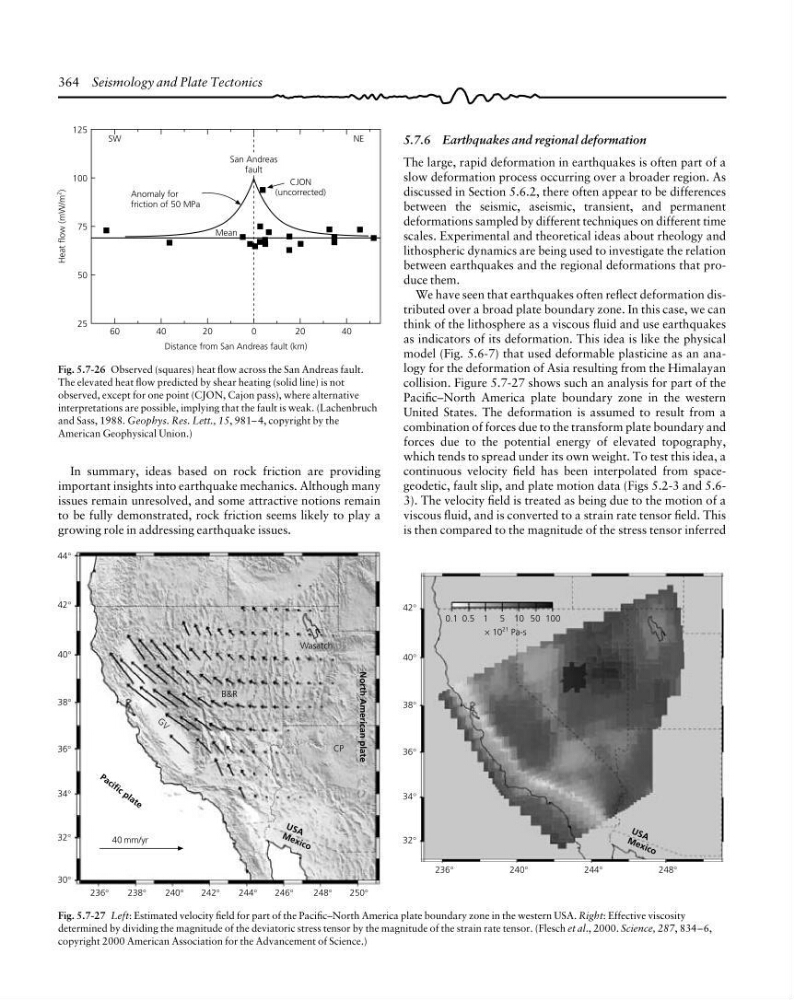
We have seen that earthquakes often reflect deformation distributed over a broad plate boundary zone. In this case, we can
think of the lithosphere as a viscous fluid and use earthquakes
as indicators of its deformation. This idea is like the physical
model (Fig. 5.6-7) that used deformable plasticine as an analogy for the deformation of Asia resulting from the Himalayan
collision. Figure 5.7-27 shows such an analysis for part of the
Pacific–North America plate boundary zone in the western
United States. The deformation is assumed to result from a
combination of forces due to the transform plate boundary and
forces due to the potential energy of elevated topography,
which tends to spread under its own weight. To test this idea, a
continuous velocity field has been interpolated from spacegeodetic, fault slip, and plate motion data (Figs 5.2-3 and 5.63). The velocity field is treated as being due to the motion of a
viscous fluid, and is converted to a strain rate tensor field. This
is then compared to the magnitude of the stress tensor inferred
Fig. 5.7-27 Left: Estimated velocity field for part of the Pacific–North America plate boundary zone in the western USA. Right: Effective viscosity
determined by dividing the magnitude of the deviatoric stress tensor by the magnitude of the strain rate tensor. (Flesch et al., 2000. Science, 287, 834–6,
copyright 2000 American Association for the Advancement of Science.)
In summary, ideas based on rock friction are providing
important insights into earthquake mechanics. Although many
issues remain unresolved, and some attractive notions remain
to be fully demonstrated, rock friction seems likely to play a
growing role in addressing earthquake issues.
P a c i f i c p l a t e
CP
B&R
40 mm/yr
U S A
M e x ic o
North American plate
Wasatch
G V
236°
238°
240°
242°
244°
246°
248°
250°
44°
42°
40°
38°
36°
34°
32°
30°
42°
40°
38°
36°
34°
32°
0.1 0.5 1 5 10 50 100
× 10
21 Pa-s
U S A
M e x ic o
236°
240°
244°
248°
Fig. 5.7-26 Observed (squares) heat flow across the San Andreas fault.
The elevated heat flow predicted by shear heating (solid line) is not
observed, except for one point (CJON, Cajon pass), where alternative
interpretations are possible, implying that the fault is weak. (Lachenbruch
and Sass, 1988. Geophys. Res. Lett., 15, 981– 4, copyright by the
American Geophysical Union.)
Heat flow (mW/m
2
)
125
100
75
50
25
Anomaly for
friction of 50 MPa
Mean
60
40
20
0
20
40
Distance from San Andreas fault (km)
San Andreas
fault
CJON
(uncorrected)
SW
NE
5.7.6 Earthquakes and regional deformation
The large, rapid deformation in earthquakes is often part of a
slow deformation process occurring over a broader region. As
discussed in Section 5.6.2, there often appear to be differences
between the seismic, aseismic, transient, and permanent
deformations sampled by different techniques on different time
scales. Experimental and theoretical ideas about rheology and
lithospheric dynamics are being used to investigate the relation
between earthquakes and the regional deformations that produce them.
We have seen that earthquakes often reflect deformation distributed over a broad plate boundary zone. In this case, we can
think of the lithosphere as a viscous fluid and use earthquakes
as indicators of its deformation. This idea is like the physical
model (Fig. 5.6-7) that used deformable plasticine as an analogy for the deformation of Asia resulting from the Himalayan
collision. Figure 5.7-27 shows such an analysis for part of the
Pacific–North America plate boundary zone in the western
United States. The deformation is assumed to result from a
combination of forces due to the transform plate boundary and
forces due to the potential energy of elevated topography,
which tends to spread under its own weight. To test this idea, a
continuous velocity field has been interpolated from spacegeodetic, fault slip, and plate motion data (Figs 5.2-3 and 5.63). The velocity field is treated as being due to the motion of a
viscous fluid, and is converted to a strain rate tensor field. This
is then compared to the magnitude of the stress tensor inferred
Fig. 5.7-27 Left: Estimated velocity field for part of the Pacific–North America plate boundary zone in the western USA. Right: Effective viscosity
determined by dividing the magnitude of the deviatoric stress tensor by the magnitude of the strain rate tensor. (Flesch et al., 2000. Science, 287, 834–6,
copyright 2000 American Association for the Advancement of Science.)
In summary, ideas based on rock friction are providing
important insights into earthquake mechanics. Although many
issues remain unresolved, and some attractive notions remain
to be fully demonstrated, rock friction seems likely to play a
growing role in addressing earthquake issues.