

Slow
µ
a
Fast
b
a − b
L
Slip
u t
k
( ) =
∆µσ (1 − cos ωt) (slip),
du t
dt
km
( ) =
∆µσ sin ω t (velocity),
du t
dt
m
2
2
( ) =
∆µσ cos ωt (acceleration),
(46)
where ω
/ .
= k m As shown, the block starts slipping because
the spring force exceeds the friction force. During the slip
event, the spring force decreases as the spring shortens, until it
becomes less than the friction force and the block slows and
eventually stops. The block stops once the shaded area above
the spring force line equals that below the line, or when the
work done accelerating the block equals that which decelerated
it. If the spring end continues to move, loading continues until
the spring force again equals the static friction force and
another slip event occurs.
It is interesting to think of analogies between this model of
slip events and earthquakes. The slip event’s duration t D ,
analogous to an earthquake rise time (Section 4.3.2), satisfies
du t
dt
t
mk
D
D
( )
,
/ .
=
=
=
0
π
ω
π
(47)
The total slip during the event is
∆u = u(t D ) = 2∆µσ /k,
(48)
and the drop in the spring force, which is analogous to an
earthquake stress drop (Section 4.6.3), is
∆f = 2∆ µσ.
(49)
Thus the rise time depends on the spring constant, but not on
the difference between static and dynamic friction. However,
the total slip and stress drop depend upon the friction difference. None of these depend upon the loading rate, which is
analogous to the rate of plate motion causing earthquakes
on a plate boundary. But the loading rate determines the time
between successive slip events. Thus, in the plate boundary
analogy, the time between large earthquakes depends on the
plate motion rate, but their slip and stress drop depend on the
frictional properties of the fault and the normal stress. Hence
faster-slipping boundaries would have more frequent large
earthquakes, but the slip and stress drop in them would not
be greater than on a slower boundary with similar frictional
properties and normal stress.
Laboratory experiments show that the difference between
static and dynamic friction is more complicated than the constant values assumed in this simple model. We can think of the
lower dynamic friction as showing either velocity weakening,
decreasing as the object moves faster, or slip weakening,
decreasing as the object moves further. Frictional models called
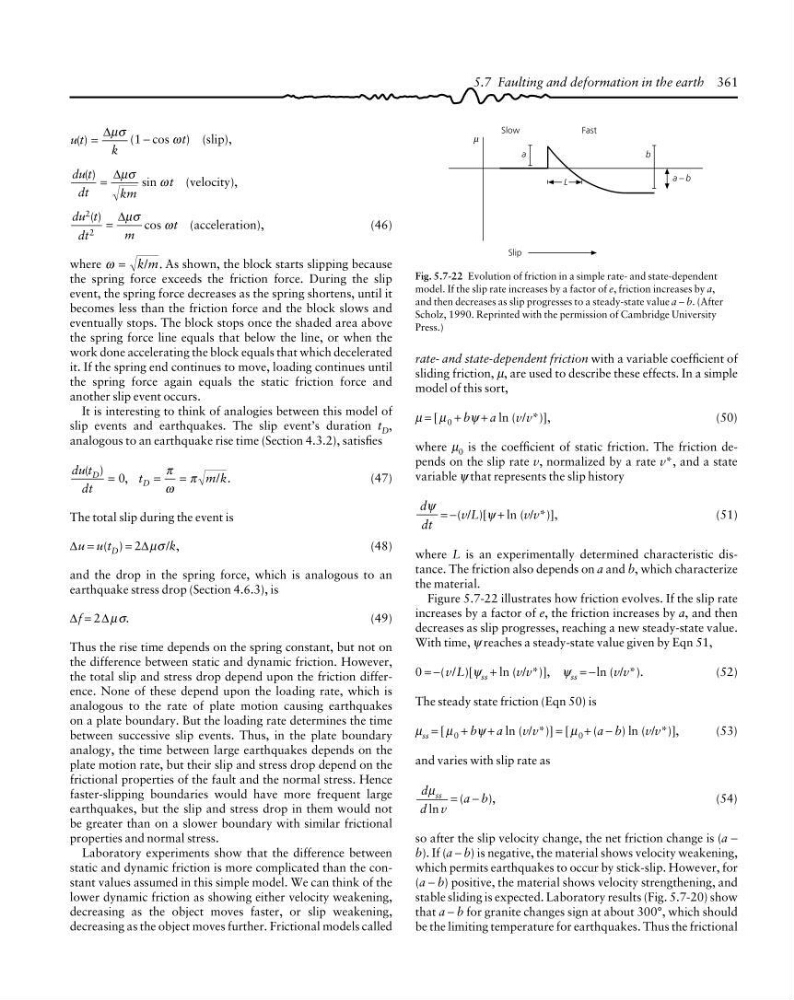
Fig. 5.7-22 Evolution of friction in a simple rate- and state-dependent
model. If the slip rate increases by a factor of e, friction increases by a,
and then decreases as slip progresses to a steady-state value a − b. (After
Scholz, 1990. Reprinted with the permission of Cambridge University
Press.)
rate- and state-dependent friction with a variable coefficient of
sliding friction, µ, are used to describe these effects. In a simple
model of this sort,
µ = [ µ 0 + bψ + a ln (v/v*)],
(50)
where µ 0 is the coefficient of static friction. The friction depends on the slip rate v, normalized by a rate v*, and a state
variable ψ that represents the slip history
d
dt
ψ = −(v/L)[ψ + ln (v/v*)],
(51)
where L is an experimentally determined characteristic distance. The friction also depends on a and b, which characterize
the material.
Figure 5.7-22 illustrates how friction evolves. If the slip rate
increases by a factor of e, the friction increases by a, and then
decreases as slip progresses, reaching a new steady-state value.
With time, ψ reaches a steady-state value given by Eqn 51,
0 = −(v/L)[ψ ss + ln (v/v*)], ψ ss = −ln (v/v*).
(52)
The steady state friction (Eqn 50) is
µ ss = [ µ 0 + bψ + a ln (v/v*)] = [ µ 0 + (a − b) ln (v/v*)],
(53)
and varies with slip rate as
d
d v
ss
µ
ln
= (a − b),
(54)
so after the slip velocity change, the net friction change is (a −
b). If (a − b) is negative, the material shows velocity weakening,
which permits earthquakes to occur by stick-slip. However, for
(a − b) positive, the material shows velocity strengthening, and
stable sliding is expected. Laboratory results (Fig. 5.7-20) show
that a − b for granite changes sign at about 300°, which should
be the limiting temperature for earthquakes. Thus the frictional
5.7 Faulting and deformation in the earth 361
µ
a
Fast
b
a − b
L
Slip
u t
k
( ) =
∆µσ (1 − cos ωt) (slip),
du t
dt
km
( ) =
∆µσ sin ω t (velocity),
du t
dt
m
2
2
( ) =
∆µσ cos ωt (acceleration),
(46)
where ω
/ .
= k m As shown, the block starts slipping because
the spring force exceeds the friction force. During the slip
event, the spring force decreases as the spring shortens, until it
becomes less than the friction force and the block slows and
eventually stops. The block stops once the shaded area above
the spring force line equals that below the line, or when the
work done accelerating the block equals that which decelerated
it. If the spring end continues to move, loading continues until
the spring force again equals the static friction force and
another slip event occurs.
It is interesting to think of analogies between this model of
slip events and earthquakes. The slip event’s duration t D ,
analogous to an earthquake rise time (Section 4.3.2), satisfies
du t
dt
t
mk
D
D
( )
,
/ .
=
=
=
0
π
ω
π
(47)
The total slip during the event is
∆u = u(t D ) = 2∆µσ /k,
(48)
and the drop in the spring force, which is analogous to an
earthquake stress drop (Section 4.6.3), is
∆f = 2∆ µσ.
(49)
Thus the rise time depends on the spring constant, but not on
the difference between static and dynamic friction. However,
the total slip and stress drop depend upon the friction difference. None of these depend upon the loading rate, which is
analogous to the rate of plate motion causing earthquakes
on a plate boundary. But the loading rate determines the time
between successive slip events. Thus, in the plate boundary
analogy, the time between large earthquakes depends on the
plate motion rate, but their slip and stress drop depend on the
frictional properties of the fault and the normal stress. Hence
faster-slipping boundaries would have more frequent large
earthquakes, but the slip and stress drop in them would not
be greater than on a slower boundary with similar frictional
properties and normal stress.
Laboratory experiments show that the difference between
static and dynamic friction is more complicated than the constant values assumed in this simple model. We can think of the
lower dynamic friction as showing either velocity weakening,
decreasing as the object moves faster, or slip weakening,
decreasing as the object moves further. Frictional models called
Fig. 5.7-22 Evolution of friction in a simple rate- and state-dependent
model. If the slip rate increases by a factor of e, friction increases by a,
and then decreases as slip progresses to a steady-state value a − b. (After
Scholz, 1990. Reprinted with the permission of Cambridge University
Press.)
rate- and state-dependent friction with a variable coefficient of
sliding friction, µ, are used to describe these effects. In a simple
model of this sort,
µ = [ µ 0 + bψ + a ln (v/v*)],
(50)
where µ 0 is the coefficient of static friction. The friction depends on the slip rate v, normalized by a rate v*, and a state
variable ψ that represents the slip history
d
dt
ψ = −(v/L)[ψ + ln (v/v*)],
(51)
where L is an experimentally determined characteristic distance. The friction also depends on a and b, which characterize
the material.
Figure 5.7-22 illustrates how friction evolves. If the slip rate
increases by a factor of e, the friction increases by a, and then
decreases as slip progresses, reaching a new steady-state value.
With time, ψ reaches a steady-state value given by Eqn 51,
0 = −(v/L)[ψ ss + ln (v/v*)], ψ ss = −ln (v/v*).
(52)
The steady state friction (Eqn 50) is
µ ss = [ µ 0 + bψ + a ln (v/v*)] = [ µ 0 + (a − b) ln (v/v*)],
(53)
and varies with slip rate as
d
d v
ss
µ
ln
= (a − b),
(54)
so after the slip velocity change, the net friction change is (a −
b). If (a − b) is negative, the material shows velocity weakening,
which permits earthquakes to occur by stick-slip. However, for
(a − b) positive, the material shows velocity strengthening, and
stable sliding is expected. Laboratory results (Fig. 5.7-20) show
that a − b for granite changes sign at about 300°, which should
be the limiting temperature for earthquakes. Thus the frictional
5.7 Faulting and deformation in the earth 361