

360 Seismology and Plate Tectonics
Spring force
f
u
+ vt
ζ
τ
f
∆f
∆u
Slope –k
Dynamic friction
Static friction
Slip u
µ σ
d
−
µ σ
s
−
10
Stress difference (MPa)
600
400
200
0
5
0
Apparent axial strain (%)
1 mm
306°
2 2 °
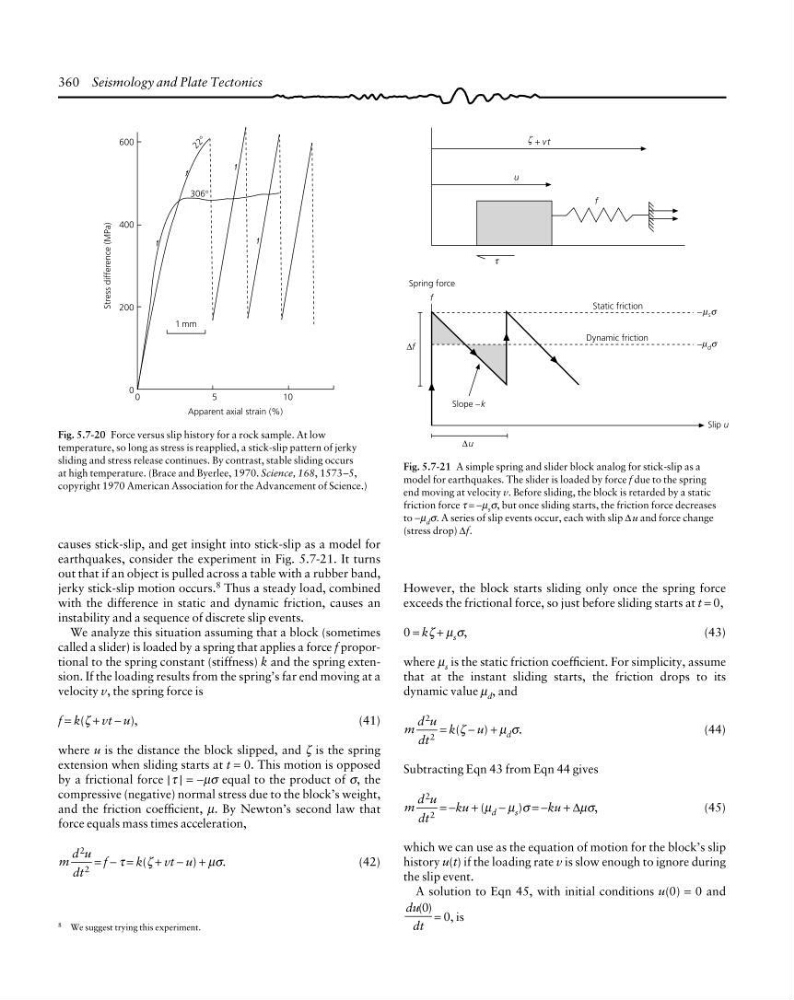
Fig. 5.7-20 Force versus slip history for a rock sample. At low
temperature, so long as stress is reapplied, a stick-slip pattern of jerky
sliding and stress release continues. By contrast, stable sliding occurs
at high temperature. (Brace and Byerlee, 1970. Science, 168, 1573–5,
copyright 1970 American Association for the Advancement of Science.)
8 We suggest trying this experiment.
However, the block starts sliding only once the spring force
exceeds the frictional force, so just before sliding starts at t = 0,
0 = kζ + µ s σ,
(43)
where µ s is the static friction coefficient. For simplicity, assume
that at the instant sliding starts, the friction drops to its
dynamic value µ d , and
m
d u
dt
2
2
= k(ζ − u) + µ d σ.
(44)
Subtracting Eqn 43 from Eqn 44 gives
m
d u
dt
2
2
= −ku + (µ d − µ s )σ = −ku + ∆µσ,
(45)
which we can use as the equation of motion for the block’s slip
history u(t) if the loading rate v is slow enough to ignore during
the slip event.
A solution to Eqn 45, with initial conditions u(0) = 0 and
du
dt
( )
0 = 0, is
causes stick-slip, and get insight into stick-slip as a model for
earthquakes, consider the experiment in Fig. 5.7-21. It turns
out that if an object is pulled across a table with a rubber band,
jerky stick-slip motion occurs. 8 Thus a steady load, combined
with the difference in static and dynamic friction, causes an
instability and a sequence of discrete slip events.
We analyze this situation assuming that a block (sometimes
called a slider) is loaded by a spring that applies a force f proportional to the spring constant (stiffness) k and the spring extension. If the loading results from the spring’s far end moving at a
velocity v, the spring force is
f = k(ζ + vt − u),
(41)
where u is the distance the block slipped, and ζ is the spring
extension when sliding starts at t = 0. This motion is opposed
by a frictional force | τ | = −µσ equal to the product of σ, the
compressive (negative) normal stress due to the block’s weight,
and the friction coefficient, µ. By Newton’s second law that
force equals mass times acceleration,
m
d u
dt
2
2
= f − τ = k(ζ + vt − u) + µσ.
(42)
Fig. 5.7-21 A simple spring and slider block analog for stick-slip as a
model for earthquakes. The slider is loaded by force f due to the spring
end moving at velocity v. Before sliding, the block is retarded by a static
friction force τ = −µ s σ, but once sliding starts, the friction force decreases
to −µ d σ. A series of slip events occur, each with slip ∆ u and force change
(stress drop) ∆f.
Spring force
f
u
+ vt
ζ
τ
f
∆f
∆u
Slope –k
Dynamic friction
Static friction
Slip u
µ σ
d
−
µ σ
s
−
10
Stress difference (MPa)
600
400
200
0
5
0
Apparent axial strain (%)
1 mm
306°
2 2 °
Fig. 5.7-20 Force versus slip history for a rock sample. At low
temperature, so long as stress is reapplied, a stick-slip pattern of jerky
sliding and stress release continues. By contrast, stable sliding occurs
at high temperature. (Brace and Byerlee, 1970. Science, 168, 1573–5,
copyright 1970 American Association for the Advancement of Science.)
8 We suggest trying this experiment.
However, the block starts sliding only once the spring force
exceeds the frictional force, so just before sliding starts at t = 0,
0 = kζ + µ s σ,
(43)
where µ s is the static friction coefficient. For simplicity, assume
that at the instant sliding starts, the friction drops to its
dynamic value µ d , and
m
d u
dt
2
2
= k(ζ − u) + µ d σ.
(44)
Subtracting Eqn 43 from Eqn 44 gives
m
d u
dt
2
2
= −ku + (µ d − µ s )σ = −ku + ∆µσ,
(45)
which we can use as the equation of motion for the block’s slip
history u(t) if the loading rate v is slow enough to ignore during
the slip event.
A solution to Eqn 45, with initial conditions u(0) = 0 and
du
dt
( )
0 = 0, is
causes stick-slip, and get insight into stick-slip as a model for
earthquakes, consider the experiment in Fig. 5.7-21. It turns
out that if an object is pulled across a table with a rubber band,
jerky stick-slip motion occurs. 8 Thus a steady load, combined
with the difference in static and dynamic friction, causes an
instability and a sequence of discrete slip events.
We analyze this situation assuming that a block (sometimes
called a slider) is loaded by a spring that applies a force f proportional to the spring constant (stiffness) k and the spring extension. If the loading results from the spring’s far end moving at a
velocity v, the spring force is
f = k(ζ + vt − u),
(41)
where u is the distance the block slipped, and ζ is the spring
extension when sliding starts at t = 0. This motion is opposed
by a frictional force | τ | = −µσ equal to the product of σ, the
compressive (negative) normal stress due to the block’s weight,
and the friction coefficient, µ. By Newton’s second law that
force equals mass times acceleration,
m
d u
dt
2
2
= f − τ = k(ζ + vt − u) + µσ.
(42)
Fig. 5.7-21 A simple spring and slider block analog for stick-slip as a
model for earthquakes. The slider is loaded by force f due to the spring
end moving at velocity v. Before sliding, the block is retarded by a static
friction force τ = −µ s σ, but once sliding starts, the friction force decreases
to −µ d σ. A series of slip events occur, each with slip ∆ u and force change
(stress drop) ∆f.