

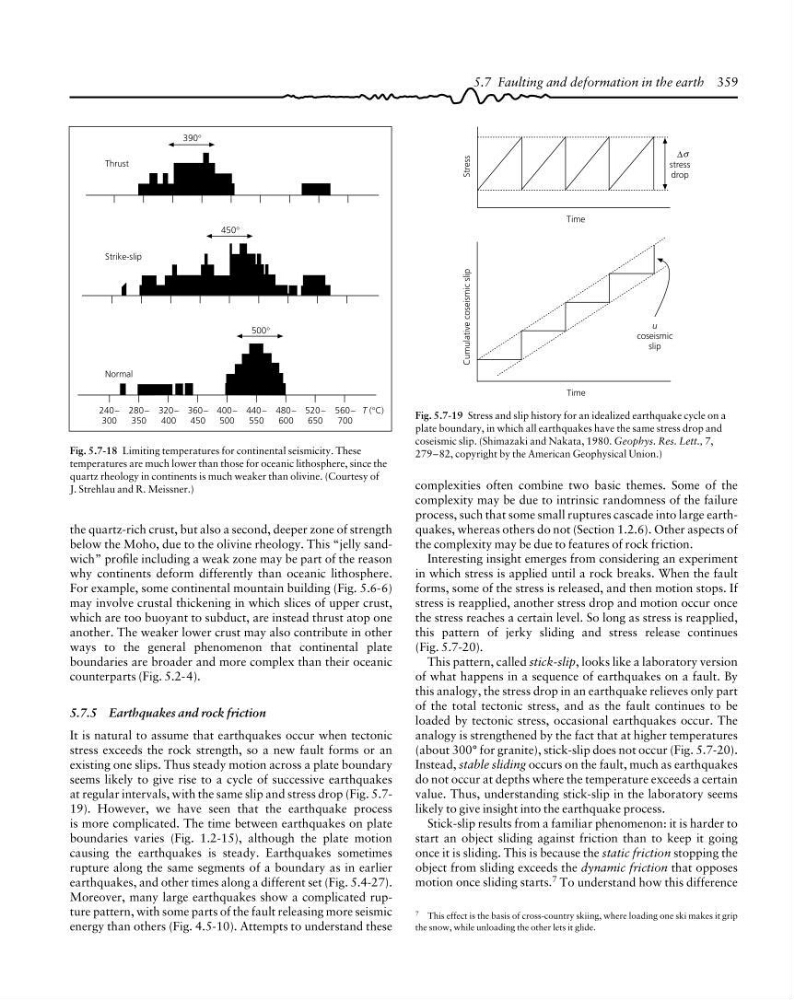
Fig. 5.7-18 Limiting temperatures for continental seismicity. These
temperatures are much lower than those for oceanic lithosphere, since the
quartz rheology in continents is much weaker than olivine. (Courtesy of
J. Strehlau and R. Meissner.)
560 –
700
T (°C)
390°
Thrust
450°
500°
Strike-slip
Normal
520 –
650
480 –
600
440 –
550
400 –
500
360 –
450
280 –
350
320 –
400
240 –
300
the quartz-rich crust, but also a second, deeper zone of strength
below the Moho, due to the olivine rheology. This “jelly sandwich” profile including a weak zone may be part of the reason
why continents deform differently than oceanic lithosphere.
For example, some continental mountain building (Fig. 5.6-6)
may involve crustal thickening in which slices of upper crust,
which are too buoyant to subduct, are instead thrust atop one
another. The weaker lower crust may also contribute in other
ways to the general phenomenon that continental plate
boundaries are broader and more complex than their oceanic
counterparts (Fig. 5.2-4).
5.7.5 Earthquakes and rock friction
It is natural to assume that earthquakes occur when tectonic
stress exceeds the rock strength, so a new fault forms or an
existing one slips. Thus steady motion across a plate boundary
seems likely to give rise to a cycle of successive earthquakes
at regular intervals, with the same slip and stress drop (Fig. 5.719). However, we have seen that the earthquake process
is more complicated. The time between earthquakes on plate
boundaries varies (Fig. 1.2-15), although the plate motion
causing the earthquakes is steady. Earthquakes sometimes
rupture along the same segments of a boundary as in earlier
earthquakes, and other times along a different set (Fig. 5.4-27).
Moreover, many large earthquakes show a complicated rupture pattern, with some parts of the fault releasing more seismic
energy than others (Fig. 4.5-10). Attempts to understand these
Fig. 5.7-19 Stress and slip history for an idealized earthquake cycle on a
plate boundary, in which all earthquakes have the same stress drop and
coseismic slip. (Shimazaki and Nakata, 1980. Geophys. Res. Lett., 7,
279–82, copyright by the American Geophysical Union.)
Stress
u
coseismic
slip
Time
Cumulative coseismic slip
∆
stress
drop
σ
Time
complexities often combine two basic themes. Some of the
complexity may be due to intrinsic randomness of the failure
process, such that some small ruptures cascade into large earthquakes, whereas others do not (Section 1.2.6). Other aspects of
the complexity may be due to features of rock friction.
Interesting insight emerges from considering an experiment
in which stress is applied until a rock breaks. When the fault
forms, some of the stress is released, and then motion stops. If
stress is reapplied, another stress drop and motion occur once
the stress reaches a certain level. So long as stress is reapplied,
this pattern of jerky sliding and stress release continues
(Fig. 5.7-20).
This pattern, called stick-slip, looks like a laboratory version
of what happens in a sequence of earthquakes on a fault. By
this analogy, the stress drop in an earthquake relieves only part
of the total tectonic stress, and as the fault continues to be
loaded by tectonic stress, occasional earthquakes occur. The
analogy is strengthened by the fact that at higher temperatures
(about 300° for granite), stick-slip does not occur (Fig. 5.7-20).
Instead, stable sliding occurs on the fault, much as earthquakes
do not occur at depths where the temperature exceeds a certain
value. Thus, understanding stick-slip in the laboratory seems
likely to give insight into the earthquake process.
Stick-slip results from a familiar phenomenon: it is harder to
start an object sliding against friction than to keep it going
once it is sliding. This is because the static friction stopping the
object from sliding exceeds the dynamic friction that opposes
motion once sliding starts. 7 To understand how this difference
7 This effect is the basis of cross-country skiing, where loading one ski makes it grip
the snow, while unloading the other lets it glide.
5.7 Faulting and deformation in the earth 359
temperatures are much lower than those for oceanic lithosphere, since the
quartz rheology in continents is much weaker than olivine. (Courtesy of
J. Strehlau and R. Meissner.)
560 –
700
T (°C)
390°
Thrust
450°
500°
Strike-slip
Normal
520 –
650
480 –
600
440 –
550
400 –
500
360 –
450
280 –
350
320 –
400
240 –
300
the quartz-rich crust, but also a second, deeper zone of strength
below the Moho, due to the olivine rheology. This “jelly sandwich” profile including a weak zone may be part of the reason
why continents deform differently than oceanic lithosphere.
For example, some continental mountain building (Fig. 5.6-6)
may involve crustal thickening in which slices of upper crust,
which are too buoyant to subduct, are instead thrust atop one
another. The weaker lower crust may also contribute in other
ways to the general phenomenon that continental plate
boundaries are broader and more complex than their oceanic
counterparts (Fig. 5.2-4).
5.7.5 Earthquakes and rock friction
It is natural to assume that earthquakes occur when tectonic
stress exceeds the rock strength, so a new fault forms or an
existing one slips. Thus steady motion across a plate boundary
seems likely to give rise to a cycle of successive earthquakes
at regular intervals, with the same slip and stress drop (Fig. 5.719). However, we have seen that the earthquake process
is more complicated. The time between earthquakes on plate
boundaries varies (Fig. 1.2-15), although the plate motion
causing the earthquakes is steady. Earthquakes sometimes
rupture along the same segments of a boundary as in earlier
earthquakes, and other times along a different set (Fig. 5.4-27).
Moreover, many large earthquakes show a complicated rupture pattern, with some parts of the fault releasing more seismic
energy than others (Fig. 4.5-10). Attempts to understand these
Fig. 5.7-19 Stress and slip history for an idealized earthquake cycle on a
plate boundary, in which all earthquakes have the same stress drop and
coseismic slip. (Shimazaki and Nakata, 1980. Geophys. Res. Lett., 7,
279–82, copyright by the American Geophysical Union.)
Stress
u
coseismic
slip
Time
Cumulative coseismic slip
∆
stress
drop
σ
Time
complexities often combine two basic themes. Some of the
complexity may be due to intrinsic randomness of the failure
process, such that some small ruptures cascade into large earthquakes, whereas others do not (Section 1.2.6). Other aspects of
the complexity may be due to features of rock friction.
Interesting insight emerges from considering an experiment
in which stress is applied until a rock breaks. When the fault
forms, some of the stress is released, and then motion stops. If
stress is reapplied, another stress drop and motion occur once
the stress reaches a certain level. So long as stress is reapplied,
this pattern of jerky sliding and stress release continues
(Fig. 5.7-20).
This pattern, called stick-slip, looks like a laboratory version
of what happens in a sequence of earthquakes on a fault. By
this analogy, the stress drop in an earthquake relieves only part
of the total tectonic stress, and as the fault continues to be
loaded by tectonic stress, occasional earthquakes occur. The
analogy is strengthened by the fact that at higher temperatures
(about 300° for granite), stick-slip does not occur (Fig. 5.7-20).
Instead, stable sliding occurs on the fault, much as earthquakes
do not occur at depths where the temperature exceeds a certain
value. Thus, understanding stick-slip in the laboratory seems
likely to give insight into the earthquake process.
Stick-slip results from a familiar phenomenon: it is harder to
start an object sliding against friction than to keep it going
once it is sliding. This is because the static friction stopping the
object from sliding exceeds the dynamic friction that opposes
motion once sliding starts. 7 To understand how this difference
7 This effect is the basis of cross-country skiing, where loading one ski makes it grip
the snow, while unloading the other lets it glide.
5.7 Faulting and deformation in the earth 359