

356 Seismology and Plate Tectonics
Maximum fiber stress (MPa)
400
200
0
100
200
300
400
500
Distance (km)
Deflection (m)
2500
5000
100
200
300
400
500
Distance (km)
Time
elastic (T = 0)
elastic (T = 0)
isostatic
Time
M
t
o
σ
e
o
σ
σ
τ
Maxwell
relaxation
time
k
η
σ
(a)
(b)
(c)
that we can treat the mantle as a solid for seismological
purposes and as a fluid in tectonic modeling. If we model the
mantle as viscoelastic, then a load applied on the surface has an
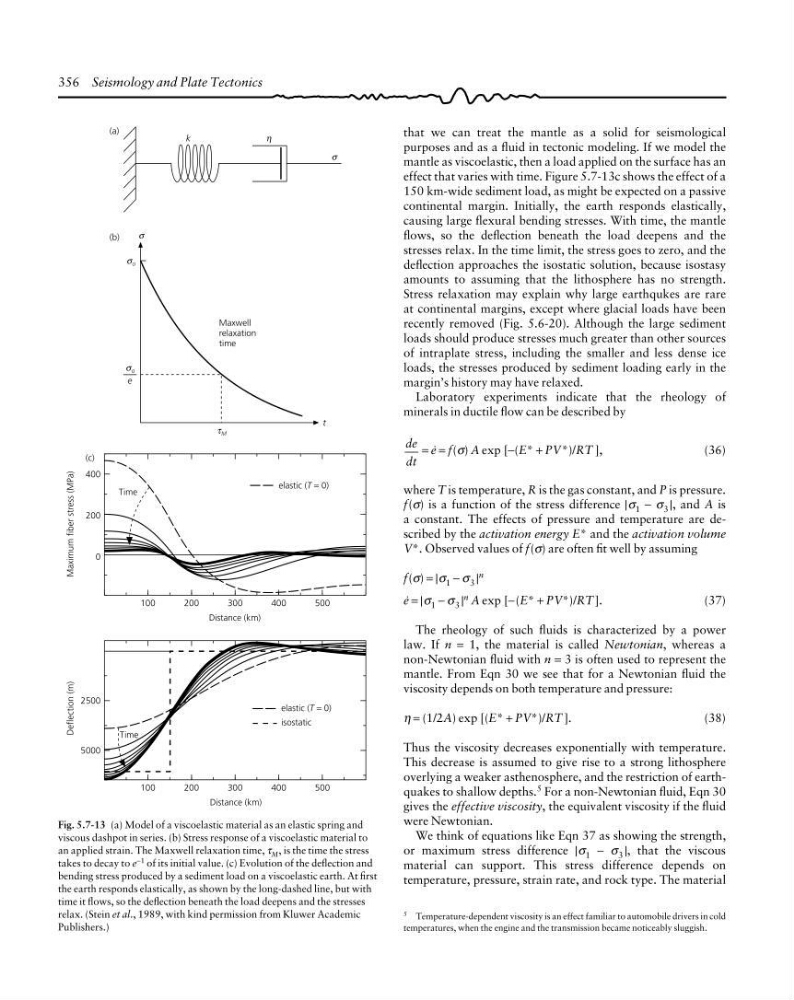
effect that varies with time. Figure 5.7-13c shows the effect of a
150 km-wide sediment load, as might be expected on a passive
continental margin. Initially, the earth responds elastically,
causing large flexural bending stresses. With time, the mantle
flows, so the deflection beneath the load deepens and the
stresses relax. In the time limit, the stress goes to zero, and the
deflection approaches the isostatic solution, because isostasy
amounts to assuming that the lithosphere has no strength.
Stress relaxation may explain why large earthqukes are rare
at continental margins, except where glacial loads have been
recently removed (Fig. 5.6-20). Although the large sediment
loads should produce stresses much greater than other sources
of intraplate stress, including the smaller and less dense ice
loads, the stresses produced by sediment loading early in the
margin’s history may have relaxed.
Laboratory experiments indicate that the rheology of
minerals in ductile flow can be described by
de
dt
= G = f(σ) A exp [−(E* + PV*)/RT ],
(36)
where T is temperature, R is the gas constant, and P is pressure.
f(σ) is a function of the stress difference |σ 1 − σ 3 |, and A is
a constant. The effects of pressure and temperature are described by the activation energy E* and the activation volume
V*. Observed values of f(σ) are often fit well by assuming
f(σ) = |σ 1 − σ 3 | n
G = |σ 1 − σ 3 | n A exp [−(E* + PV*)/RT ].
(37)
The rheology of such fluids is characterized by a power
law. If n = 1, the material is called Newtonian, whereas a
non-Newtonian fluid with n = 3 is often used to represent the
mantle. From Eqn 30 we see that for a Newtonian fluid the
viscosity depends on both temperature and pressure:
η = (1/2A) exp [(E* + PV*)/RT ].
(38)
Thus the viscosity decreases exponentially with temperature.
This decrease is assumed to give rise to a strong lithosphere
overlying a weaker asthenosphere, and the restriction of earthquakes to shallow depths. 5 For a non-Newtonian fluid, Eqn 30
gives the effective viscosity, the equivalent viscosity if the fluid
were Newtonian.
We think of equations like Eqn 37 as showing the strength,
or maximum stress difference |σ 1 − σ 3 |, that the viscous
material can support. This stress difference depends on
temperature, pressure, strain rate, and rock type. The material
5 Temperature-dependent viscosity is an effect familiar to automobile drivers in cold
temperatures, when the engine and the transmission became noticeably sluggish.
Fig. 5.7-13 (a) Model of a viscoelastic material as an elastic spring and
viscous dashpot in series. (b) Stress response of a viscoelastic material to
an applied strain. The Maxwell relaxation time, τ M , is the time the stress
takes to decay to e
−1 of its initial value. (c) Evolution of the deflection and
bending stress produced by a sediment load on a viscoelastic earth. At first
the earth responds elastically, as shown by the long-dashed line, but with
time it flows, so the deflection beneath the load deepens and the stresses
relax. (Stein et al., 1989, with kind permission from Kluwer Academic
Publishers.)
Maximum fiber stress (MPa)
400
200
0
100
200
300
400
500
Distance (km)
Deflection (m)
2500
5000
100
200
300
400
500
Distance (km)
Time
elastic (T = 0)
elastic (T = 0)
isostatic
Time
M
t
o
σ
e
o
σ
σ
τ
Maxwell
relaxation
time
k
η
σ
(a)
(b)
(c)
that we can treat the mantle as a solid for seismological
purposes and as a fluid in tectonic modeling. If we model the
mantle as viscoelastic, then a load applied on the surface has an
effect that varies with time. Figure 5.7-13c shows the effect of a
150 km-wide sediment load, as might be expected on a passive
continental margin. Initially, the earth responds elastically,
causing large flexural bending stresses. With time, the mantle
flows, so the deflection beneath the load deepens and the
stresses relax. In the time limit, the stress goes to zero, and the
deflection approaches the isostatic solution, because isostasy
amounts to assuming that the lithosphere has no strength.
Stress relaxation may explain why large earthqukes are rare
at continental margins, except where glacial loads have been
recently removed (Fig. 5.6-20). Although the large sediment
loads should produce stresses much greater than other sources
of intraplate stress, including the smaller and less dense ice
loads, the stresses produced by sediment loading early in the
margin’s history may have relaxed.
Laboratory experiments indicate that the rheology of
minerals in ductile flow can be described by
de
dt
= G = f(σ) A exp [−(E* + PV*)/RT ],
(36)
where T is temperature, R is the gas constant, and P is pressure.
f(σ) is a function of the stress difference |σ 1 − σ 3 |, and A is
a constant. The effects of pressure and temperature are described by the activation energy E* and the activation volume
V*. Observed values of f(σ) are often fit well by assuming
f(σ) = |σ 1 − σ 3 | n
G = |σ 1 − σ 3 | n A exp [−(E* + PV*)/RT ].
(37)
The rheology of such fluids is characterized by a power
law. If n = 1, the material is called Newtonian, whereas a
non-Newtonian fluid with n = 3 is often used to represent the
mantle. From Eqn 30 we see that for a Newtonian fluid the
viscosity depends on both temperature and pressure:
η = (1/2A) exp [(E* + PV*)/RT ].
(38)
Thus the viscosity decreases exponentially with temperature.
This decrease is assumed to give rise to a strong lithosphere
overlying a weaker asthenosphere, and the restriction of earthquakes to shallow depths. 5 For a non-Newtonian fluid, Eqn 30
gives the effective viscosity, the equivalent viscosity if the fluid
were Newtonian.
We think of equations like Eqn 37 as showing the strength,
or maximum stress difference |σ 1 − σ 3 |, that the viscous
material can support. This stress difference depends on
temperature, pressure, strain rate, and rock type. The material
5 Temperature-dependent viscosity is an effect familiar to automobile drivers in cold
temperatures, when the engine and the transmission became noticeably sluggish.
Fig. 5.7-13 (a) Model of a viscoelastic material as an elastic spring and
viscous dashpot in series. (b) Stress response of a viscoelastic material to
an applied strain. The Maxwell relaxation time, τ M , is the time the stress
takes to decay to e
−1 of its initial value. (c) Evolution of the deflection and
bending stress produced by a sediment load on a viscoelastic earth. At first
the earth responds elastically, as shown by the long-dashed line, but with
time it flows, so the deflection beneath the load deepens and the stresses
relax. (Stein et al., 1989, with kind permission from Kluwer Academic
Publishers.)