

Depth (km)
0
1
2
BY-D
RY
26.5 MPa / km
0
2 0
4 0
6 0
8 0
Horizontal stresses (MPa)
L
it
h
o
s
t
a
t
ic
B Y -D R Y
where η is the viscosity, and e F is the fluid portion of the strain.
This equation defines the viscosity, the property that measures
a fluid’s resistance to shear. 3
We often think of an elastic material as a spring, which
exerts a force proportional to distance. Thus stress and
strain are proportional at any instant, and there are no timedependent effects. By contrast, the viscous material is though of
as a dashpot, a fluid damper that exerts a force proportional to
velocity. Hence the stress and strain rate are proportional, and
the material’s response varies with time. These effects are combined in a viscoelastic material, which can be thought of as a
spring and dashpot in series (Fig. 5.7-13). The combined elastic
and viscous response comes from the combined strain rate
de
dt
de
dt
de
dt
E
d
dt
E
F
.
=
+
=
+
1
2
σ
σ
η
(31)
This differential equation, the rheological law for a Maxwell
substance, shows how the stress in the material evolves after
a strain e o is applied at time t = 0 and then remains constant. At
t = 0 the derivative terms dominate, so the material behaves
elastically, and has an initial stress
σ o = Ee o .
(32)
For t > 0, de/dt = 0, so
d
dt
E
σ
η
σ ,
= −
2
(33)
whose integral is
σ(t) = σ o exp [−(Et/2η)].
(34)
Thus stress relaxes from its initial value as a function of time
(Fig. 5.7-13). A useful parameter is the Maxwell relaxation
time,
4
τ
η η
µ
M
E
=
≈ ,
2
(35)
required for the stress to decay to e
−1 of its initial value. For
times less than τ M the material can be considered an elastic
solid, whereas for longer times it can be considered a viscous
fluid.
For example, if the mantle is approximately a Poisson solid
with µ ≈ 10 12 dyn/cm 2 and η ≈ 10 22 poise, its Maxwell time is
about 10
10 s or 300 years. Although the viscosity is not that
well known, so estimates of the Maxwell time vary, it is clear
5.7 Faulting and deformation in the earth 355
3 In familiar terms, viscosity measures how “gooey” a fluid is. Maple syrup is somewhat more viscous than water, and the earth’s mantle is about 10
24 times more viscous.
4 Definitions of the Maxwell time vary, but always involve the ratio of the viscosity
to an elastic constant.
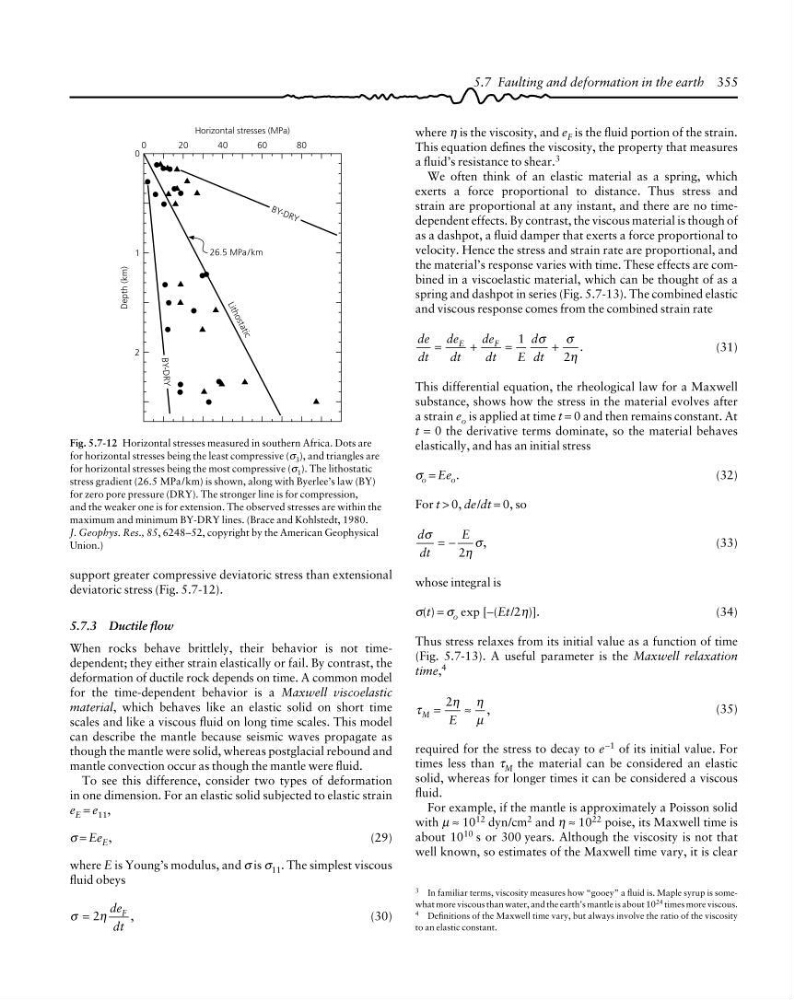
Fig. 5.7-12 Horizontal stresses measured in southern Africa. Dots are
for horizontal stresses being the least compressive (σ 3 ), and triangles are
for horizontal stresses being the most compressive (σ 1 ). The lithostatic
stress gradient (26.5 MPa/km) is shown, along with Byerlee’s law (BY)
for zero pore pressure (DRY). The stronger line is for compression,
and the weaker one is for extension. The observed stresses are within the
maximum and minimum BY-DRY lines. (Brace and Kohlstedt, 1980.
J. Geophys. Res., 85, 6248–52, copyright by the American Geophysical
Union.)
support greater compressive deviatoric stress than extensional
deviatoric stress (Fig. 5.7-12).
5.7.3 Ductile flow
When rocks behave brittlely, their behavior is not timedependent; they either strain elastically or fail. By contrast, the
deformation of ductile rock depends on time. A common model
for the time-dependent behavior is a Maxwell viscoelastic
material, which behaves like an elastic solid on short time
scales and like a viscous fluid on long time scales. This model
can describe the mantle because seismic waves propagate as
though the mantle were solid, whereas postglacial rebound and
mantle convection occur as though the mantle were fluid.
To see this difference, consider two types of deformation
in one dimension. For an elastic solid subjected to elastic strain
e E = e 11 ,
σ = Ee E ,
(29)
where E is Young’s modulus, and σ is σ 11 . The simplest viscous
fluid obeys
σ
η
,
= 2
de
dt
F
(30)
0
1
2
BY-D
RY
26.5 MPa / km
0
2 0
4 0
6 0
8 0
Horizontal stresses (MPa)
L
it
h
o
s
t
a
t
ic
B Y -D R Y
where η is the viscosity, and e F is the fluid portion of the strain.
This equation defines the viscosity, the property that measures
a fluid’s resistance to shear. 3
We often think of an elastic material as a spring, which
exerts a force proportional to distance. Thus stress and
strain are proportional at any instant, and there are no timedependent effects. By contrast, the viscous material is though of
as a dashpot, a fluid damper that exerts a force proportional to
velocity. Hence the stress and strain rate are proportional, and
the material’s response varies with time. These effects are combined in a viscoelastic material, which can be thought of as a
spring and dashpot in series (Fig. 5.7-13). The combined elastic
and viscous response comes from the combined strain rate
de
dt
de
dt
de
dt
E
d
dt
E
F
.
=
+
=
+
1
2
σ
σ
η
(31)
This differential equation, the rheological law for a Maxwell
substance, shows how the stress in the material evolves after
a strain e o is applied at time t = 0 and then remains constant. At
t = 0 the derivative terms dominate, so the material behaves
elastically, and has an initial stress
σ o = Ee o .
(32)
For t > 0, de/dt = 0, so
d
dt
E
σ
η
σ ,
= −
2
(33)
whose integral is
σ(t) = σ o exp [−(Et/2η)].
(34)
Thus stress relaxes from its initial value as a function of time
(Fig. 5.7-13). A useful parameter is the Maxwell relaxation
time,
4
τ
η η
µ
M
E
=
≈ ,
2
(35)
required for the stress to decay to e
−1 of its initial value. For
times less than τ M the material can be considered an elastic
solid, whereas for longer times it can be considered a viscous
fluid.
For example, if the mantle is approximately a Poisson solid
with µ ≈ 10 12 dyn/cm 2 and η ≈ 10 22 poise, its Maxwell time is
about 10
10 s or 300 years. Although the viscosity is not that
well known, so estimates of the Maxwell time vary, it is clear
5.7 Faulting and deformation in the earth 355
3 In familiar terms, viscosity measures how “gooey” a fluid is. Maple syrup is somewhat more viscous than water, and the earth’s mantle is about 10
24 times more viscous.
4 Definitions of the Maxwell time vary, but always involve the ratio of the viscosity
to an elastic constant.
Fig. 5.7-12 Horizontal stresses measured in southern Africa. Dots are
for horizontal stresses being the least compressive (σ 3 ), and triangles are
for horizontal stresses being the most compressive (σ 1 ). The lithostatic
stress gradient (26.5 MPa/km) is shown, along with Byerlee’s law (BY)
for zero pore pressure (DRY). The stronger line is for compression,
and the weaker one is for extension. The observed stresses are within the
maximum and minimum BY-DRY lines. (Brace and Kohlstedt, 1980.
J. Geophys. Res., 85, 6248–52, copyright by the American Geophysical
Union.)
support greater compressive deviatoric stress than extensional
deviatoric stress (Fig. 5.7-12).
5.7.3 Ductile flow
When rocks behave brittlely, their behavior is not timedependent; they either strain elastically or fail. By contrast, the
deformation of ductile rock depends on time. A common model
for the time-dependent behavior is a Maxwell viscoelastic
material, which behaves like an elastic solid on short time
scales and like a viscous fluid on long time scales. This model
can describe the mantle because seismic waves propagate as
though the mantle were solid, whereas postglacial rebound and
mantle convection occur as though the mantle were fluid.
To see this difference, consider two types of deformation
in one dimension. For an elastic solid subjected to elastic strain
e E = e 11 ,
σ = Ee E ,
(29)
where E is Young’s modulus, and σ is σ 11 . The simplest viscous
fluid obeys
σ
η
,
= 2
de
dt
F
(30)