

354 Seismology and Plate Tectonics
Normal stress, σ (MPa)
Shear stress,
τ (MPa)
1200
800
400
0
0
= 0 . 8 5
τ
2000
σ
400
800
1200
1600
= 5 0 + 0 . 6
τ
σ
τ
σ
2 f
θ
α
τ
σ
We assume that one principal stress, σ 1 or σ 3 , is the vertical
stress due to the lithostatic pressure as a function of depth (z),
σ V = −ρgz.
(23)
The other principal stress, which must be horizontal, is denoted
σ H . The pore pressure P f (z) is unknown. One common assumption is that the rock is dry, so P f (z) = 0. Another is that the pore
pressure is hydrostatic, which is equivalent to assuming that
pores are connected up to the surface, so
P f (z) = −ρ f gz,
(24)
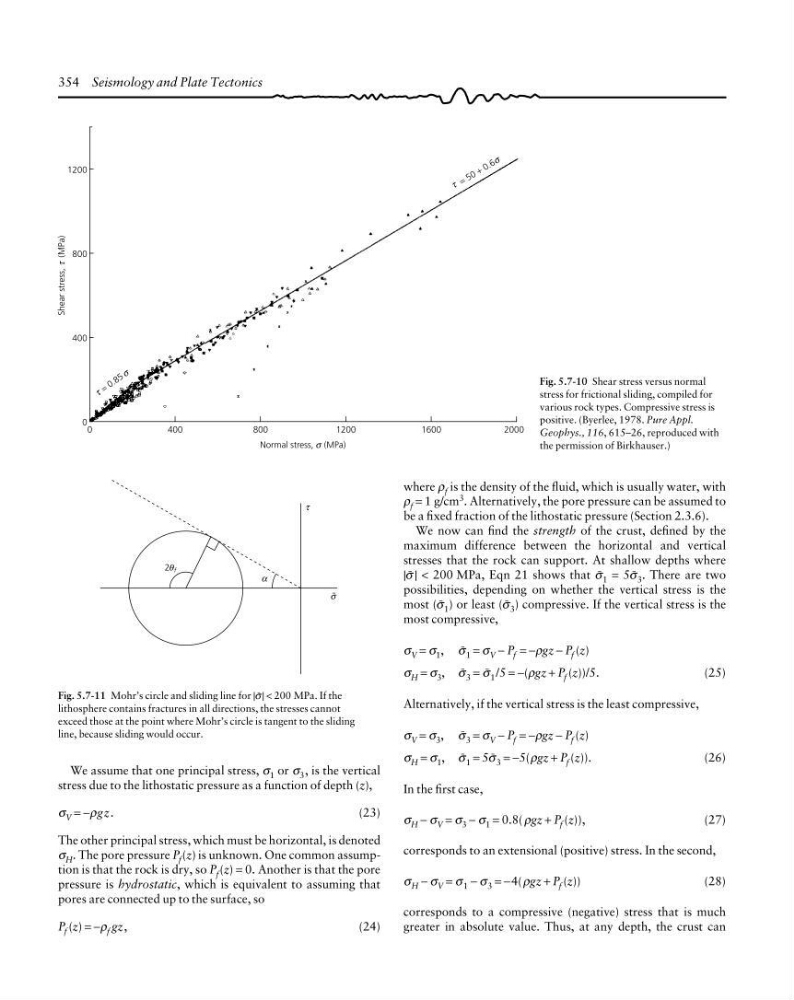
Fig. 5.7-10 Shear stress versus normal
stress for frictional sliding, compiled for
various rock types. Compressive stress is
positive. (Byerlee, 1978. Pure Appl.
Geophys., 116, 615–26, reproduced with
the permission of Birkhauser.)
Fig. 5.7-11 Mohr’s circle and sliding line for |O| < 200 MPa. If the
lithosphere contains fractures in all directions, the stresses cannot
exceed those at the point where Mohr’s circle is tangent to the sliding
line, because sliding would occur.
where ρ f is the density of the fluid, which is usually water, with
ρ f = 1 g/cm 3 . Alternatively, the pore pressure can be assumed to
be a fixed fraction of the lithostatic pressure (Section 2.3.6).
We now can find the strength of the crust, defined by the
maximum difference between the horizontal and vertical
stresses that the rock can support. At shallow depths where
|O | < 200 MPa, Eqn 21 shows that O 1 = 5O 3 . There are two
possibilities, depending on whether the vertical stress is the
most (O 1 ) or least (O 3 ) compressive. If the vertical stress is the
most compressive,
σ V = σ 1 , O 1 = σ V − P f = −ρgz − P f (z)
σ H = σ 3 , O 3 = O 1 /5 = −(ρgz + P f (z))/5.
(25)
Alternatively, if the vertical stress is the least compressive,
σ V = σ 3 , O 3 = σ V − P f = −ρgz − P f (z)
σ H = σ 1 , O 1 = 5O 3 = −5(ρgz + P f (z)).
(26)
In the first case,
σ H − σ V = σ 3 − σ 1 = 0.8( ρgz + P f (z)),
(27)
corresponds to an extensional (positive) stress. In the second,
σ H − σ V = σ 1 − σ 3 = −4(ρgz + P f (z))
(28)
corresponds to a compressive (negative) stress that is much
greater in absolute value. Thus, at any depth, the crust can
Normal stress, σ (MPa)
Shear stress,
τ (MPa)
1200
800
400
0
0
= 0 . 8 5
τ
2000
σ
400
800
1200
1600
= 5 0 + 0 . 6
τ
σ
τ
σ
2 f
θ
α
τ
σ
We assume that one principal stress, σ 1 or σ 3 , is the vertical
stress due to the lithostatic pressure as a function of depth (z),
σ V = −ρgz.
(23)
The other principal stress, which must be horizontal, is denoted
σ H . The pore pressure P f (z) is unknown. One common assumption is that the rock is dry, so P f (z) = 0. Another is that the pore
pressure is hydrostatic, which is equivalent to assuming that
pores are connected up to the surface, so
P f (z) = −ρ f gz,
(24)
Fig. 5.7-10 Shear stress versus normal
stress for frictional sliding, compiled for
various rock types. Compressive stress is
positive. (Byerlee, 1978. Pure Appl.
Geophys., 116, 615–26, reproduced with
the permission of Birkhauser.)
Fig. 5.7-11 Mohr’s circle and sliding line for |O| < 200 MPa. If the
lithosphere contains fractures in all directions, the stresses cannot
exceed those at the point where Mohr’s circle is tangent to the sliding
line, because sliding would occur.
where ρ f is the density of the fluid, which is usually water, with
ρ f = 1 g/cm 3 . Alternatively, the pore pressure can be assumed to
be a fixed fraction of the lithostatic pressure (Section 2.3.6).
We now can find the strength of the crust, defined by the
maximum difference between the horizontal and vertical
stresses that the rock can support. At shallow depths where
|O | < 200 MPa, Eqn 21 shows that O 1 = 5O 3 . There are two
possibilities, depending on whether the vertical stress is the
most (O 1 ) or least (O 3 ) compressive. If the vertical stress is the
most compressive,
σ V = σ 1 , O 1 = σ V − P f = −ρgz − P f (z)
σ H = σ 3 , O 3 = O 1 /5 = −(ρgz + P f (z))/5.
(25)
Alternatively, if the vertical stress is the least compressive,
σ V = σ 3 , O 3 = σ V − P f = −ρgz − P f (z)
σ H = σ 1 , O 1 = 5O 3 = −5(ρgz + P f (z)).
(26)
In the first case,
σ H − σ V = σ 3 − σ 1 = 0.8( ρgz + P f (z)),
(27)
corresponds to an extensional (positive) stress. In the second,
σ H − σ V = σ 1 − σ 3 = −4(ρgz + P f (z))
(28)
corresponds to a compressive (negative) stress that is much
greater in absolute value. Thus, at any depth, the crust can