

Seismicity of the
eastern Canadian
passive margin
1972 mb 4.5
1933 Ms 7.3
1976
Ms
5.8
1963
mb
5.3
1970
m b 4.9
68N
Greenland
Baffin
Bay
Baffin
Island
64N
60N
56N
52W
56W
60W
64W
68W
Labrador
Sea
1969
m b 5.0
72W
76W
Labrador
1971
M s 5.3
52N
Newfoundland
Grand
Banks
1929
M s 7.2
1000 m
3000 m
5.7 Faulting and deformation in the earth 349
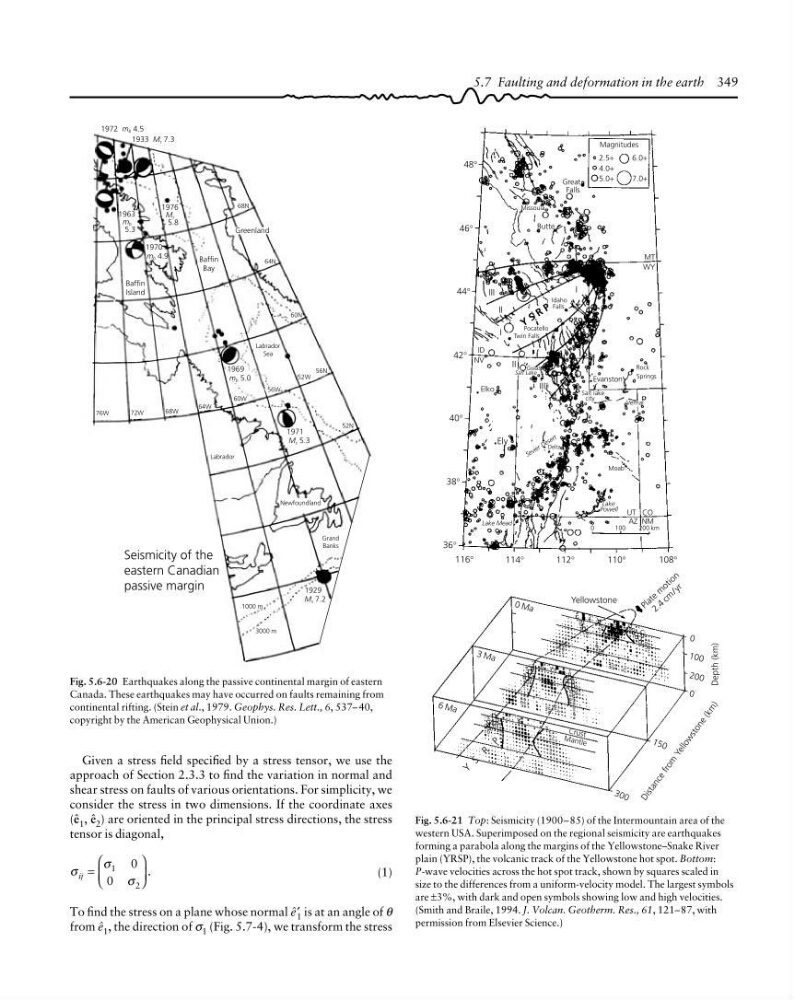
Fig. 5.6-20 Earthquakes along the passive continental margin of eastern
Canada. These earthquakes may have occurred on faults remaining from
continental rifting. (Stein et al., 1979. Geophys. Res. Lett., 6, 537– 40,
copyright by the American Geophysical Union.)
10 0
Depth (km)
P l a t e
m
o t i o n
2 . 4
c m
/ y r
108°
Magnitudes
2.5+
5.0+
4.0+
6.0+
7.0+
Great
Falls
Missoula
Butte
MT
WY
I
II
III
II
I
III
Idaho
Falls
Y
S R P
Pocatello
Twin Falls
42°
ID
NV
Elko
Ely
Lake Mead
Lake
Powell UT CO
AZ NM
Moab
S e v ie r D e s e rt
Delta
Vernal
Salt lake
city
Evanston
Rock
Springs
Great
Salt Lake
0
100
200 km
44°
46°
48°
40°
38°
36°
116°
114°
112°
110°
0 M a
3 M a
6 M a
Y
S
R
P
Cr us t
M an tle
20 0
0
0
1 5 0
3 0 0
D is t a n c e f r o m
Y e ll o w s t o n e ( k m
)
Yellowstone
Fig. 5.6-21 Top: Seismicity (1900–85) of the Intermountain area of the
western USA. Superimposed on the regional seismicity are earthquakes
forming a parabola along the margins of the Yellowstone–Snake River
plain (YRSP), the volcanic track of the Yellowstone hot spot. Bottom:
P-wave velocities across the hot spot track, shown by squares scaled in
size to the differences from a uniform-velocity model. The largest symbols
are ±3%, with dark and open symbols showing low and high velocities.
(Smith and Braile, 1994. J. Volcan. Geotherm. Res., 61, 121–87, with
permission from Elsevier Science.)
Given a stress field specified by a stress tensor, we use the
approach of Section 2.3.3 to find the variation in normal and
shear stress on faults of various orientations. For simplicity, we
consider the stress in two dimensions. If the coordinate axes
(ê 1 , ê 2 ) are oriented in the principal stress directions, the stress
tensor is diagonal,
σ
σ
σ
ij =
⎛
⎝
⎜
⎞
⎠
⎟ .
1
2
0
0
(1)
To find the stress on a plane whose normal ê′ 1 is at an angle of θ
from ê 1 , the direction of σ 1 (Fig. 5.7-4), we transform the stress
eastern Canadian
passive margin
1972 mb 4.5
1933 Ms 7.3
1976
Ms
5.8
1963
mb
5.3
1970
m b 4.9
68N
Greenland
Baffin
Bay
Baffin
Island
64N
60N
56N
52W
56W
60W
64W
68W
Labrador
Sea
1969
m b 5.0
72W
76W
Labrador
1971
M s 5.3
52N
Newfoundland
Grand
Banks
1929
M s 7.2
1000 m
3000 m
5.7 Faulting and deformation in the earth 349
Fig. 5.6-20 Earthquakes along the passive continental margin of eastern
Canada. These earthquakes may have occurred on faults remaining from
continental rifting. (Stein et al., 1979. Geophys. Res. Lett., 6, 537– 40,
copyright by the American Geophysical Union.)
10 0
Depth (km)
P l a t e
m
o t i o n
2 . 4
c m
/ y r
108°
Magnitudes
2.5+
5.0+
4.0+
6.0+
7.0+
Great
Falls
Missoula
Butte
MT
WY
I
II
III
II
I
III
Idaho
Falls
Y
S R P
Pocatello
Twin Falls
42°
ID
NV
Elko
Ely
Lake Mead
Lake
Powell UT CO
AZ NM
Moab
S e v ie r D e s e rt
Delta
Vernal
Salt lake
city
Evanston
Rock
Springs
Great
Salt Lake
0
100
200 km
44°
46°
48°
40°
38°
36°
116°
114°
112°
110°
0 M a
3 M a
6 M a
Y
S
R
P
Cr us t
M an tle
20 0
0
0
1 5 0
3 0 0
D is t a n c e f r o m
Y e ll o w s t o n e ( k m
)
Yellowstone
Fig. 5.6-21 Top: Seismicity (1900–85) of the Intermountain area of the
western USA. Superimposed on the regional seismicity are earthquakes
forming a parabola along the margins of the Yellowstone–Snake River
plain (YRSP), the volcanic track of the Yellowstone hot spot. Bottom:
P-wave velocities across the hot spot track, shown by squares scaled in
size to the differences from a uniform-velocity model. The largest symbols
are ±3%, with dark and open symbols showing low and high velocities.
(Smith and Braile, 1994. J. Volcan. Geotherm. Res., 61, 121–87, with
permission from Elsevier Science.)
Given a stress field specified by a stress tensor, we use the
approach of Section 2.3.3 to find the variation in normal and
shear stress on faults of various orientations. For simplicity, we
consider the stress in two dimensions. If the coordinate axes
(ê 1 , ê 2 ) are oriented in the principal stress directions, the stress
tensor is diagonal,
σ
σ
σ
ij =
⎛
⎝
⎜
⎞
⎠
⎟ .
1
2
0
0
(1)
To find the stress on a plane whose normal ê′ 1 is at an angle of θ
from ê 1 , the direction of σ 1 (Fig. 5.7-4), we transform the stress