

348 Seismology and Plate Tectonics
240°
240°
260°
260°
280°
280°
300°
300°
320°
320°
20°
20°
40°
40°
60°
60°
Focal mechanism
Break-out
Overcoring
Hydro. fracture.
Geol. indicators
NF SS
TF U
QUALITY:
A
B
C
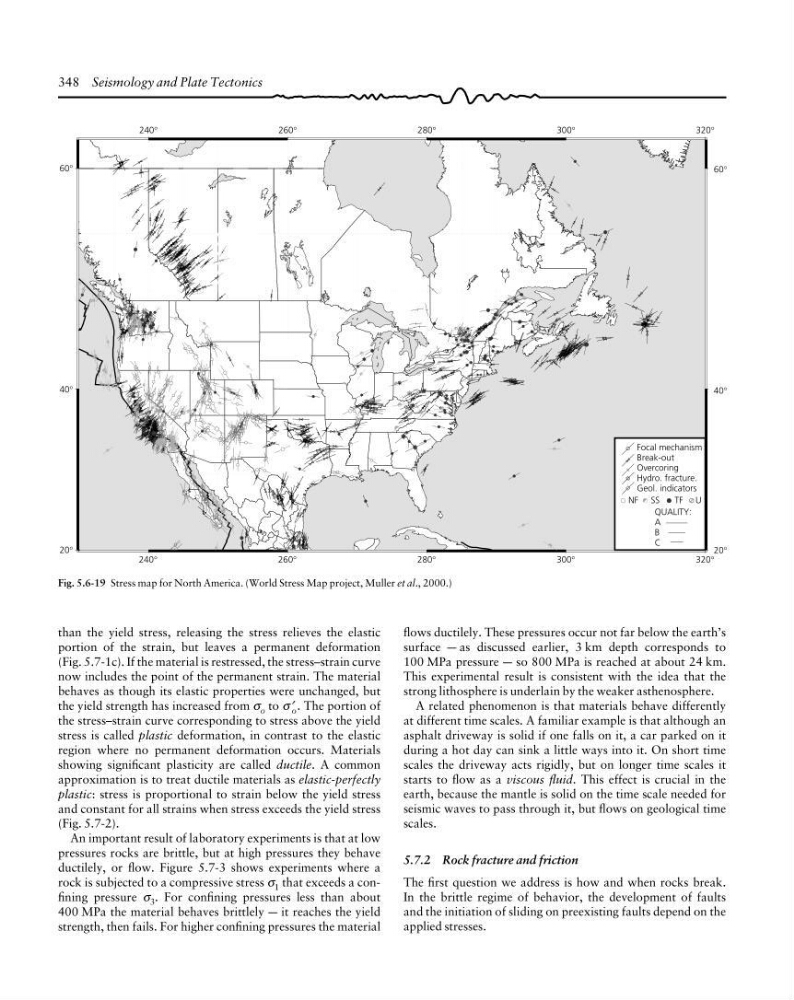
Fig. 5.6-19 Stress map for North America. (World Stress Map project, Muller et al., 2000.)
than the yield stress, releasing the stress relieves the elastic
portion of the strain, but leaves a permanent deformation
(Fig. 5.7-1c). If the material is restressed, the stress–strain curve
now includes the point of the permanent strain. The material
behaves as though its elastic properties were unchanged, but
the yield strength has increased from σ o to σ′ o . The portion of
the stress–strain curve corresponding to stress above the yield
stress is called plastic deformation, in contrast to the elastic
region where no permanent deformation occurs. Materials
showing significant plasticity are called ductile. A common
approximation is to treat ductile materials as elastic-perfectly
plastic: stress is proportional to strain below the yield stress
and constant for all strains when stress exceeds the yield stress
(Fig. 5.7-2).
An important result of laboratory experiments is that at low
pressures rocks are brittle, but at high pressures they behave
ductilely, or flow. Figure 5.7-3 shows experiments where a
rock is subjected to a compressive stress σ 1 that exceeds a confining pressure σ 3 . For confining pressures less than about
400 MPa the material behaves brittlely a it reaches the yield
strength, then fails. For higher confining pressures the material
flows ductilely. These pressures occur not far below the earth’s
surface a as discussed earlier, 3 km depth corresponds to
100 MPa pressure a so 800 MPa is reached at about 24 km.
This experimental result is consistent with the idea that the
strong lithosphere is underlain by the weaker asthenosphere.
A related phenomenon is that materials behave differently
at different time scales. A familiar example is that although an
asphalt driveway is solid if one falls on it, a car parked on it
during a hot day can sink a little ways into it. On short time
scales the driveway acts rigidly, but on longer time scales it
starts to flow as a viscous fluid. This effect is crucial in the
earth, because the mantle is solid on the time scale needed for
seismic waves to pass through it, but flows on geological time
scales.
5.7.2 Rock fracture and friction
The first question we address is how and when rocks break.
In the brittle regime of behavior, the development of faults
and the initiation of sliding on preexisting faults depend on the
applied stresses.
240°
240°
260°
260°
280°
280°
300°
300°
320°
320°
20°
20°
40°
40°
60°
60°
Focal mechanism
Break-out
Overcoring
Hydro. fracture.
Geol. indicators
NF SS
TF U
QUALITY:
A
B
C
Fig. 5.6-19 Stress map for North America. (World Stress Map project, Muller et al., 2000.)
than the yield stress, releasing the stress relieves the elastic
portion of the strain, but leaves a permanent deformation
(Fig. 5.7-1c). If the material is restressed, the stress–strain curve
now includes the point of the permanent strain. The material
behaves as though its elastic properties were unchanged, but
the yield strength has increased from σ o to σ′ o . The portion of
the stress–strain curve corresponding to stress above the yield
stress is called plastic deformation, in contrast to the elastic
region where no permanent deformation occurs. Materials
showing significant plasticity are called ductile. A common
approximation is to treat ductile materials as elastic-perfectly
plastic: stress is proportional to strain below the yield stress
and constant for all strains when stress exceeds the yield stress
(Fig. 5.7-2).
An important result of laboratory experiments is that at low
pressures rocks are brittle, but at high pressures they behave
ductilely, or flow. Figure 5.7-3 shows experiments where a
rock is subjected to a compressive stress σ 1 that exceeds a confining pressure σ 3 . For confining pressures less than about
400 MPa the material behaves brittlely a it reaches the yield
strength, then fails. For higher confining pressures the material
flows ductilely. These pressures occur not far below the earth’s
surface a as discussed earlier, 3 km depth corresponds to
100 MPa pressure a so 800 MPa is reached at about 24 km.
This experimental result is consistent with the idea that the
strong lithosphere is underlain by the weaker asthenosphere.
A related phenomenon is that materials behave differently
at different time scales. A familiar example is that although an
asphalt driveway is solid if one falls on it, a car parked on it
during a hot day can sink a little ways into it. On short time
scales the driveway acts rigidly, but on longer time scales it
starts to flow as a viscous fluid. This effect is crucial in the
earth, because the mantle is solid on the time scale needed for
seismic waves to pass through it, but flows on geological time
scales.
5.7.2 Rock fracture and friction
The first question we address is how and when rocks break.
In the brittle regime of behavior, the development of faults
and the initiation of sliding on preexisting faults depend on the
applied stresses.