

346 Seismology and Plate Tectonics
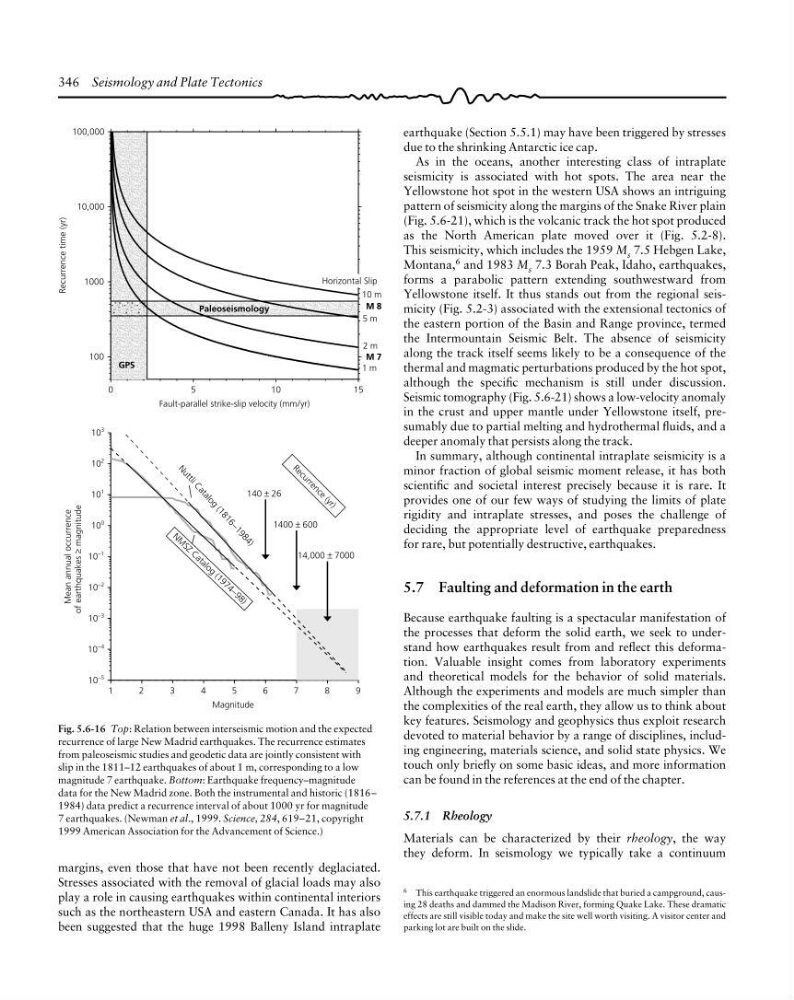
Fig. 5.6-16 Top: Relation between interseismic motion and the expected
recurrence of large New Madrid earthquakes. The recurrence estimates
from paleoseismic studies and geodetic data are jointly consistent with
slip in the 1811–12 earthquakes of about 1 m, corresponding to a low
magnitude 7 earthquake. Bottom: Earthquake frequency–magnitude
data for the New Madrid zone. Both the instrumental and historic (1816–
1984) data predict a recurrence interval of about 1000 yr for magnitude
7 earthquakes. (Newman et al., 1999. Science, 284, 619–21, copyright
1999 American Association for the Advancement of Science.)
margins, even those that have not been recently deglaciated.
Stresses associated with the removal of glacial loads may also
play a role in causing earthquakes within continental interiors
such as the northeastern USA and eastern Canada. It has also
been suggested that the huge 1998 Balleny Island intraplate
earthquake (Section 5.5.1) may have been triggered by stresses
due to the shrinking Antarctic ice cap.
As in the oceans, another interesting class of intraplate
seismicity is associated with hot spots. The area near the
Yellowstone hot spot in the western USA shows an intriguing
pattern of seismicity along the margins of the Snake River plain
(Fig. 5.6-21), which is the volcanic track the hot spot produced
as the North American plate moved over it (Fig. 5.2-8).
This seismicity, which includes the 1959 M s 7.5 Hebgen Lake,
Montana, 6 and 1983 M s 7.3 Borah Peak, Idaho, earthquakes,
forms a parabolic pattern extending southwestward from
Yellowstone itself. It thus stands out from the regional seismicity (Fig. 5.2-3) associated with the extensional tectonics of
the eastern portion of the Basin and Range province, termed
the Intermountain Seismic Belt. The absence of seismicity
along the track itself seems likely to be a consequence of the
thermal and magmatic perturbations produced by the hot spot,
although the specific mechanism is still under discussion.
Seismic tomography (Fig. 5.6-21) shows a low-velocity anomaly
in the crust and upper mantle under Yellowstone itself, presumably due to partial melting and hydrothermal fluids, and a
deeper anomaly that persists along the track.
In summary, although continental intraplate seismicity is a
minor fraction of global seismic moment release, it has both
scientific and societal interest precisely because it is rare. It
provides one of our few ways of studying the limits of plate
rigidity and intraplate stresses, and poses the challenge of
deciding the appropriate level of earthquake preparedness
for rare, but potentially destructive, earthquakes.
5.7 Faulting and deformation in the earth
Because earthquake faulting is a spectacular manifestation of
the processes that deform the solid earth, we seek to understand how earthquakes result from and reflect this deformation. Valuable insight comes from laboratory experiments
and theoretical models for the behavior of solid materials.
Although the experiments and models are much simpler than
the complexities of the real earth, they allow us to think about
key features. Seismology and geophysics thus exploit research
devoted to material behavior by a range of disciplines, including engineering, materials science, and solid state physics. We
touch only briefly on some basic ideas, and more information
can be found in the references at the end of the chapter.
5.7.1 Rheology
Materials can be characterized by their rheology, the way
they deform. In seismology we typically take a continuum
6 This earthquake triggered an enormous landslide that buried a campground, causing 28 deaths and dammed the Madison River, forming Quake Lake. These dramatic
effects are still visible today and make the site well worth visiting. A visitor center and
parking lot are built on the slide.
100
1000
10,000
100,000
0
5
10
15
Paleoseismology
GPS
Fault-parallel strike-slip velocity (mm/yr)
Recurrence time (yr)
10 m
5 m
2 m
1 m
M 8
M 7
Horizontal Slip
10
3
10
2
10
1
10
0
10
−1
10
−2
10
−3
10
−4
10
−5
1
2
3
4
5
6
7
8
9
Magnitude
Mean annual occurrence
of earthquakes
≥ magnitude
N
u
t
t
l
i
C
a
t
a
l
o
g
(
1
8
1
6
−
1
9
8
4
)
N M S Z C a t a l o g ( 1 9 7 4 – 9 8 )
14,000 ± 7000
1400 ± 600
140 ± 26
R
e
c
u
r
r
e
n
c
e
(
y
r
)
Fig. 5.6-16 Top: Relation between interseismic motion and the expected
recurrence of large New Madrid earthquakes. The recurrence estimates
from paleoseismic studies and geodetic data are jointly consistent with
slip in the 1811–12 earthquakes of about 1 m, corresponding to a low
magnitude 7 earthquake. Bottom: Earthquake frequency–magnitude
data for the New Madrid zone. Both the instrumental and historic (1816–
1984) data predict a recurrence interval of about 1000 yr for magnitude
7 earthquakes. (Newman et al., 1999. Science, 284, 619–21, copyright
1999 American Association for the Advancement of Science.)
margins, even those that have not been recently deglaciated.
Stresses associated with the removal of glacial loads may also
play a role in causing earthquakes within continental interiors
such as the northeastern USA and eastern Canada. It has also
been suggested that the huge 1998 Balleny Island intraplate
earthquake (Section 5.5.1) may have been triggered by stresses
due to the shrinking Antarctic ice cap.
As in the oceans, another interesting class of intraplate
seismicity is associated with hot spots. The area near the
Yellowstone hot spot in the western USA shows an intriguing
pattern of seismicity along the margins of the Snake River plain
(Fig. 5.6-21), which is the volcanic track the hot spot produced
as the North American plate moved over it (Fig. 5.2-8).
This seismicity, which includes the 1959 M s 7.5 Hebgen Lake,
Montana, 6 and 1983 M s 7.3 Borah Peak, Idaho, earthquakes,
forms a parabolic pattern extending southwestward from
Yellowstone itself. It thus stands out from the regional seismicity (Fig. 5.2-3) associated with the extensional tectonics of
the eastern portion of the Basin and Range province, termed
the Intermountain Seismic Belt. The absence of seismicity
along the track itself seems likely to be a consequence of the
thermal and magmatic perturbations produced by the hot spot,
although the specific mechanism is still under discussion.
Seismic tomography (Fig. 5.6-21) shows a low-velocity anomaly
in the crust and upper mantle under Yellowstone itself, presumably due to partial melting and hydrothermal fluids, and a
deeper anomaly that persists along the track.
In summary, although continental intraplate seismicity is a
minor fraction of global seismic moment release, it has both
scientific and societal interest precisely because it is rare. It
provides one of our few ways of studying the limits of plate
rigidity and intraplate stresses, and poses the challenge of
deciding the appropriate level of earthquake preparedness
for rare, but potentially destructive, earthquakes.
5.7 Faulting and deformation in the earth
Because earthquake faulting is a spectacular manifestation of
the processes that deform the solid earth, we seek to understand how earthquakes result from and reflect this deformation. Valuable insight comes from laboratory experiments
and theoretical models for the behavior of solid materials.
Although the experiments and models are much simpler than
the complexities of the real earth, they allow us to think about
key features. Seismology and geophysics thus exploit research
devoted to material behavior by a range of disciplines, including engineering, materials science, and solid state physics. We
touch only briefly on some basic ideas, and more information
can be found in the references at the end of the chapter.
5.7.1 Rheology
Materials can be characterized by their rheology, the way
they deform. In seismology we typically take a continuum
6 This earthquake triggered an enormous landslide that buried a campground, causing 28 deaths and dammed the Madison River, forming Quake Lake. These dramatic
effects are still visible today and make the site well worth visiting. A visitor center and
parking lot are built on the slide.
100
1000
10,000
100,000
0
5
10
15
Paleoseismology
GPS
Fault-parallel strike-slip velocity (mm/yr)
Recurrence time (yr)
10 m
5 m
2 m
1 m
M 8
M 7
Horizontal Slip
10
3
10
2
10
1
10
0
10
−1
10
−2
10
−3
10
−4
10
−5
1
2
3
4
5
6
7
8
9
Magnitude
Mean annual occurrence
of earthquakes
≥ magnitude
N
u
t
t
l
i
C
a
t
a
l
o
g
(
1
8
1
6
−
1
9
8
4
)
N M S Z C a t a l o g ( 1 9 7 4 – 9 8 )
14,000 ± 7000
1400 ± 600
140 ± 26
R
e
c
u
r
r
e
n
c
e
(
y
r
)