

5.6 Continental earthquakes and tectonics 345
magnitude 7 earthquakes can occur, as on the eastern coast of
North America (Fig. 5.6-20). Such earthquakes may be associated with stresses, including those due to the removal of glacial
loads, which reactivate faults remaining from the original
continental rifting (Fig. 5.6-1). Although such earthquakes
are observed primarily on previously glaciated margins, they
also occur on nonglaciated passive margins, perhaps due to
sediment loading. In some cases large sediment slides occur,
as was noted for the 1929 M s 7.2 earthquake on the Grand
Banks of Newfoundland, because the slides broke transAtlantic telephone cables and generated a tsunami that caused
230°
240°
250°
260°
270°
280°
290°
300°
310°
20°
30°
40°
50°
60°
70°
ALGO
CHUR
DET1
KELY
MDO1
NLIB
TMGO
YELL
ARP3
BRMU
CHA1
GODE
MIA1
RCM5
STJO
10 mm/yr
North American plate rigidity
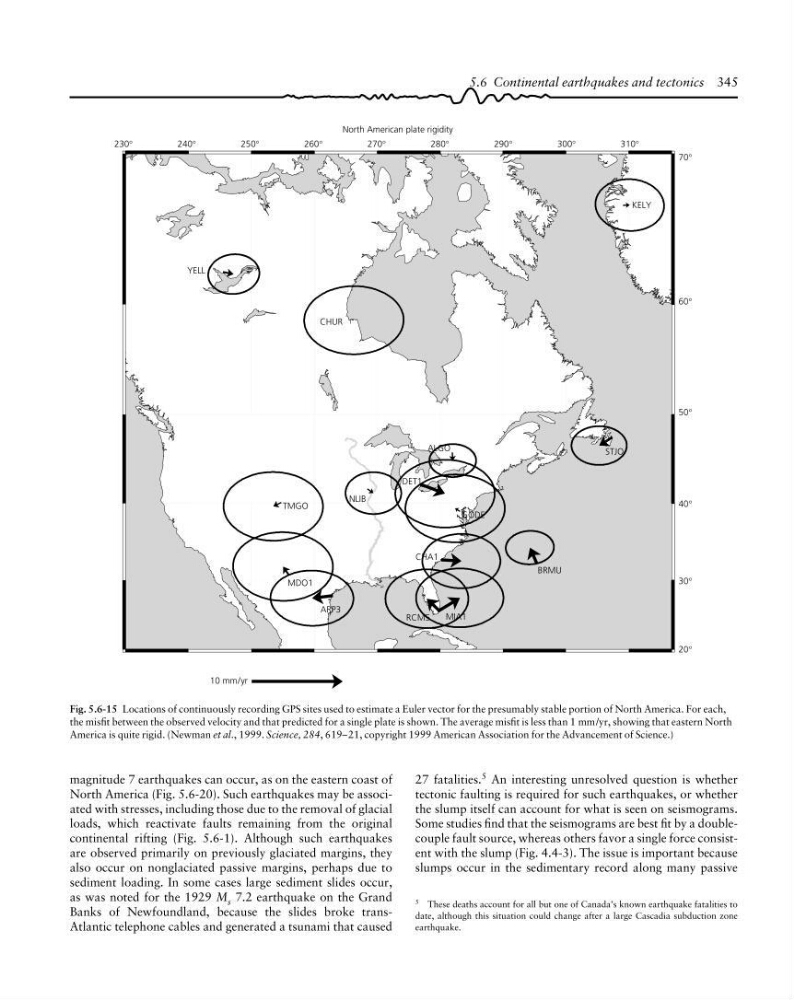
Fig. 5.6-15 Locations of continuously recording GPS sites used to estimate a Euler vector for the presumably stable portion of North America. For each,
the misfit between the observed velocity and that predicted for a single plate is shown. The average misfit is less than 1 mm/yr, showing that eastern North
America is quite rigid. (Newman et al., 1999. Science, 284, 619–21, copyright 1999 American Association for the Advancement of Science.)
27 fatalities. 5 An interesting unresolved question is whether
tectonic faulting is required for such earthquakes, or whether
the slump itself can account for what is seen on seismograms.
Some studies find that the seismograms are best fit by a doublecouple fault source, whereas others favor a single force consistent with the slump (Fig. 4.4-3). The issue is important because
slumps occur in the sedimentary record along many passive
5 These deaths account for all but one of Canada’s known earthquake fatalities to
date, although this situation could change after a large Cascadia subduction zone
earthquake.
magnitude 7 earthquakes can occur, as on the eastern coast of
North America (Fig. 5.6-20). Such earthquakes may be associated with stresses, including those due to the removal of glacial
loads, which reactivate faults remaining from the original
continental rifting (Fig. 5.6-1). Although such earthquakes
are observed primarily on previously glaciated margins, they
also occur on nonglaciated passive margins, perhaps due to
sediment loading. In some cases large sediment slides occur,
as was noted for the 1929 M s 7.2 earthquake on the Grand
Banks of Newfoundland, because the slides broke transAtlantic telephone cables and generated a tsunami that caused
230°
240°
250°
260°
270°
280°
290°
300°
310°
20°
30°
40°
50°
60°
70°
ALGO
CHUR
DET1
KELY
MDO1
NLIB
TMGO
YELL
ARP3
BRMU
CHA1
GODE
MIA1
RCM5
STJO
10 mm/yr
North American plate rigidity
Fig. 5.6-15 Locations of continuously recording GPS sites used to estimate a Euler vector for the presumably stable portion of North America. For each,
the misfit between the observed velocity and that predicted for a single plate is shown. The average misfit is less than 1 mm/yr, showing that eastern North
America is quite rigid. (Newman et al., 1999. Science, 284, 619–21, copyright 1999 American Association for the Advancement of Science.)
27 fatalities. 5 An interesting unresolved question is whether
tectonic faulting is required for such earthquakes, or whether
the slump itself can account for what is seen on seismograms.
Some studies find that the seismograms are best fit by a doublecouple fault source, whereas others favor a single force consistent with the slump (Fig. 4.4-3). The issue is important because
slumps occur in the sedimentary record along many passive
5 These deaths account for all but one of Canada’s known earthquake fatalities to
date, although this situation could change after a large Cascadia subduction zone
earthquake.