

344 Seismology and Plate Tectonics
220°
230°
240°
250°
260°
270°
280°
290°
300°
20°
30°
40°
50°
60°
310°
0
250
500
750
1000
1500
2000
2500
3000
Elevation (m)
Magnitude
5
6
7
NMSZ
46 mm/yr
few mm/yr
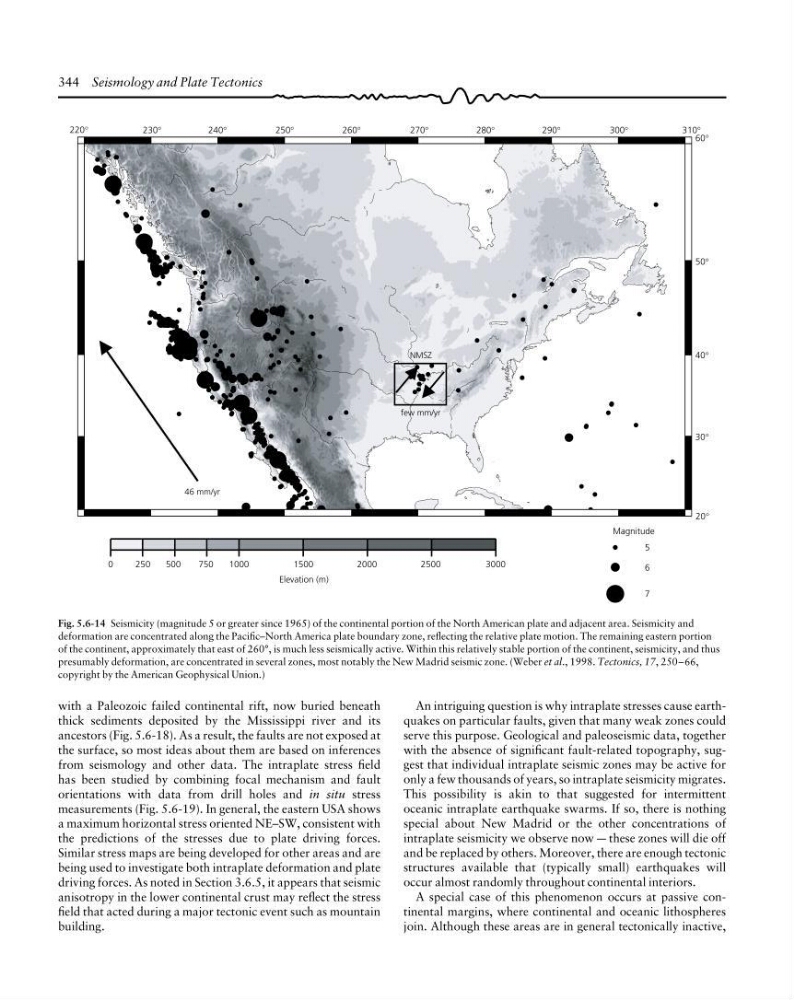
Fig. 5.6-14 Seismicity (magnitude 5 or greater since 1965) of the continental portion of the North American plate and adjacent area. Seismicity and
deformation are concentrated along the Pacific–North America plate boundary zone, reflecting the relative plate motion. The remaining eastern portion
of the continent, approximately that east of 260°, is much less seismically active. Within this relatively stable portion of the continent, seismicity, and thus
presumably deformation, are concentrated in several zones, most notably the New Madrid seismic zone. (Weber et al., 1998. Tectonics, 17, 250–66,
copyright by the American Geophysical Union.)
with a Paleozoic failed continental rift, now buried beneath
thick sediments deposited by the Mississippi river and its
ancestors (Fig. 5.6-18). As a result, the faults are not exposed at
the surface, so most ideas about them are based on inferences
from seismology and other data. The intraplate stress field
has been studied by combining focal mechanism and fault
orientations with data from drill holes and in situ stress
measurements (Fig. 5.6-19). In general, the eastern USA shows
a maximum horizontal stress oriented NE–SW, consistent with
the predictions of the stresses due to plate driving forces.
Similar stress maps are being developed for other areas and are
being used to investigate both intraplate deformation and plate
driving forces. As noted in Section 3.6.5, it appears that seismic
anisotropy in the lower continental crust may reflect the stress
field that acted during a major tectonic event such as mountain
building.
An intriguing question is why intraplate stresses cause earthquakes on particular faults, given that many weak zones could
serve this purpose. Geological and paleoseismic data, together
with the absence of significant fault-related topography, suggest that individual intraplate seismic zones may be active for
only a few thousands of years, so intraplate seismicity migrates.
This possibility is akin to that suggested for intermittent
oceanic intraplate earthquake swarms. If so, there is nothing
special about New Madrid or the other concentrations of
intraplate seismicity we observe now a these zones will die off
and be replaced by others. Moreover, there are enough tectonic
structures available that (typically small) earthquakes will
occur almost randomly throughout continental interiors.
A special case of this phenomenon occurs at passive continental margins, where continental and oceanic lithospheres
join. Although these areas are in general tectonically inactive,
220°
230°
240°
250°
260°
270°
280°
290°
300°
20°
30°
40°
50°
60°
310°
0
250
500
750
1000
1500
2000
2500
3000
Elevation (m)
Magnitude
5
6
7
NMSZ
46 mm/yr
few mm/yr
Fig. 5.6-14 Seismicity (magnitude 5 or greater since 1965) of the continental portion of the North American plate and adjacent area. Seismicity and
deformation are concentrated along the Pacific–North America plate boundary zone, reflecting the relative plate motion. The remaining eastern portion
of the continent, approximately that east of 260°, is much less seismically active. Within this relatively stable portion of the continent, seismicity, and thus
presumably deformation, are concentrated in several zones, most notably the New Madrid seismic zone. (Weber et al., 1998. Tectonics, 17, 250–66,
copyright by the American Geophysical Union.)
with a Paleozoic failed continental rift, now buried beneath
thick sediments deposited by the Mississippi river and its
ancestors (Fig. 5.6-18). As a result, the faults are not exposed at
the surface, so most ideas about them are based on inferences
from seismology and other data. The intraplate stress field
has been studied by combining focal mechanism and fault
orientations with data from drill holes and in situ stress
measurements (Fig. 5.6-19). In general, the eastern USA shows
a maximum horizontal stress oriented NE–SW, consistent with
the predictions of the stresses due to plate driving forces.
Similar stress maps are being developed for other areas and are
being used to investigate both intraplate deformation and plate
driving forces. As noted in Section 3.6.5, it appears that seismic
anisotropy in the lower continental crust may reflect the stress
field that acted during a major tectonic event such as mountain
building.
An intriguing question is why intraplate stresses cause earthquakes on particular faults, given that many weak zones could
serve this purpose. Geological and paleoseismic data, together
with the absence of significant fault-related topography, suggest that individual intraplate seismic zones may be active for
only a few thousands of years, so intraplate seismicity migrates.
This possibility is akin to that suggested for intermittent
oceanic intraplate earthquake swarms. If so, there is nothing
special about New Madrid or the other concentrations of
intraplate seismicity we observe now a these zones will die off
and be replaced by others. Moreover, there are enough tectonic
structures available that (typically small) earthquakes will
occur almost randomly throughout continental interiors.
A special case of this phenomenon occurs at passive continental margins, where continental and oceanic lithospheres
join. Although these areas are in general tectonically inactive,