

50°N
probably 50–100% seismic
,,
15–50%
,,
,, less than 15% ,,
unknown
40°
30°
10°E
2 0 °
30°
40°
50°
60°E
5.6 Continental earthquakes and tectonics 343
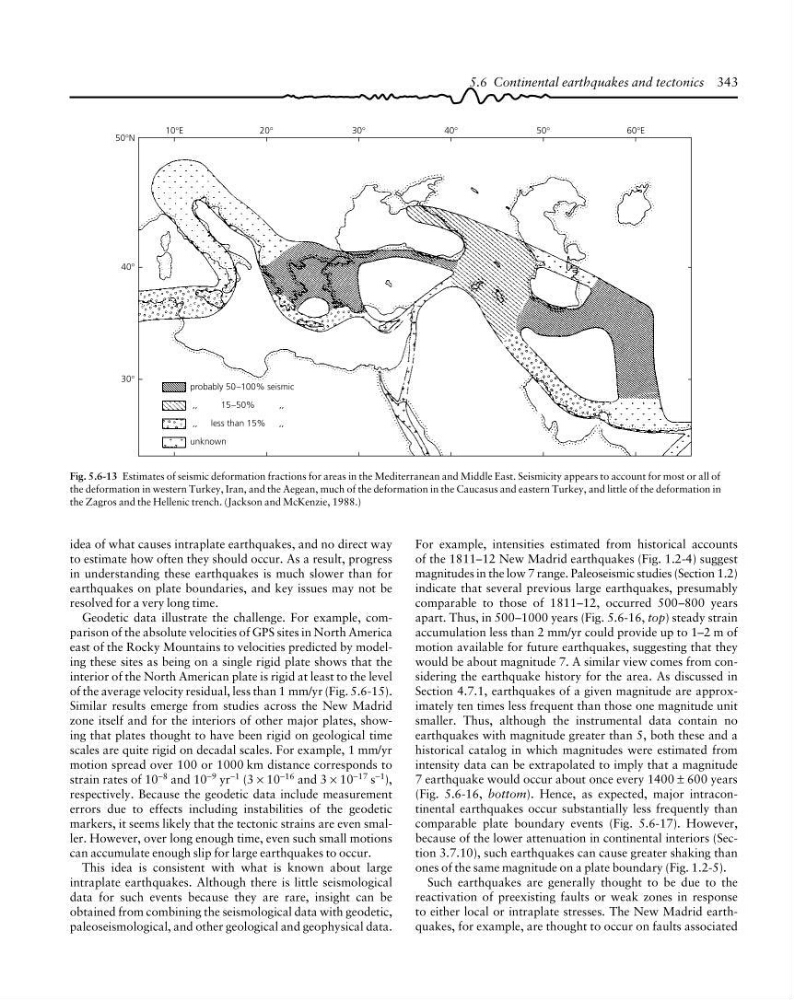
Fig. 5.6-13 Estimates of seismic deformation fractions for areas in the Mediterranean and Middle East. Seismicity appears to account for most or all of
the deformation in western Turkey, Iran, and the Aegean, much of the deformation in the Caucasus and eastern Turkey, and little of the deformation in
the Zagros and the Hellenic trench. (Jackson and McKenzie, 1988.)
idea of what causes intraplate earthquakes, and no direct way
to estimate how often they should occur. As a result, progress
in understanding these earthquakes is much slower than for
earthquakes on plate boundaries, and key issues may not be
resolved for a very long time.
Geodetic data illustrate the challenge. For example, comparison of the absolute velocities of GPS sites in North America
east of the Rocky Mountains to velocities predicted by modeling these sites as being on a single rigid plate shows that the
interior of the North American plate is rigid at least to the level
of the average velocity residual, less than 1 mm/yr (Fig. 5.6-15).
Similar results emerge from studies across the New Madrid
zone itself and for the interiors of other major plates, showing that plates thought to have been rigid on geological time
scales are quite rigid on decadal scales. For example, 1 mm/yr
motion spread over 100 or 1000 km distance corresponds to
strain rates of 10 −8 and 10 −9 yr −1 (3 × 10 −16 and 3 × 10 −17 s −1 ),
respectively. Because the geodetic data include measurement
errors due to effects including instabilities of the geodetic
markers, it seems likely that the tectonic strains are even smaller. However, over long enough time, even such small motions
can accumulate enough slip for large earthquakes to occur.
This idea is consistent with what is known about large
intraplate earthquakes. Although there is little seismological
data for such events because they are rare, insight can be
obtained from combining the seismological data with geodetic,
paleoseismological, and other geological and geophysical data.
For example, intensities estimated from historical accounts
of the 1811–12 New Madrid earthquakes (Fig. 1.2-4) suggest
magnitudes in the low 7 range. Paleoseismic studies (Section 1.2)
indicate that several previous large earthquakes, presumably
comparable to those of 1811–12, occurred 500–800 years
apart. Thus, in 500–1000 years (Fig. 5.6-16, top) steady strain
accumulation less than 2 mm/yr could provide up to 1–2 m of
motion available for future earthquakes, suggesting that they
would be about magnitude 7. A similar view comes from considering the earthquake history for the area. As discussed in
Section 4.7.1, earthquakes of a given magnitude are approximately ten times less frequent than those one magnitude unit
smaller. Thus, although the instrumental data contain no
earthquakes with magnitude greater than 5, both these and a
historical catalog in which magnitudes were estimated from
intensity data can be extrapolated to imply that a magnitude
7 earthquake would occur about once every 1400 ± 600 years
(Fig. 5.6-16, bottom). Hence, as expected, major intracontinental earthquakes occur substantially less frequently than
comparable plate boundary events (Fig. 5.6-17). However,
because of the lower attenuation in continental interiors (Section 3.7.10), such earthquakes can cause greater shaking than
ones of the same magnitude on a plate boundary (Fig. 1.2-5).
Such earthquakes are generally thought to be due to the
reactivation of preexisting faults or weak zones in response
to either local or intraplate stresses. The New Madrid earthquakes, for example, are thought to occur on faults associated
probably 50–100% seismic
,,
15–50%
,,
,, less than 15% ,,
unknown
40°
30°
10°E
2 0 °
30°
40°
50°
60°E
5.6 Continental earthquakes and tectonics 343
Fig. 5.6-13 Estimates of seismic deformation fractions for areas in the Mediterranean and Middle East. Seismicity appears to account for most or all of
the deformation in western Turkey, Iran, and the Aegean, much of the deformation in the Caucasus and eastern Turkey, and little of the deformation in
the Zagros and the Hellenic trench. (Jackson and McKenzie, 1988.)
idea of what causes intraplate earthquakes, and no direct way
to estimate how often they should occur. As a result, progress
in understanding these earthquakes is much slower than for
earthquakes on plate boundaries, and key issues may not be
resolved for a very long time.
Geodetic data illustrate the challenge. For example, comparison of the absolute velocities of GPS sites in North America
east of the Rocky Mountains to velocities predicted by modeling these sites as being on a single rigid plate shows that the
interior of the North American plate is rigid at least to the level
of the average velocity residual, less than 1 mm/yr (Fig. 5.6-15).
Similar results emerge from studies across the New Madrid
zone itself and for the interiors of other major plates, showing that plates thought to have been rigid on geological time
scales are quite rigid on decadal scales. For example, 1 mm/yr
motion spread over 100 or 1000 km distance corresponds to
strain rates of 10 −8 and 10 −9 yr −1 (3 × 10 −16 and 3 × 10 −17 s −1 ),
respectively. Because the geodetic data include measurement
errors due to effects including instabilities of the geodetic
markers, it seems likely that the tectonic strains are even smaller. However, over long enough time, even such small motions
can accumulate enough slip for large earthquakes to occur.
This idea is consistent with what is known about large
intraplate earthquakes. Although there is little seismological
data for such events because they are rare, insight can be
obtained from combining the seismological data with geodetic,
paleoseismological, and other geological and geophysical data.
For example, intensities estimated from historical accounts
of the 1811–12 New Madrid earthquakes (Fig. 1.2-4) suggest
magnitudes in the low 7 range. Paleoseismic studies (Section 1.2)
indicate that several previous large earthquakes, presumably
comparable to those of 1811–12, occurred 500–800 years
apart. Thus, in 500–1000 years (Fig. 5.6-16, top) steady strain
accumulation less than 2 mm/yr could provide up to 1–2 m of
motion available for future earthquakes, suggesting that they
would be about magnitude 7. A similar view comes from considering the earthquake history for the area. As discussed in
Section 4.7.1, earthquakes of a given magnitude are approximately ten times less frequent than those one magnitude unit
smaller. Thus, although the instrumental data contain no
earthquakes with magnitude greater than 5, both these and a
historical catalog in which magnitudes were estimated from
intensity data can be extrapolated to imply that a magnitude
7 earthquake would occur about once every 1400 ± 600 years
(Fig. 5.6-16, bottom). Hence, as expected, major intracontinental earthquakes occur substantially less frequently than
comparable plate boundary events (Fig. 5.6-17). However,
because of the lower attenuation in continental interiors (Section 3.7.10), such earthquakes can cause greater shaking than
ones of the same magnitude on a plate boundary (Fig. 1.2-5).
Such earthquakes are generally thought to be due to the
reactivation of preexisting faults or weak zones in response
to either local or intraplate stresses. The New Madrid earthquakes, for example, are thought to occur on faults associated