

Number of events
8
6
4
2
1−10
11−20
21−40 41−80
> 80
Other oceanic
areas
12
10
8
6
4
2
Number of events
1−10
11−20
21−40 41−80
> 80
Lithospheric age (Ma)
Mechanism
type:
thrust
strike-slip
normal
Central Indian Ocean
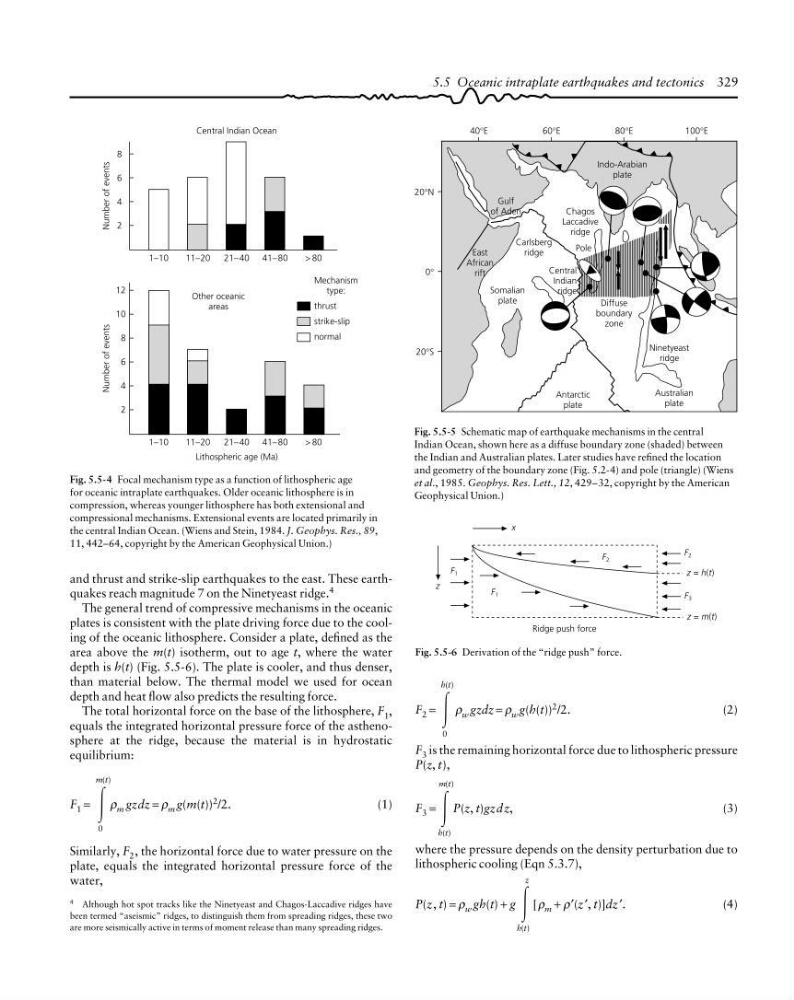
Fig. 5.5-4 Focal mechanism type as a function of lithospheric age
for oceanic intraplate earthquakes. Older oceanic lithosphere is in
compression, whereas younger lithosphere has both extensional and
compressional mechanisms. Extensional events are located primarily in
the central Indian Ocean. (Wiens and Stein, 1984. J. Geophys. Res., 89,
11, 442–64, copyright by the American Geophysical Union.)
F 2 =
Ύ
0
h t
( )
ρ w gzdz = ρ w g(h(t))
2 /2.
(2)
F 3 is the remaining horizontal force due to lithospheric pressure
P(z, t),
F 3 =
Ύ
h t
m t
( )
( )
P(z, t)gzdz,
(3)
where the pressure depends on the density perturbation due to
lithospheric cooling (Eqn 5.3.7),
P(z, t) = ρ w gh(t) + g
Ύ
h t
z
( )
[ρ m + ρ′(z ′, t)]dz ′.
(4)
5.5 Oceanic intraplate earthquakes and tectonics 329
20°N
0°
20°S
40°E
6 0 °E
8 0 °E
100°E
Indo-Arabian
plate
Gulf
of Aden
Chagos
Laccadive
ridge
Pole
Carlsberg
ridge
Somalian
plate
Central
Indian
ridge
Diffuse
boundary
zone
Ninetyeast
ridge
Australian
plate
Antarctic
plate
East
African
rift
Fig. 5.5-5 Schematic map of earthquake mechanisms in the central
Indian Ocean, shown here as a diffuse boundary zone (shaded) between
the Indian and Australian plates. Later studies have refined the location
and geometry of the boundary zone (Fig. 5.2-4) and pole (triangle) (Wiens
et al., 1985. Geophys. Res. Lett., 12, 429–32, copyright by the American
Geophysical Union.)
4 Although hot spot tracks like the Ninetyeast and Chagos-Laccadive ridges have
been termed “aseismic” ridges, to distinguish them from spreading ridges, these two
are more seismically active in terms of moment release than many spreading ridges.
Ridge push force
F 1
F 2
F 1
F 3
F 2
z = m(t)
z = h(t)
z
x
Fig. 5.5-6 Derivation of the “ridge push” force.
and thrust and strike-slip earthquakes to the east. These earthquakes reach magnitude 7 on the Ninetyeast ridge. 4
The general trend of compressive mechanisms in the oceanic
plates is consistent with the plate driving force due to the cooling of the oceanic lithosphere. Consider a plate, defined as the
area above the m(t) isotherm, out to age t, where the water
depth is h(t) (Fig. 5.5-6). The plate is cooler, and thus denser,
than material below. The thermal model we used for ocean
depth and heat flow also predicts the resulting force.
The total horizontal force on the base of the lithosphere, F 1 ,
equals the integrated horizontal pressure force of the asthenosphere at the ridge, because the material is in hydrostatic
equilibrium:
F 1 =
Ύ
0
m t
( )
ρ m gzdz = ρ m g(m(t)) 2 /2.
(1)
Similarly, F 2 , the horizontal force due to water pressure on the
plate, equals the integrated horizontal pressure force of the
water,
8
6
4
2
1−10
11−20
21−40 41−80
> 80
Other oceanic
areas
12
10
8
6
4
2
Number of events
1−10
11−20
21−40 41−80
> 80
Lithospheric age (Ma)
Mechanism
type:
thrust
strike-slip
normal
Central Indian Ocean
Fig. 5.5-4 Focal mechanism type as a function of lithospheric age
for oceanic intraplate earthquakes. Older oceanic lithosphere is in
compression, whereas younger lithosphere has both extensional and
compressional mechanisms. Extensional events are located primarily in
the central Indian Ocean. (Wiens and Stein, 1984. J. Geophys. Res., 89,
11, 442–64, copyright by the American Geophysical Union.)
F 2 =
Ύ
0
h t
( )
ρ w gzdz = ρ w g(h(t))
2 /2.
(2)
F 3 is the remaining horizontal force due to lithospheric pressure
P(z, t),
F 3 =
Ύ
h t
m t
( )
( )
P(z, t)gzdz,
(3)
where the pressure depends on the density perturbation due to
lithospheric cooling (Eqn 5.3.7),
P(z, t) = ρ w gh(t) + g
Ύ
h t
z
( )
[ρ m + ρ′(z ′, t)]dz ′.
(4)
5.5 Oceanic intraplate earthquakes and tectonics 329
20°N
0°
20°S
40°E
6 0 °E
8 0 °E
100°E
Indo-Arabian
plate
Gulf
of Aden
Chagos
Laccadive
ridge
Pole
Carlsberg
ridge
Somalian
plate
Central
Indian
ridge
Diffuse
boundary
zone
Ninetyeast
ridge
Australian
plate
Antarctic
plate
East
African
rift
Fig. 5.5-5 Schematic map of earthquake mechanisms in the central
Indian Ocean, shown here as a diffuse boundary zone (shaded) between
the Indian and Australian plates. Later studies have refined the location
and geometry of the boundary zone (Fig. 5.2-4) and pole (triangle) (Wiens
et al., 1985. Geophys. Res. Lett., 12, 429–32, copyright by the American
Geophysical Union.)
4 Although hot spot tracks like the Ninetyeast and Chagos-Laccadive ridges have
been termed “aseismic” ridges, to distinguish them from spreading ridges, these two
are more seismically active in terms of moment release than many spreading ridges.
Ridge push force
F 1
F 2
F 1
F 3
F 2
z = m(t)
z = h(t)
z
x
Fig. 5.5-6 Derivation of the “ridge push” force.
and thrust and strike-slip earthquakes to the east. These earthquakes reach magnitude 7 on the Ninetyeast ridge. 4
The general trend of compressive mechanisms in the oceanic
plates is consistent with the plate driving force due to the cooling of the oceanic lithosphere. Consider a plate, defined as the
area above the m(t) isotherm, out to age t, where the water
depth is h(t) (Fig. 5.5-6). The plate is cooler, and thus denser,
than material below. The thermal model we used for ocean
depth and heat flow also predicts the resulting force.
The total horizontal force on the base of the lithosphere, F 1 ,
equals the integrated horizontal pressure force of the asthenosphere at the ridge, because the material is in hydrostatic
equilibrium:
F 1 =
Ύ
0
m t
( )
ρ m gzdz = ρ m g(m(t)) 2 /2.
(1)
Similarly, F 2 , the horizontal force due to water pressure on the
plate, equals the integrated horizontal pressure force of the
water,