

Transition zone
Upper
mantle
peridotite
Lower
mantle
minerals
Olivine
+
orthopyroxene
+
clinopyroxene
+
garnet
P = 13.3 GPa
P = 23.8 GPa
400 km
670 km
Heat
Reaction box
Deep
earthquakes
Magnesiowustite
+
perovskites
schematic model in which the earthquakes are presumed to
occur in subducting oceanic crust, rather than throughout the
subducting mantle that makes up most of the slabs, because
detailed location studies show that the earthquakes are close to
the top of the subducting slabs. The crust should undergo two
important mineralogical transitions as it subducts. Hydrous
(water-bearing) minerals formed at fractures and faults should
warm up and dehydrate. Eventually, the gabbro transforms to
eclogite, a rock of the same chemical composition composed
of denser minerals. 4 Under equilibrium conditions, eclogite
should form by the time slab material reaches about 70 km
depth. However, travel time studies in some slabs find a lowvelocity waveguide interpreted as subducting crust extending
to deeper depths. Hence it has been suggested that the eclogiteforming reaction is slowed in cold downgoing slabs, allowing
gabbro to persist metastably. Once dehydration occurs, the
freed water weakens the faults, favoring earthquakes and
promoting the eclogite-forming reactions. In this model the
intermediate earthquakes occur by slip on faults, but the phase
changes favor faulting. The extensional focal mechanisms may
also reflect the phase change, which would produce extension
in the subducting crust. Support for this model comes from the
fact that the intermediate earthquakes occur below the island
arc volcanoes, which are thought to result when water released
from the subducting slab causes partial melting in the overlying
asthenosphere.
The fact that various explanations are under discussion illustrates the difficulty in understanding the complex thermal
structure, mineralogy, rheology, and geometry of real slabs.
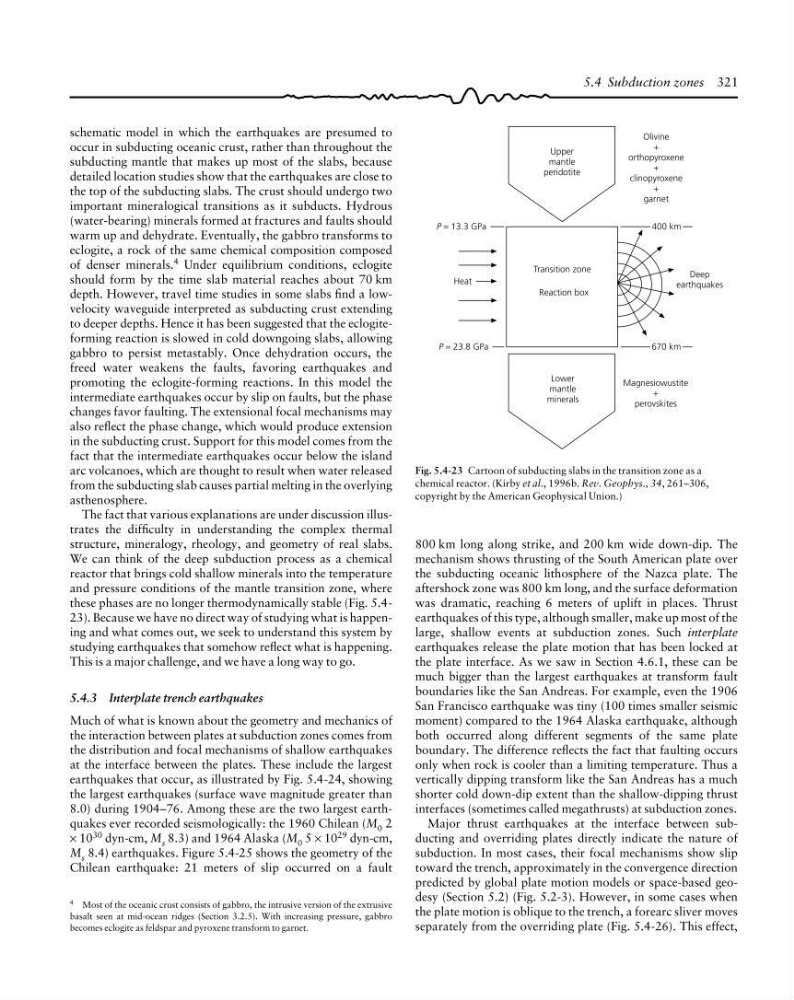
We can think of the deep subduction process as a chemical
reactor that brings cold shallow minerals into the temperature
and pressure conditions of the mantle transition zone, where
these phases are no longer thermodynamically stable (Fig. 5.423). Because we have no direct way of studying what is happening and what comes out, we seek to understand this system by
studying earthquakes that somehow reflect what is happening.
This is a major challenge, and we have a long way to go.
5.4.3 Interplate trench earthquakes
Much of what is known about the geometry and mechanics of
the interaction between plates at subduction zones comes from
the distribution and focal mechanisms of shallow earthquakes
at the interface between the plates. These include the largest
earthquakes that occur, as illustrated by Fig. 5.4-24, showing
the largest earthquakes (surface wave magnitude greater than
8.0) during 1904–76. Among these are the two largest earthquakes ever recorded seismologically: the 1960 Chilean (M 0 2
× 10 30 dyn-cm, M s 8.3) and 1964 Alaska (M 0 5 × 10 29 dyn-cm,
M s 8.4) earthquakes. Figure 5.4-25 shows the geometry of the
Chilean earthquake: 21 meters of slip occurred on a fault
4 Most of the oceanic crust consists of gabbro, the intrusive version of the extrusive
basalt seen at mid-ocean ridges (Section 3.2.5). With increasing pressure, gabbro
becomes eclogite as feldspar and pyroxene transform to garnet.
5.4 Subduction zones 321
Fig. 5.4-23 Cartoon of subducting slabs in the transition zone as a
chemical reactor. (Kirby et al., 1996b. Rev. Geophys., 34, 261–306,
copyright by the American Geophysical Union.)
800 km long along strike, and 200 km wide down-dip. The
mechanism shows thrusting of the South American plate over
the subducting oceanic lithosphere of the Nazca plate. The
aftershock zone was 800 km long, and the surface deformation
was dramatic, reaching 6 meters of uplift in places. Thrust
earthquakes of this type, although smaller, make up most of the
large, shallow events at subduction zones. Such interplate
earthquakes release the plate motion that has been locked at
the plate interface. As we saw in Section 4.6.1, these can be
much bigger than the largest earthquakes at transform fault
boundaries like the San Andreas. For example, even the 1906
San Francisco earthquake was tiny (100 times smaller seismic
moment) compared to the 1964 Alaska earthquake, although
both occurred along different segments of the same plate
boundary. The difference reflects the fact that faulting occurs
only when rock is cooler than a limiting temperature. Thus a
vertically dipping transform like the San Andreas has a much
shorter cold down-dip extent than the shallow-dipping thrust
interfaces (sometimes called megathrusts) at subduction zones.
Major thrust earthquakes at the interface between subducting and overriding plates directly indicate the nature of
subduction. In most cases, their focal mechanisms show slip
toward the trench, approximately in the convergence direction
predicted by global plate motion models or space-based geodesy (Section 5.2) (Fig. 5.2-3). However, in some cases when
the plate motion is oblique to the trench, a forearc sliver moves
separately from the overriding plate (Fig. 5.4-26). This effect,
Upper
mantle
peridotite
Lower
mantle
minerals
Olivine
+
orthopyroxene
+
clinopyroxene
+
garnet
P = 13.3 GPa
P = 23.8 GPa
400 km
670 km
Heat
Reaction box
Deep
earthquakes
Magnesiowustite
+
perovskites
schematic model in which the earthquakes are presumed to
occur in subducting oceanic crust, rather than throughout the
subducting mantle that makes up most of the slabs, because
detailed location studies show that the earthquakes are close to
the top of the subducting slabs. The crust should undergo two
important mineralogical transitions as it subducts. Hydrous
(water-bearing) minerals formed at fractures and faults should
warm up and dehydrate. Eventually, the gabbro transforms to
eclogite, a rock of the same chemical composition composed
of denser minerals. 4 Under equilibrium conditions, eclogite
should form by the time slab material reaches about 70 km
depth. However, travel time studies in some slabs find a lowvelocity waveguide interpreted as subducting crust extending
to deeper depths. Hence it has been suggested that the eclogiteforming reaction is slowed in cold downgoing slabs, allowing
gabbro to persist metastably. Once dehydration occurs, the
freed water weakens the faults, favoring earthquakes and
promoting the eclogite-forming reactions. In this model the
intermediate earthquakes occur by slip on faults, but the phase
changes favor faulting. The extensional focal mechanisms may
also reflect the phase change, which would produce extension
in the subducting crust. Support for this model comes from the
fact that the intermediate earthquakes occur below the island
arc volcanoes, which are thought to result when water released
from the subducting slab causes partial melting in the overlying
asthenosphere.
The fact that various explanations are under discussion illustrates the difficulty in understanding the complex thermal
structure, mineralogy, rheology, and geometry of real slabs.
We can think of the deep subduction process as a chemical
reactor that brings cold shallow minerals into the temperature
and pressure conditions of the mantle transition zone, where
these phases are no longer thermodynamically stable (Fig. 5.423). Because we have no direct way of studying what is happening and what comes out, we seek to understand this system by
studying earthquakes that somehow reflect what is happening.
This is a major challenge, and we have a long way to go.
5.4.3 Interplate trench earthquakes
Much of what is known about the geometry and mechanics of
the interaction between plates at subduction zones comes from
the distribution and focal mechanisms of shallow earthquakes
at the interface between the plates. These include the largest
earthquakes that occur, as illustrated by Fig. 5.4-24, showing
the largest earthquakes (surface wave magnitude greater than
8.0) during 1904–76. Among these are the two largest earthquakes ever recorded seismologically: the 1960 Chilean (M 0 2
× 10 30 dyn-cm, M s 8.3) and 1964 Alaska (M 0 5 × 10 29 dyn-cm,
M s 8.4) earthquakes. Figure 5.4-25 shows the geometry of the
Chilean earthquake: 21 meters of slip occurred on a fault
4 Most of the oceanic crust consists of gabbro, the intrusive version of the extrusive
basalt seen at mid-ocean ridges (Section 3.2.5). With increasing pressure, gabbro
becomes eclogite as feldspar and pyroxene transform to garnet.
5.4 Subduction zones 321
Fig. 5.4-23 Cartoon of subducting slabs in the transition zone as a
chemical reactor. (Kirby et al., 1996b. Rev. Geophys., 34, 261–306,
copyright by the American Geophysical Union.)
800 km long along strike, and 200 km wide down-dip. The
mechanism shows thrusting of the South American plate over
the subducting oceanic lithosphere of the Nazca plate. The
aftershock zone was 800 km long, and the surface deformation
was dramatic, reaching 6 meters of uplift in places. Thrust
earthquakes of this type, although smaller, make up most of the
large, shallow events at subduction zones. Such interplate
earthquakes release the plate motion that has been locked at
the plate interface. As we saw in Section 4.6.1, these can be
much bigger than the largest earthquakes at transform fault
boundaries like the San Andreas. For example, even the 1906
San Francisco earthquake was tiny (100 times smaller seismic
moment) compared to the 1964 Alaska earthquake, although
both occurred along different segments of the same plate
boundary. The difference reflects the fact that faulting occurs
only when rock is cooler than a limiting temperature. Thus a
vertically dipping transform like the San Andreas has a much
shorter cold down-dip extent than the shallow-dipping thrust
interfaces (sometimes called megathrusts) at subduction zones.
Major thrust earthquakes at the interface between subducting and overriding plates directly indicate the nature of
subduction. In most cases, their focal mechanisms show slip
toward the trench, approximately in the convergence direction
predicted by global plate motion models or space-based geodesy (Section 5.2) (Fig. 5.2-3). However, in some cases when
the plate motion is oblique to the trench, a forearc sliver moves
separately from the overriding plate (Fig. 5.4-26). This effect,