

Depth (km)
100
200
300
400
500
600
700
10
20
30
40
50
60
Latitude (°N)
Marianas
7 Mar. 62
30 May 55
Izu-Bonin
NE Japan
29 Sept. 73
Kuril-Kamchatka
30 Aug. 70
Trench cusps
Fig. 5.4-19 Seismicity cross-section for the Fiji subduction zone, showing
“outlier” deep earthquakes. Lines through symbols show P axes, which
often differ from those for the main Wadati–Benioff zone. (Lundgren
and Giardini, 1994. J. Geophys. Res., 99, 15, 833– 42, copyright by the
American Geophysical Union.)
0
700
Fiji
5.4 Subduction zones 319
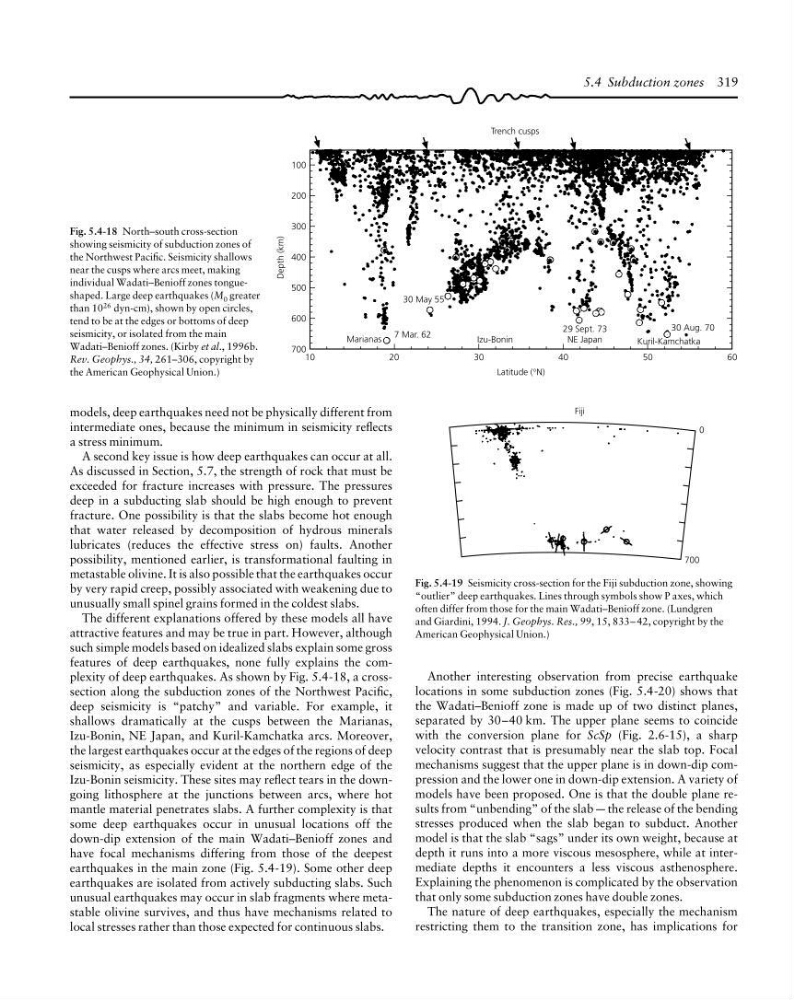
Fig. 5.4-18 North–south cross-section
showing seismicity of subduction zones of
the Northwest Pacific. Seismicity shallows
near the cusps where arcs meet, making
individual Wadati–Benioff zones tongueshaped. Large deep earthquakes (M 0 greater
than 10
26 dyn-cm), shown by open circles,
tend to be at the edges or bottoms of deep
seismicity, or isolated from the main
Wadati–Benioff zones. (Kirby et al., 1996b.
Rev. Geophys., 34, 261–306, copyright by
the American Geophysical Union.)
models, deep earthquakes need not be physically different from
intermediate ones, because the minimum in seismicity reflects
a stress minimum.
A second key issue is how deep earthquakes can occur at all.
As discussed in Section, 5.7, the strength of rock that must be
exceeded for fracture increases with pressure. The pressures
deep in a subducting slab should be high enough to prevent
fracture. One possibility is that the slabs become hot enough
that water released by decomposition of hydrous minerals
lubricates (reduces the effective stress on) faults. Another
possibility, mentioned earlier, is transformational faulting in
metastable olivine. It is also possible that the earthquakes occur
by very rapid creep, possibly associated with weakening due to
unusually small spinel grains formed in the coldest slabs.
The different explanations offered by these models all have
attractive features and may be true in part. However, although
such simple models based on idealized slabs explain some gross
features of deep earthquakes, none fully explains the complexity of deep earthquakes. As shown by Fig. 5.4-18, a crosssection along the subduction zones of the Northwest Pacific,
deep seismicity is “patchy” and variable. For example, it
shallows dramatically at the cusps between the Marianas,
Izu-Bonin, NE Japan, and Kuril-Kamchatka arcs. Moreover,
the largest earthquakes occur at the edges of the regions of deep
seismicity, as especially evident at the northern edge of the
Izu-Bonin seismicity. These sites may reflect tears in the downgoing lithosphere at the junctions between arcs, where hot
mantle material penetrates slabs. A further complexity is that
some deep earthquakes occur in unusual locations off the
down-dip extension of the main Wadati–Benioff zones and
have focal mechanisms differing from those of the deepest
earthquakes in the main zone (Fig. 5.4-19). Some other deep
earthquakes are isolated from actively subducting slabs. Such
unusual earthquakes may occur in slab fragments where metastable olivine survives, and thus have mechanisms related to
local stresses rather than those expected for continuous slabs.
Another interesting observation from precise earthquake
locations in some subduction zones (Fig. 5.4-20) shows that
the Wadati–Benioff zone is made up of two distinct planes,
separated by 30–40 km. The upper plane seems to coincide
with the conversion plane for ScSp (Fig. 2.6-15), a sharp
velocity contrast that is presumably near the slab top. Focal
mechanisms suggest that the upper plane is in down-dip compression and the lower one in down-dip extension. A variety of
models have been proposed. One is that the double plane results from “unbending” of the slab a the release of the bending
stresses produced when the slab began to subduct. Another
model is that the slab “sags” under its own weight, because at
depth it runs into a more viscous mesosphere, while at intermediate depths it encounters a less viscous asthenosphere.
Explaining the phenomenon is complicated by the observation
that only some subduction zones have double zones.
The nature of deep earthquakes, especially the mechanism
restricting them to the transition zone, has implications for
100
200
300
400
500
600
700
10
20
30
40
50
60
Latitude (°N)
Marianas
7 Mar. 62
30 May 55
Izu-Bonin
NE Japan
29 Sept. 73
Kuril-Kamchatka
30 Aug. 70
Trench cusps
Fig. 5.4-19 Seismicity cross-section for the Fiji subduction zone, showing
“outlier” deep earthquakes. Lines through symbols show P axes, which
often differ from those for the main Wadati–Benioff zone. (Lundgren
and Giardini, 1994. J. Geophys. Res., 99, 15, 833– 42, copyright by the
American Geophysical Union.)
0
700
Fiji
5.4 Subduction zones 319
Fig. 5.4-18 North–south cross-section
showing seismicity of subduction zones of
the Northwest Pacific. Seismicity shallows
near the cusps where arcs meet, making
individual Wadati–Benioff zones tongueshaped. Large deep earthquakes (M 0 greater
than 10
26 dyn-cm), shown by open circles,
tend to be at the edges or bottoms of deep
seismicity, or isolated from the main
Wadati–Benioff zones. (Kirby et al., 1996b.
Rev. Geophys., 34, 261–306, copyright by
the American Geophysical Union.)
models, deep earthquakes need not be physically different from
intermediate ones, because the minimum in seismicity reflects
a stress minimum.
A second key issue is how deep earthquakes can occur at all.
As discussed in Section, 5.7, the strength of rock that must be
exceeded for fracture increases with pressure. The pressures
deep in a subducting slab should be high enough to prevent
fracture. One possibility is that the slabs become hot enough
that water released by decomposition of hydrous minerals
lubricates (reduces the effective stress on) faults. Another
possibility, mentioned earlier, is transformational faulting in
metastable olivine. It is also possible that the earthquakes occur
by very rapid creep, possibly associated with weakening due to
unusually small spinel grains formed in the coldest slabs.
The different explanations offered by these models all have
attractive features and may be true in part. However, although
such simple models based on idealized slabs explain some gross
features of deep earthquakes, none fully explains the complexity of deep earthquakes. As shown by Fig. 5.4-18, a crosssection along the subduction zones of the Northwest Pacific,
deep seismicity is “patchy” and variable. For example, it
shallows dramatically at the cusps between the Marianas,
Izu-Bonin, NE Japan, and Kuril-Kamchatka arcs. Moreover,
the largest earthquakes occur at the edges of the regions of deep
seismicity, as especially evident at the northern edge of the
Izu-Bonin seismicity. These sites may reflect tears in the downgoing lithosphere at the junctions between arcs, where hot
mantle material penetrates slabs. A further complexity is that
some deep earthquakes occur in unusual locations off the
down-dip extension of the main Wadati–Benioff zones and
have focal mechanisms differing from those of the deepest
earthquakes in the main zone (Fig. 5.4-19). Some other deep
earthquakes are isolated from actively subducting slabs. Such
unusual earthquakes may occur in slab fragments where metastable olivine survives, and thus have mechanisms related to
local stresses rather than those expected for continuous slabs.
Another interesting observation from precise earthquake
locations in some subduction zones (Fig. 5.4-20) shows that
the Wadati–Benioff zone is made up of two distinct planes,
separated by 30–40 km. The upper plane seems to coincide
with the conversion plane for ScSp (Fig. 2.6-15), a sharp
velocity contrast that is presumably near the slab top. Focal
mechanisms suggest that the upper plane is in down-dip compression and the lower one in down-dip extension. A variety of
models have been proposed. One is that the double plane results from “unbending” of the slab a the release of the bending
stresses produced when the slab began to subduct. Another
model is that the slab “sags” under its own weight, because at
depth it runs into a more viscous mesosphere, while at intermediate depths it encounters a less viscous asthenosphere.
Explaining the phenomenon is complicated by the observation
that only some subduction zones have double zones.
The nature of deep earthquakes, especially the mechanism
restricting them to the transition zone, has implications for