

x
y
670 km
670 km
Lithosphere
∆ρ 60°
Upper mantle
Lower mantle
800
700
600
500
400
300
200
100
0
Stress magnitude (bars)
0 100 200 300 400 500 600 700
Depth (km)
A
B
C
A + B = shallow slab
C = long slab
A
B
1 kbar
Down-dip
compression
Down-dip
tension
670 km
5 cm/yr
A
B
η = 10
η = 1
η = 25
η = 10
η = 1
η = 1
h
= 670 km
x
y
5.4 Subduction zones 317
Fig. 5.4-15 Diagram showing the early
stages of a phase transformation. Grains of
the new phase (shaded) nucleate on grain
boundaries and grow by consuming the
original phase until none remains. (Kirby
et al., 1996b. Rev. Geophys., 34, 261–306,
copyright by the American Geophysical
Union.)
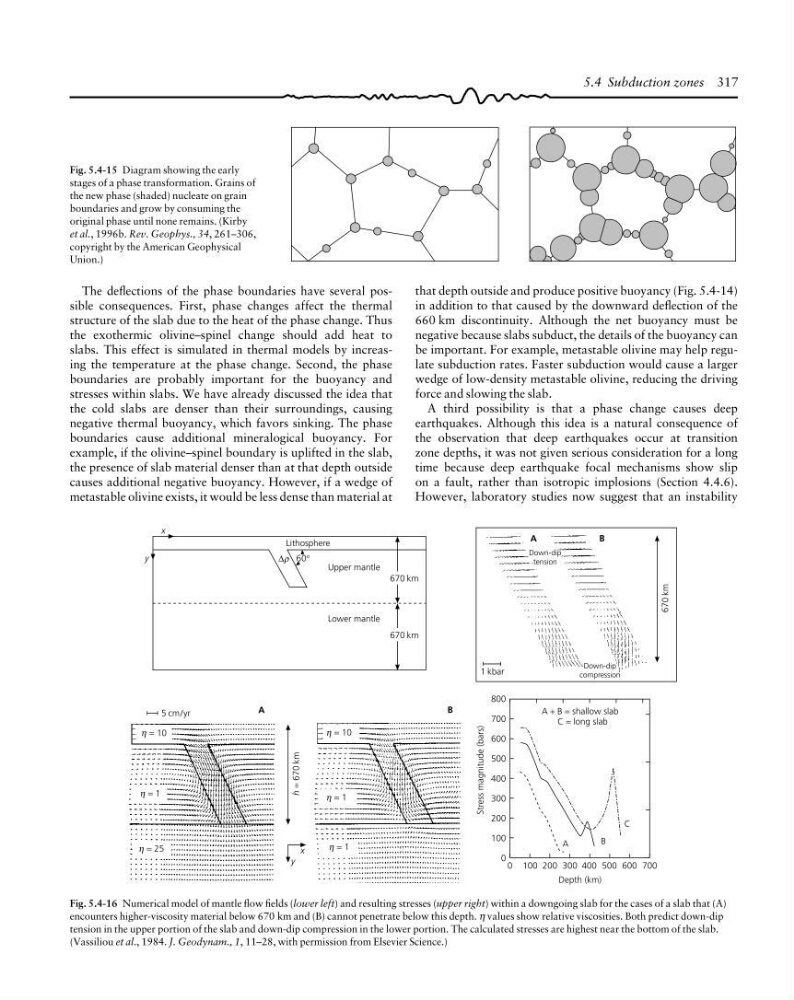
Fig. 5.4-16 Numerical model of mantle flow fields (lower left) and resulting stresses (upper right) within a downgoing slab for the cases of a slab that (A)
encounters higher-viscosity material below 670 km and (B) cannot penetrate below this depth. η values show relative viscosities. Both predict down-dip
tension in the upper portion of the slab and down-dip compression in the lower portion. The calculated stresses are highest near the bottom of the slab.
(Vassiliou et al., 1984. J. Geodynam., 1, 11–28, with permission from Elsevier Science.)
The deflections of the phase boundaries have several possible consequences. First, phase changes affect the thermal
structure of the slab due to the heat of the phase change. Thus
the exothermic olivine–spinel change should add heat to
slabs. This effect is simulated in thermal models by increasing the temperature at the phase change. Second, the phase
boundaries are probably important for the buoyancy and
stresses within slabs. We have already discussed the idea that
the cold slabs are denser than their surroundings, causing
negative thermal buoyancy, which favors sinking. The phase
boundaries cause additional mineralogical buoyancy. For
example, if the olivine–spinel boundary is uplifted in the slab,
the presence of slab material denser than at that depth outside
causes additional negative buoyancy. However, if a wedge of
metastable olivine exists, it would be less dense than material at
that depth outside and produce positive buoyancy (Fig. 5.4-14)
in addition to that caused by the downward deflection of the
660 km discontinuity. Although the net buoyancy must be
negative because slabs subduct, the details of the buoyancy can
be important. For example, metastable olivine may help regulate subduction rates. Faster subduction would cause a larger
wedge of low-density metastable olivine, reducing the driving
force and slowing the slab.
A third possibility is that a phase change causes deep
earthquakes. Although this idea is a natural consequence of
the observation that deep earthquakes occur at transition
zone depths, it was not given serious consideration for a long
time because deep earthquake focal mechanisms show slip
on a fault, rather than isotropic implosions (Section 4.4.6).
However, laboratory studies now suggest that an instability
y
670 km
670 km
Lithosphere
∆ρ 60°
Upper mantle
Lower mantle
800
700
600
500
400
300
200
100
0
Stress magnitude (bars)
0 100 200 300 400 500 600 700
Depth (km)
A
B
C
A + B = shallow slab
C = long slab
A
B
1 kbar
Down-dip
compression
Down-dip
tension
670 km
5 cm/yr
A
B
η = 10
η = 1
η = 25
η = 10
η = 1
η = 1
h
= 670 km
x
y
5.4 Subduction zones 317
Fig. 5.4-15 Diagram showing the early
stages of a phase transformation. Grains of
the new phase (shaded) nucleate on grain
boundaries and grow by consuming the
original phase until none remains. (Kirby
et al., 1996b. Rev. Geophys., 34, 261–306,
copyright by the American Geophysical
Union.)
Fig. 5.4-16 Numerical model of mantle flow fields (lower left) and resulting stresses (upper right) within a downgoing slab for the cases of a slab that (A)
encounters higher-viscosity material below 670 km and (B) cannot penetrate below this depth. η values show relative viscosities. Both predict down-dip
tension in the upper portion of the slab and down-dip compression in the lower portion. The calculated stresses are highest near the bottom of the slab.
(Vassiliou et al., 1984. J. Geodynam., 1, 11–28, with permission from Elsevier Science.)
The deflections of the phase boundaries have several possible consequences. First, phase changes affect the thermal
structure of the slab due to the heat of the phase change. Thus
the exothermic olivine–spinel change should add heat to
slabs. This effect is simulated in thermal models by increasing the temperature at the phase change. Second, the phase
boundaries are probably important for the buoyancy and
stresses within slabs. We have already discussed the idea that
the cold slabs are denser than their surroundings, causing
negative thermal buoyancy, which favors sinking. The phase
boundaries cause additional mineralogical buoyancy. For
example, if the olivine–spinel boundary is uplifted in the slab,
the presence of slab material denser than at that depth outside
causes additional negative buoyancy. However, if a wedge of
metastable olivine exists, it would be less dense than material at
that depth outside and produce positive buoyancy (Fig. 5.4-14)
in addition to that caused by the downward deflection of the
660 km discontinuity. Although the net buoyancy must be
negative because slabs subduct, the details of the buoyancy can
be important. For example, metastable olivine may help regulate subduction rates. Faster subduction would cause a larger
wedge of low-density metastable olivine, reducing the driving
force and slowing the slab.
A third possibility is that a phase change causes deep
earthquakes. Although this idea is a natural consequence of
the observation that deep earthquakes occur at transition
zone depths, it was not given serious consideration for a long
time because deep earthquake focal mechanisms show slip
on a fault, rather than isotropic implosions (Section 4.4.6).
However, laboratory studies now suggest that an instability