

18 Introduction
the swing, whereas pushing repeatedly at its resonant period
gives the person on it a good ride. Through this mechanism,
an earthquake can destroy certain buildings and not others.
Similarly, a building might collapse after a magnitude 7 earthquake, but remain standing after a magnitude 8 event with
peak energy at a lower frequency. Sometimes damage occurs
because adjacent buildings resonate out of phase, making their
tops collide.
Another crucial factor for earthquake-resistant construction
is the ground material of the site. Loose sediments and other
weak rocks at the surface enhance ground motion compared
to bedrock sites. As shown in Section 2.4.5, near-surface
sediments can increase ground displacements by more than
an order of magnitude. For instance, during the 1989 Loma
Prieta earthquake, areas that sustained the worst damage
corresponded to ones of high risk identified on the basis of
subsurface geology. The failures of buildings in the Marina
district, the Bay Bridge, and the Nimitz freeway all occurred
on sedimentary layers.
An example of these effects occurred in 1985 in Mexico City,
which is built on the sedimentary fill of an ancient lake that has
dried up since the time of the Aztecs. A magnitude 7.9 earthquake at the subduction zone to the west caused the sedimentary basin to shake for more than 3 minutes (an unusually long
time) at a dominant period of about 2 s. The worst damage was
sustained by buildings with 6–15 stories, which had resonant
periods of 1–3 s. Shorter or taller buildings were less damaged
because they did not resonate with the ground shaking. This
damage pattern has repeated for successive earthquakes.
1.2.3 Highways, bridges, dams, and pipelines
Buildings are not the only challenge for earthquake-resistant
construction. Highways, bridges, parking structures, landfills, dams, pipelines, and power plants present additional
problems. Many of these structures are crucial to society, so
considerable effort is made to ensure that they will survive
earthquakes.
Elevated highways often fail during earthquakes. Most of
the lives lost during the 1989 Loma Prieta earthquake were due
to the collapse of the Nimitz freeway in Oakland. In Los Angeles, the I-5 freeway was built to withstand a large earthquake,
but parts were destroyed during the 1971 San Fernando earthquake. These were rebuilt, but parts collapsed again during the
1994 Northridge shock. A dramatic highway failure occurred
during the 1995 Kobe earthquake, when a 20 km length of
an expressway supported by large concrete piers fell over,
crushing many cars and trucks.
Similar problems beset bridges, as illustrated in the 1989
Loma Prieta earthquake. The Bay Bridge connecting San Francisco and Oakland is a double-deck bridge built in 1936 with
little flexibility and rests on sedimentary rocks. A large piece of
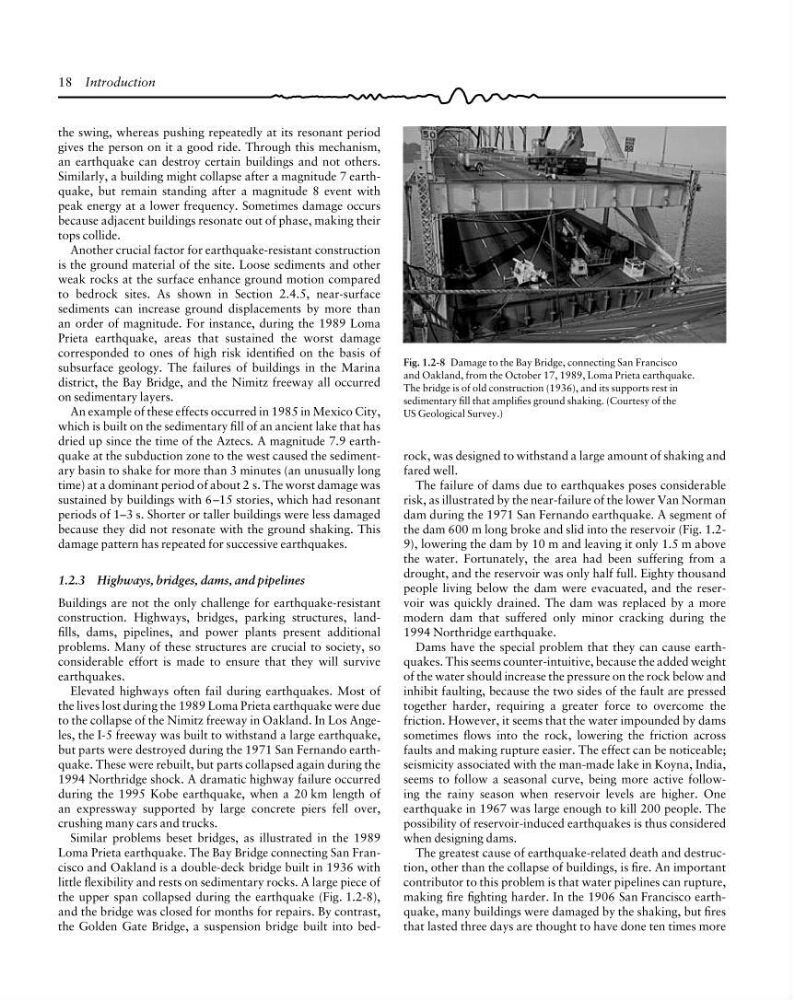
the upper span collapsed during the earthquake (Fig. 1.2-8),
and the bridge was closed for months for repairs. By contrast,
the Golden Gate Bridge, a suspension bridge built into bedFig. 1.2-8 Damage to the Bay Bridge, connecting San Francisco
and Oakland, from the October 17, 1989, Loma Prieta earthquake.
The bridge is of old construction (1936), and its supports rest in
sedimentary fill that amplifies ground shaking. (Courtesy of the
US Geological Survey.)
rock, was designed to withstand a large amount of shaking and
fared well.
The failure of dams due to earthquakes poses considerable
risk, as illustrated by the near-failure of the lower Van Norman
dam during the 1971 San Fernando earthquake. A segment of
the dam 600 m long broke and slid into the reservoir (Fig. 1.29), lowering the dam by 10 m and leaving it only 1.5 m above
the water. Fortunately, the area had been suffering from a
drought, and the reservoir was only half full. Eighty thousand
people living below the dam were evacuated, and the reservoir was quickly drained. The dam was replaced by a more
modern dam that suffered only minor cracking during the
1994 Northridge earthquake.
Dams have the special problem that they can cause earthquakes. This seems counter-intuitive, because the added weight
of the water should increase the pressure on the rock below and
inhibit faulting, because the two sides of the fault are pressed
together harder, requiring a greater force to overcome the
friction. However, it seems that the water impounded by dams
sometimes flows into the rock, lowering the friction across
faults and making rupture easier. The effect can be noticeable;
seismicity associated with the man-made lake in Koyna, India,
seems to follow a seasonal curve, being more active following the rainy season when reservoir levels are higher. One
earthquake in 1967 was large enough to kill 200 people. The
possibility of reservoir-induced earthquakes is thus considered
when designing dams.
The greatest cause of earthquake-related death and destruction, other than the collapse of buildings, is fire. An important
contributor to this problem is that water pipelines can rupture,
making fire fighting harder. In the 1906 San Francisco earthquake, many buildings were damaged by the shaking, but fires
that lasted three days are thought to have done ten times more
the swing, whereas pushing repeatedly at its resonant period
gives the person on it a good ride. Through this mechanism,
an earthquake can destroy certain buildings and not others.
Similarly, a building might collapse after a magnitude 7 earthquake, but remain standing after a magnitude 8 event with
peak energy at a lower frequency. Sometimes damage occurs
because adjacent buildings resonate out of phase, making their
tops collide.
Another crucial factor for earthquake-resistant construction
is the ground material of the site. Loose sediments and other
weak rocks at the surface enhance ground motion compared
to bedrock sites. As shown in Section 2.4.5, near-surface
sediments can increase ground displacements by more than
an order of magnitude. For instance, during the 1989 Loma
Prieta earthquake, areas that sustained the worst damage
corresponded to ones of high risk identified on the basis of
subsurface geology. The failures of buildings in the Marina
district, the Bay Bridge, and the Nimitz freeway all occurred
on sedimentary layers.
An example of these effects occurred in 1985 in Mexico City,
which is built on the sedimentary fill of an ancient lake that has
dried up since the time of the Aztecs. A magnitude 7.9 earthquake at the subduction zone to the west caused the sedimentary basin to shake for more than 3 minutes (an unusually long
time) at a dominant period of about 2 s. The worst damage was
sustained by buildings with 6–15 stories, which had resonant
periods of 1–3 s. Shorter or taller buildings were less damaged
because they did not resonate with the ground shaking. This
damage pattern has repeated for successive earthquakes.
1.2.3 Highways, bridges, dams, and pipelines
Buildings are not the only challenge for earthquake-resistant
construction. Highways, bridges, parking structures, landfills, dams, pipelines, and power plants present additional
problems. Many of these structures are crucial to society, so
considerable effort is made to ensure that they will survive
earthquakes.
Elevated highways often fail during earthquakes. Most of
the lives lost during the 1989 Loma Prieta earthquake were due
to the collapse of the Nimitz freeway in Oakland. In Los Angeles, the I-5 freeway was built to withstand a large earthquake,
but parts were destroyed during the 1971 San Fernando earthquake. These were rebuilt, but parts collapsed again during the
1994 Northridge shock. A dramatic highway failure occurred
during the 1995 Kobe earthquake, when a 20 km length of
an expressway supported by large concrete piers fell over,
crushing many cars and trucks.
Similar problems beset bridges, as illustrated in the 1989
Loma Prieta earthquake. The Bay Bridge connecting San Francisco and Oakland is a double-deck bridge built in 1936 with
little flexibility and rests on sedimentary rocks. A large piece of
the upper span collapsed during the earthquake (Fig. 1.2-8),
and the bridge was closed for months for repairs. By contrast,
the Golden Gate Bridge, a suspension bridge built into bedFig. 1.2-8 Damage to the Bay Bridge, connecting San Francisco
and Oakland, from the October 17, 1989, Loma Prieta earthquake.
The bridge is of old construction (1936), and its supports rest in
sedimentary fill that amplifies ground shaking. (Courtesy of the
US Geological Survey.)
rock, was designed to withstand a large amount of shaking and
fared well.
The failure of dams due to earthquakes poses considerable
risk, as illustrated by the near-failure of the lower Van Norman
dam during the 1971 San Fernando earthquake. A segment of
the dam 600 m long broke and slid into the reservoir (Fig. 1.29), lowering the dam by 10 m and leaving it only 1.5 m above
the water. Fortunately, the area had been suffering from a
drought, and the reservoir was only half full. Eighty thousand
people living below the dam were evacuated, and the reservoir was quickly drained. The dam was replaced by a more
modern dam that suffered only minor cracking during the
1994 Northridge earthquake.
Dams have the special problem that they can cause earthquakes. This seems counter-intuitive, because the added weight
of the water should increase the pressure on the rock below and
inhibit faulting, because the two sides of the fault are pressed
together harder, requiring a greater force to overcome the
friction. However, it seems that the water impounded by dams
sometimes flows into the rock, lowering the friction across
faults and making rupture easier. The effect can be noticeable;
seismicity associated with the man-made lake in Koyna, India,
seems to follow a seasonal curve, being more active following the rainy season when reservoir levels are higher. One
earthquake in 1967 was large enough to kill 200 people. The
possibility of reservoir-induced earthquakes is thus considered
when designing dams.
The greatest cause of earthquake-related death and destruction, other than the collapse of buildings, is fire. An important
contributor to this problem is that water pipelines can rupture,
making fire fighting harder. In the 1906 San Francisco earthquake, many buildings were damaged by the shaking, but fires
that lasted three days are thought to have done ten times more