

Percentage of buildings collapsed
100
Reinforced
concrete
r-c (anti-seismic)
50
0
V
VI
VII
VIII
IX
X
Timber
frame
Fired
brick
Adobe and
other weak
masonry
Modified Mercalli intensity
Fig. 1.2-5 Comparison of the predicted strong ground motion as a
function of distance from magnitude 7 and 6 earthquakes in the eastern
and western United States. Shaking from an earthquake in the east is
comparable to that from one a magnitude unit larger in the west. The
curves are computed from models by Atkinson and Boore (1995) and
Sadigh et al. (1997).
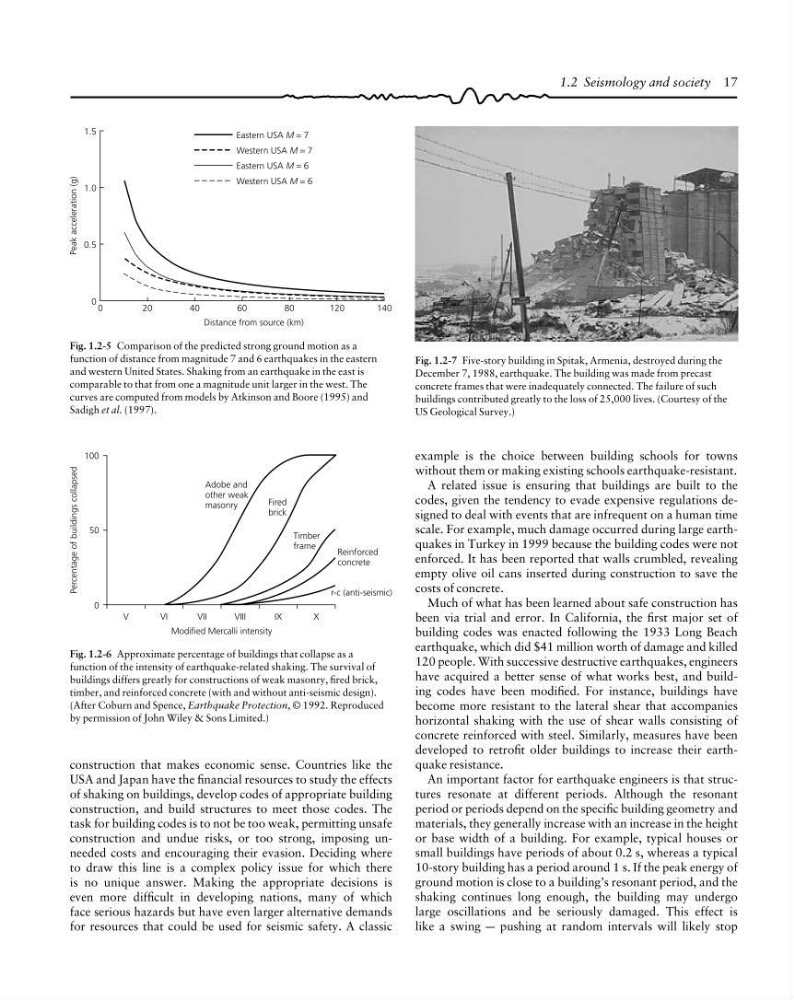
Fig. 1.2-6 Approximate percentage of buildings that collapse as a
function of the intensity of earthquake-related shaking. The survival of
buildings differs greatly for constructions of weak masonry, fired brick,
timber, and reinforced concrete (with and without anti-seismic design).
(After Coburn and Spence, Earthquake Protection, © 1992. Reproduced
by permission of John Wiley & Sons Limited.)
Fig. 1.2-7 Five-story building in Spitak, Armenia, destroyed during the
December 7, 1988, earthquake. The building was made from precast
concrete frames that were inadequately connected. The failure of such
buildings contributed greatly to the loss of 25,000 lives. (Courtesy of the
US Geological Survey.)
Peak acceleration (g)
1.5
1.0
0.5
0
140
120
80
60
40
20
0
Distance from source (km)
Eastern USA M = 7
Western USA M = 7
Eastern USA M = 6
Western USA M = 6
construction that makes economic sense. Countries like the
USA and Japan have the financial resources to study the effects
of shaking on buildings, develop codes of appropriate building
construction, and build structures to meet those codes. The
task for building codes is to not be too weak, permitting unsafe
construction and undue risks, or too strong, imposing unneeded costs and encouraging their evasion. Deciding where
to draw this line is a complex policy issue for which there
is no unique answer. Making the appropriate decisions is
even more difficult in developing nations, many of which
face serious hazards but have even larger alternative demands
for resources that could be used for seismic safety. A classic
example is the choice between building schools for towns
without them or making existing schools earthquake-resistant.
A related issue is ensuring that buildings are built to the
codes, given the tendency to evade expensive regulations designed to deal with events that are infrequent on a human time
scale. For example, much damage occurred during large earthquakes in Turkey in 1999 because the building codes were not
enforced. It has been reported that walls crumbled, revealing
empty olive oil cans inserted during construction to save the
costs of concrete.
Much of what has been learned about safe construction has
been via trial and error. In California, the first major set of
building codes was enacted following the 1933 Long Beach
earthquake, which did $41 million worth of damage and killed
120 people. With successive destructive earthquakes, engineers
have acquired a better sense of what works best, and building codes have been modified. For instance, buildings have
become more resistant to the lateral shear that accompanies
horizontal shaking with the use of shear walls consisting of
concrete reinforced with steel. Similarly, measures have been
developed to retrofit older buildings to increase their earthquake resistance.
An important factor for earthquake engineers is that structures resonate at different periods. Although the resonant
period or periods depend on the specific building geometry and
materials, they generally increase with an increase in the height
or base width of a building. For example, typical houses or
small buildings have periods of about 0.2 s, whereas a typical
10-story building has a period around 1 s. If the peak energy of
ground motion is close to a building’s resonant period, and the
shaking continues long enough, the building may undergo
large oscillations and be seriously damaged. This effect is
like a swing a pushing at random intervals will likely stop
1.2 Seismology and society 17
100
Reinforced
concrete
r-c (anti-seismic)
50
0
V
VI
VII
VIII
IX
X
Timber
frame
Fired
brick
Adobe and
other weak
masonry
Modified Mercalli intensity
Fig. 1.2-5 Comparison of the predicted strong ground motion as a
function of distance from magnitude 7 and 6 earthquakes in the eastern
and western United States. Shaking from an earthquake in the east is
comparable to that from one a magnitude unit larger in the west. The
curves are computed from models by Atkinson and Boore (1995) and
Sadigh et al. (1997).
Fig. 1.2-6 Approximate percentage of buildings that collapse as a
function of the intensity of earthquake-related shaking. The survival of
buildings differs greatly for constructions of weak masonry, fired brick,
timber, and reinforced concrete (with and without anti-seismic design).
(After Coburn and Spence, Earthquake Protection, © 1992. Reproduced
by permission of John Wiley & Sons Limited.)
Fig. 1.2-7 Five-story building in Spitak, Armenia, destroyed during the
December 7, 1988, earthquake. The building was made from precast
concrete frames that were inadequately connected. The failure of such
buildings contributed greatly to the loss of 25,000 lives. (Courtesy of the
US Geological Survey.)
Peak acceleration (g)
1.5
1.0
0.5
0
140
120
80
60
40
20
0
Distance from source (km)
Eastern USA M = 7
Western USA M = 7
Eastern USA M = 6
Western USA M = 6
construction that makes economic sense. Countries like the
USA and Japan have the financial resources to study the effects
of shaking on buildings, develop codes of appropriate building
construction, and build structures to meet those codes. The
task for building codes is to not be too weak, permitting unsafe
construction and undue risks, or too strong, imposing unneeded costs and encouraging their evasion. Deciding where
to draw this line is a complex policy issue for which there
is no unique answer. Making the appropriate decisions is
even more difficult in developing nations, many of which
face serious hazards but have even larger alternative demands
for resources that could be used for seismic safety. A classic
example is the choice between building schools for towns
without them or making existing schools earthquake-resistant.
A related issue is ensuring that buildings are built to the
codes, given the tendency to evade expensive regulations designed to deal with events that are infrequent on a human time
scale. For example, much damage occurred during large earthquakes in Turkey in 1999 because the building codes were not
enforced. It has been reported that walls crumbled, revealing
empty olive oil cans inserted during construction to save the
costs of concrete.
Much of what has been learned about safe construction has
been via trial and error. In California, the first major set of
building codes was enacted following the 1933 Long Beach
earthquake, which did $41 million worth of damage and killed
120 people. With successive destructive earthquakes, engineers
have acquired a better sense of what works best, and building codes have been modified. For instance, buildings have
become more resistant to the lateral shear that accompanies
horizontal shaking with the use of shear walls consisting of
concrete reinforced with steel. Similarly, measures have been
developed to retrofit older buildings to increase their earthquake resistance.
An important factor for earthquake engineers is that structures resonate at different periods. Although the resonant
period or periods depend on the specific building geometry and
materials, they generally increase with an increase in the height
or base width of a building. For example, typical houses or
small buildings have periods of about 0.2 s, whereas a typical
10-story building has a period around 1 s. If the peak energy of
ground motion is close to a building’s resonant period, and the
shaking continues long enough, the building may undergo
large oscillations and be seriously damaged. This effect is
like a swing a pushing at random intervals will likely stop
1.2 Seismology and society 17