

310 Seismology and Plate Tectonics
Earthquake depth (km)
0
100
200
300
400
500
600
700
Thermal parameter versus maximum earthquake depth
next deepest earthquake
deepest earthquake
Izu-Bonin N
Izu-Bonin S
SE
Sumatra
Java W
Tonga
0
5000
10 000
15 000
20 000
Thermal parameter, (km)
φ
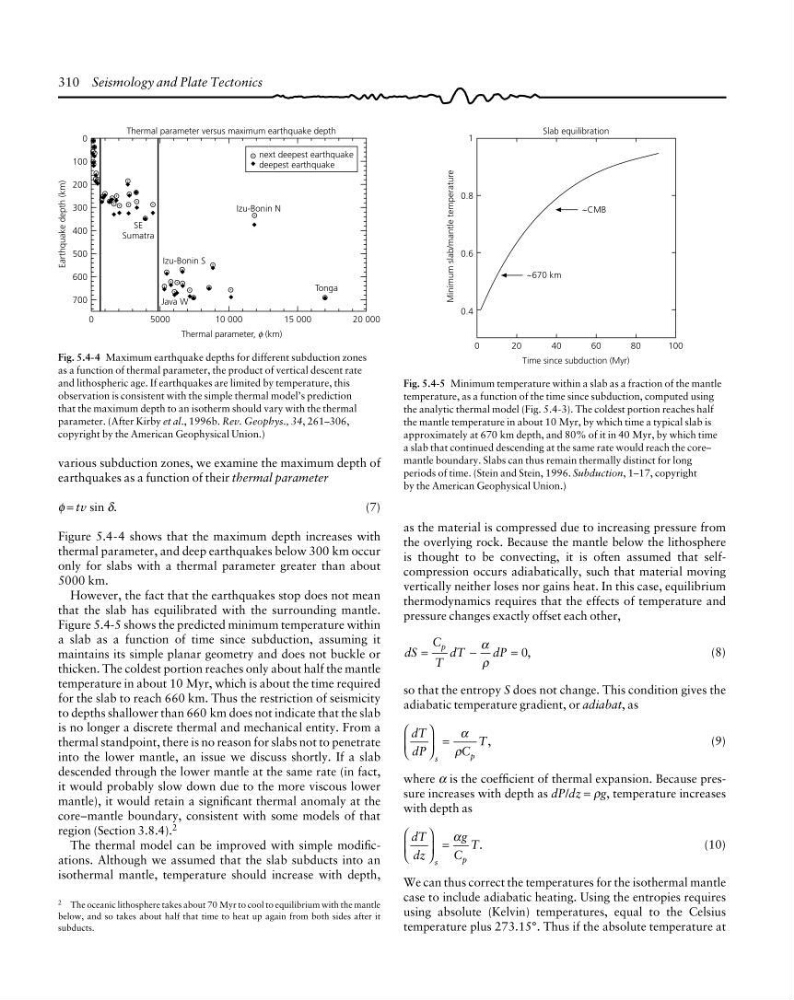
Fig. 5.4-4 Maximum earthquake depths for different subduction zones
as a function of thermal parameter, the product of vertical descent rate
and lithospheric age. If earthquakes are limited by temperature, this
observation is consistent with the simple thermal model’s prediction
that the maximum depth to an isotherm should vary with the thermal
parameter. (After Kirby et al., 1996b. Rev. Geophys., 34, 261–306,
copyright by the American Geophysical Union.)
2 The oceanic lithosphere takes about 70 Myr to cool to equilibrium with the mantle
below, and so takes about half that time to heat up again from both sides after it
subducts.
various subduction zones, we examine the maximum depth of
earthquakes as a function of their thermal parameter
φ = tv sin δ.
(7)
Figure 5.4-4 shows that the maximum depth increases with
thermal parameter, and deep earthquakes below 300 km occur
only for slabs with a thermal parameter greater than about
5000 km.
However, the fact that the earthquakes stop does not mean
that the slab has equilibrated with the surrounding mantle.
Figure 5.4-5 shows the predicted minimum temperature within
a slab as a function of time since subduction, assuming it
maintains its simple planar geometry and does not buckle or
thicken. The coldest portion reaches only about half the mantle
temperature in about 10 Myr, which is about the time required
for the slab to reach 660 km. Thus the restriction of seismicity
to depths shallower than 660 km does not indicate that the slab
is no longer a discrete thermal and mechanical entity. From a
thermal standpoint, there is no reason for slabs not to penetrate
into the lower mantle, an issue we discuss shortly. If a slab
descended through the lower mantle at the same rate (in fact,
it would probably slow down due to the more viscous lower
mantle), it would retain a significant thermal anomaly at the
core–mantle boundary, consistent with some models of that
region (Section 3.8.4). 2
The thermal model can be improved with simple modifications. Although we assumed that the slab subducts into an
isothermal mantle, temperature should increase with depth,
Fig. 5.4-5 Minimum temperature within a slab as a fraction of the mantle
temperature, as a function of the time since subduction, computed using
the analytic thermal model (Fig. 5.4-3). The coldest portion reaches half
the mantle temperature in about 10 Myr, by which time a typical slab is
approximately at 670 km depth, and 80% of it in 40 Myr, by which time
a slab that continued descending at the same rate would reach the core–
mantle boundary. Slabs can thus remain thermally distinct for long
periods of time. (Stein and Stein, 1996. Subduction, 1–17, copyright
by the American Geophysical Union.)
Minimum slab/mantle temperature
1
0.8
0.6
0.4
Time since subduction (Myr)
0
20
40
60
80
100
Slab equilibration
~CMB
~670 km
as the material is compressed due to increasing pressure from
the overlying rock. Because the mantle below the lithosphere
is thought to be convecting, it is often assumed that selfcompression occurs adiabatically, such that material moving
vertically neither loses nor gains heat. In this case, equilibrium
thermodynamics requires that the effects of temperature and
pressure changes exactly offset each other,
dS
C
T
dT
dP
p
,
=
−
=
α
ρ
0
(8)
so that the entropy S does not change. This condition gives the
adiabatic temperature gradient, or adiabat, as
dT
dP
C
T
s
p
⎛
⎝
⎜
⎞
⎠
⎟ =
,
α
ρ
(9)
where α is the coefficient of thermal expansion. Because pressure increases with depth as dP/dz = ρg, temperature increases
with depth as
dT
dz
g
C
T
s
p
⎛
⎝
⎜
⎞
⎠
⎟ =
.
α
(10)
We can thus correct the temperatures for the isothermal mantle
case to include adiabatic heating. Using the entropies requires
using absolute (Kelvin) temperatures, equal to the Celsius
temperature plus 273.15°. Thus if the absolute temperature at
Earthquake depth (km)
0
100
200
300
400
500
600
700
Thermal parameter versus maximum earthquake depth
next deepest earthquake
deepest earthquake
Izu-Bonin N
Izu-Bonin S
SE
Sumatra
Java W
Tonga
0
5000
10 000
15 000
20 000
Thermal parameter, (km)
φ
Fig. 5.4-4 Maximum earthquake depths for different subduction zones
as a function of thermal parameter, the product of vertical descent rate
and lithospheric age. If earthquakes are limited by temperature, this
observation is consistent with the simple thermal model’s prediction
that the maximum depth to an isotherm should vary with the thermal
parameter. (After Kirby et al., 1996b. Rev. Geophys., 34, 261–306,
copyright by the American Geophysical Union.)
2 The oceanic lithosphere takes about 70 Myr to cool to equilibrium with the mantle
below, and so takes about half that time to heat up again from both sides after it
subducts.
various subduction zones, we examine the maximum depth of
earthquakes as a function of their thermal parameter
φ = tv sin δ.
(7)
Figure 5.4-4 shows that the maximum depth increases with
thermal parameter, and deep earthquakes below 300 km occur
only for slabs with a thermal parameter greater than about
5000 km.
However, the fact that the earthquakes stop does not mean
that the slab has equilibrated with the surrounding mantle.
Figure 5.4-5 shows the predicted minimum temperature within
a slab as a function of time since subduction, assuming it
maintains its simple planar geometry and does not buckle or
thicken. The coldest portion reaches only about half the mantle
temperature in about 10 Myr, which is about the time required
for the slab to reach 660 km. Thus the restriction of seismicity
to depths shallower than 660 km does not indicate that the slab
is no longer a discrete thermal and mechanical entity. From a
thermal standpoint, there is no reason for slabs not to penetrate
into the lower mantle, an issue we discuss shortly. If a slab
descended through the lower mantle at the same rate (in fact,
it would probably slow down due to the more viscous lower
mantle), it would retain a significant thermal anomaly at the
core–mantle boundary, consistent with some models of that
region (Section 3.8.4). 2
The thermal model can be improved with simple modifications. Although we assumed that the slab subducts into an
isothermal mantle, temperature should increase with depth,
Fig. 5.4-5 Minimum temperature within a slab as a fraction of the mantle
temperature, as a function of the time since subduction, computed using
the analytic thermal model (Fig. 5.4-3). The coldest portion reaches half
the mantle temperature in about 10 Myr, by which time a typical slab is
approximately at 670 km depth, and 80% of it in 40 Myr, by which time
a slab that continued descending at the same rate would reach the core–
mantle boundary. Slabs can thus remain thermally distinct for long
periods of time. (Stein and Stein, 1996. Subduction, 1–17, copyright
by the American Geophysical Union.)
Minimum slab/mantle temperature
1
0.8
0.6
0.4
Time since subduction (Myr)
0
20
40
60
80
100
Slab equilibration
~CMB
~670 km
as the material is compressed due to increasing pressure from
the overlying rock. Because the mantle below the lithosphere
is thought to be convecting, it is often assumed that selfcompression occurs adiabatically, such that material moving
vertically neither loses nor gains heat. In this case, equilibrium
thermodynamics requires that the effects of temperature and
pressure changes exactly offset each other,
dS
C
T
dT
dP
p
,
=
−
=
α
ρ
0
(8)
so that the entropy S does not change. This condition gives the
adiabatic temperature gradient, or adiabat, as
dT
dP
C
T
s
p
⎛
⎝
⎜
⎞
⎠
⎟ =
,
α
ρ
(9)
where α is the coefficient of thermal expansion. Because pressure increases with depth as dP/dz = ρg, temperature increases
with depth as
dT
dz
g
C
T
s
p
⎛
⎝
⎜
⎞
⎠
⎟ =
.
α
(10)
We can thus correct the temperatures for the isothermal mantle
case to include adiabatic heating. Using the entropies requires
using absolute (Kelvin) temperatures, equal to the Celsius
temperature plus 273.15°. Thus if the absolute temperature at