

308 Seismology and Plate Tectonics
Back-arc basin
Continent
Andesitic arc volcanism
Ocean
Mid-ocean
ridge
Low-viscosity
asthenosphere
High-viscosity
mesosphere
S u b d u c t in g li t h o s p h e r e
1 Slightly different definitions have been used for these depth ranges; for example,
325 km has also been used as the upper limit for deep earthquakes.
Fig. 5.4-1 Schematic diagram of processes
associated with the subduction of one
oceanic plate beneath another.
Bending earthquakes
– few, small
Small earthquakes
Intermediate
earthquakes
– near slab top
– primarily
down-dip tension
Great thrust earthquakes
– often, but not always
– e.g., 1960 Chile,
1964 Alaska
Normal fault earthquakes
– few, large
– e.g., 1933 Sanriku,
1965 Rat Island,
1977 Indonesia
– not observed everywhere
Deep seismic zone
– either single or double
– primarily down-dip compression
– dip may vary considerably
– depth may vary considerably
Fig. 5.4-2 Composite subduction zone showing some earthquake types.
Not all are observed at all subduction zones.
Wadati–Benioff zone. By contrast, when oceanic lithosphere
subducts beneath a continent, a mountain chain like the Andes
forms on the continent, and the oceanic lithosphere forms
a Wadati–Benioff zone. Finally, because continental crust
cannot subduct, convergence between two continental plates,
as in the Himalayas, causes crustal thickening, mountain building, and shallow earthquakes but does not create a Wadati–
Benioff zone.
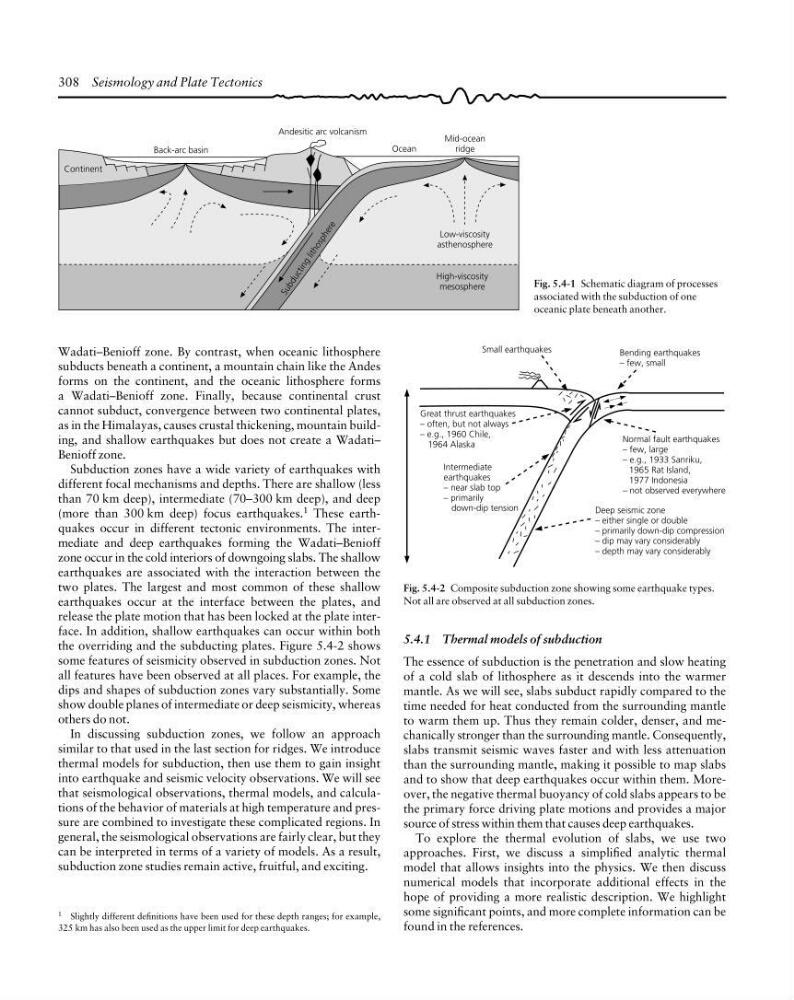
Subduction zones have a wide variety of earthquakes with
different focal mechanisms and depths. There are shallow (less
than 70 km deep), intermediate (70–300 km deep), and deep
(more than 300 km deep) focus earthquakes. 1 These earthquakes occur in different tectonic environments. The intermediate and deep earthquakes forming the Wadati–Benioff
zone occur in the cold interiors of downgoing slabs. The shallow
earthquakes are associated with the interaction between the
two plates. The largest and most common of these shallow
earthquakes occur at the interface between the plates, and
release the plate motion that has been locked at the plate interface. In addition, shallow earthquakes can occur within both
the overriding and the subducting plates. Figure 5.4-2 shows
some features of seismicity observed in subduction zones. Not
all features have been observed at all places. For example, the
dips and shapes of subduction zones vary substantially. Some
show double planes of intermediate or deep seismicity, whereas
others do not.
In discussing subduction zones, we follow an approach
similar to that used in the last section for ridges. We introduce
thermal models for subduction, then use them to gain insight
into earthquake and seismic velocity observations. We will see
that seismological observations, thermal models, and calculations of the behavior of materials at high temperature and pressure are combined to investigate these complicated regions. In
general, the seismological observations are fairly clear, but they
can be interpreted in terms of a variety of models. As a result,
subduction zone studies remain active, fruitful, and exciting.
5.4.1 Thermal models of subduction
The essence of subduction is the penetration and slow heating
of a cold slab of lithosphere as it descends into the warmer
mantle. As we will see, slabs subduct rapidly compared to the
time needed for heat conducted from the surrounding mantle
to warm them up. Thus they remain colder, denser, and mechanically stronger than the surrounding mantle. Consequently,
slabs transmit seismic waves faster and with less attenuation
than the surrounding mantle, making it possible to map slabs
and to show that deep earthquakes occur within them. Moreover, the negative thermal buoyancy of cold slabs appears to be
the primary force driving plate motions and provides a major
source of stress within them that causes deep earthquakes.
To explore the thermal evolution of slabs, we use two
approaches. First, we discuss a simplified analytic thermal
model that allows insights into the physics. We then discuss
numerical models that incorporate additional effects in the
hope of providing a more realistic description. We highlight
some significant points, and more complete information can be
found in the references.
Back-arc basin
Continent
Andesitic arc volcanism
Ocean
Mid-ocean
ridge
Low-viscosity
asthenosphere
High-viscosity
mesosphere
S u b d u c t in g li t h o s p h e r e
1 Slightly different definitions have been used for these depth ranges; for example,
325 km has also been used as the upper limit for deep earthquakes.
Fig. 5.4-1 Schematic diagram of processes
associated with the subduction of one
oceanic plate beneath another.
Bending earthquakes
– few, small
Small earthquakes
Intermediate
earthquakes
– near slab top
– primarily
down-dip tension
Great thrust earthquakes
– often, but not always
– e.g., 1960 Chile,
1964 Alaska
Normal fault earthquakes
– few, large
– e.g., 1933 Sanriku,
1965 Rat Island,
1977 Indonesia
– not observed everywhere
Deep seismic zone
– either single or double
– primarily down-dip compression
– dip may vary considerably
– depth may vary considerably
Fig. 5.4-2 Composite subduction zone showing some earthquake types.
Not all are observed at all subduction zones.
Wadati–Benioff zone. By contrast, when oceanic lithosphere
subducts beneath a continent, a mountain chain like the Andes
forms on the continent, and the oceanic lithosphere forms
a Wadati–Benioff zone. Finally, because continental crust
cannot subduct, convergence between two continental plates,
as in the Himalayas, causes crustal thickening, mountain building, and shallow earthquakes but does not create a Wadati–
Benioff zone.
Subduction zones have a wide variety of earthquakes with
different focal mechanisms and depths. There are shallow (less
than 70 km deep), intermediate (70–300 km deep), and deep
(more than 300 km deep) focus earthquakes. 1 These earthquakes occur in different tectonic environments. The intermediate and deep earthquakes forming the Wadati–Benioff
zone occur in the cold interiors of downgoing slabs. The shallow
earthquakes are associated with the interaction between the
two plates. The largest and most common of these shallow
earthquakes occur at the interface between the plates, and
release the plate motion that has been locked at the plate interface. In addition, shallow earthquakes can occur within both
the overriding and the subducting plates. Figure 5.4-2 shows
some features of seismicity observed in subduction zones. Not
all features have been observed at all places. For example, the
dips and shapes of subduction zones vary substantially. Some
show double planes of intermediate or deep seismicity, whereas
others do not.
In discussing subduction zones, we follow an approach
similar to that used in the last section for ridges. We introduce
thermal models for subduction, then use them to gain insight
into earthquake and seismic velocity observations. We will see
that seismological observations, thermal models, and calculations of the behavior of materials at high temperature and pressure are combined to investigate these complicated regions. In
general, the seismological observations are fairly clear, but they
can be interpreted in terms of a variety of models. As a result,
subduction zone studies remain active, fruitful, and exciting.
5.4.1 Thermal models of subduction
The essence of subduction is the penetration and slow heating
of a cold slab of lithosphere as it descends into the warmer
mantle. As we will see, slabs subduct rapidly compared to the
time needed for heat conducted from the surrounding mantle
to warm them up. Thus they remain colder, denser, and mechanically stronger than the surrounding mantle. Consequently,
slabs transmit seismic waves faster and with less attenuation
than the surrounding mantle, making it possible to map slabs
and to show that deep earthquakes occur within them. Moreover, the negative thermal buoyancy of cold slabs appears to be
the primary force driving plate motions and provides a major
source of stress within them that causes deep earthquakes.
To explore the thermal evolution of slabs, we use two
approaches. First, we discuss a simplified analytic thermal
model that allows insights into the physics. We then discuss
numerical models that incorporate additional effects in the
hope of providing a more realistic description. We highlight
some significant points, and more complete information can be
found in the references.