

20°S
25°
30°S
120°W
110°W
20°S
25°
30°S
115°
120°W
110°W
Tectonics of the Easter plate
Nazca
plate
West
ridge
Easter
microplate
East
ridge
Microplate
rotates
Transferred
lithosphere
Orthogonal
ridgetransform
geometry
New ridge
forms
Old ridge
slows
Oblique
spreading
Compression
T 3
T 4
T 0
T 2
T 1
N
Schematic rigid plate evolution
115°
Pacific plate
Using this relation requires inferring the fault area, which
depends on both the transform length and the depth to which
faulting occurs. Assuming the area above the 600–700 °C
isotherms fails seismically, the seismic slip rate for major
Atlantic transforms is generally less than predicted by the plate
motion. Thus, if the time period sampled is long enough to
be representative a a major question a some of the plate
motion occurs aseismically. The issue of how much slip occurs
seismically remains unresolved, as we will see when we discuss
subduction zones (Section 5.4.3) and intraplate deformation
zones (Section 5.6.2).
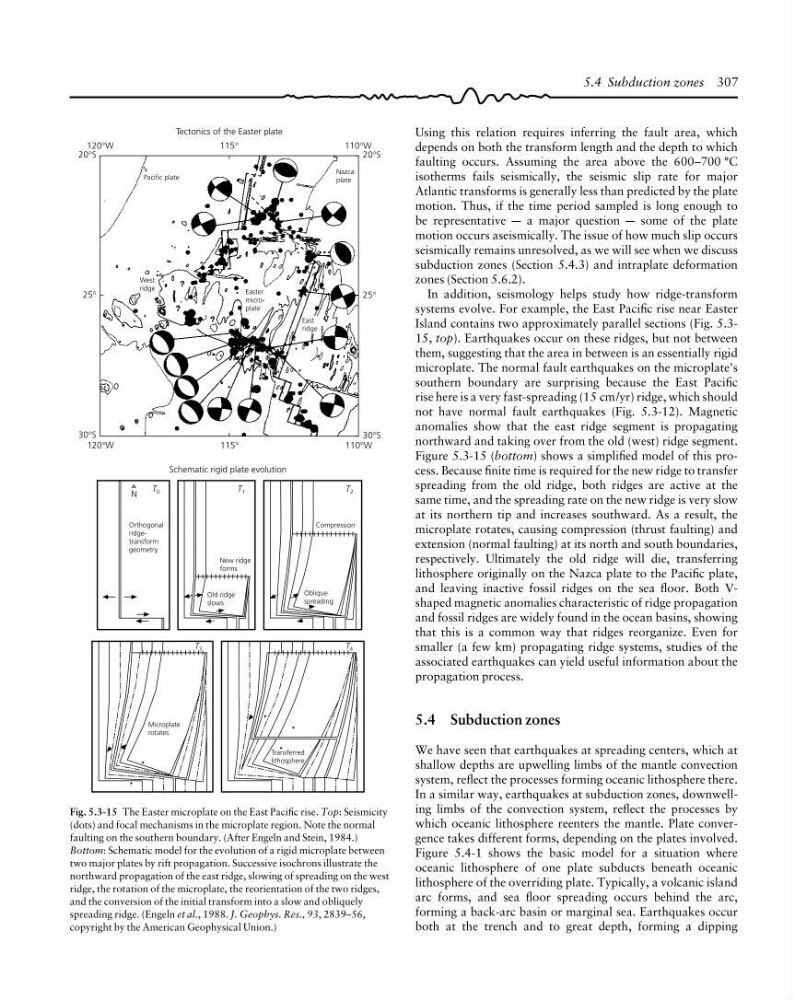
In addition, seismology helps study how ridge-transform
systems evolve. For example, the East Pacific rise near Easter
Island contains two approximately parallel sections (Fig. 5.315, top). Earthquakes occur on these ridges, but not between
them, suggesting that the area in between is an essentially rigid
microplate. The normal fault earthquakes on the microplate’s
southern boundary are surprising because the East Pacific
rise here is a very fast-spreading (15 cm/yr) ridge, which should
not have normal fault earthquakes (Fig. 5.3-12). Magnetic
anomalies show that the east ridge segment is propagating
northward and taking over from the old (west) ridge segment.
Figure 5.3-15 (bottom) shows a simplified model of this process. Because finite time is required for the new ridge to transfer
spreading from the old ridge, both ridges are active at the
same time, and the spreading rate on the new ridge is very slow
at its northern tip and increases southward. As a result, the
microplate rotates, causing compression (thrust faulting) and
extension (normal faulting) at its north and south boundaries,
respectively. Ultimately the old ridge will die, transferring
lithosphere originally on the Nazca plate to the Pacific plate,
and leaving inactive fossil ridges on the sea floor. Both Vshaped magnetic anomalies characteristic of ridge propagation
and fossil ridges are widely found in the ocean basins, showing
that this is a common way that ridges reorganize. Even for
smaller (a few km) propagating ridge systems, studies of the
associated earthquakes can yield useful information about the
propagation process.
5.4 Subduction zones
We have seen that earthquakes at spreading centers, which at
shallow depths are upwelling limbs of the mantle convection
system, reflect the processes forming oceanic lithosphere there.
In a similar way, earthquakes at subduction zones, downwelling limbs of the convection system, reflect the processes by
which oceanic lithosphere reenters the mantle. Plate convergence takes different forms, depending on the plates involved.
Figure 5.4-1 shows the basic model for a situation where
oceanic lithosphere of one plate subducts beneath oceanic
lithosphere of the overriding plate. Typically, a volcanic island
arc forms, and sea floor spreading occurs behind the arc,
forming a back-arc basin or marginal sea. Earthquakes occur
both at the trench and to great depth, forming a dipping
5.4 Subduction zones 307
Fig. 5.3-15 The Easter microplate on the East Pacific rise. Top: Seismicity
(dots) and focal mechanisms in the microplate region. Note the normal
faulting on the southern boundary. (After Engeln and Stein, 1984.)
Bottom: Schematic model for the evolution of a rigid microplate between
two major plates by rift propagation. Successive isochrons illustrate the
northward propagation of the east ridge, slowing of spreading on the west
ridge, the rotation of the microplate, the reorientation of the two ridges,
and the conversion of the initial transform into a slow and obliquely
spreading ridge. (Engeln et al., 1988. J. Geophys. Res., 93, 2839–56,
copyright by the American Geophysical Union.)
25°
30°S
120°W
110°W
20°S
25°
30°S
115°
120°W
110°W
Tectonics of the Easter plate
Nazca
plate
West
ridge
Easter
microplate
East
ridge
Microplate
rotates
Transferred
lithosphere
Orthogonal
ridgetransform
geometry
New ridge
forms
Old ridge
slows
Oblique
spreading
Compression
T 3
T 4
T 0
T 2
T 1
N
Schematic rigid plate evolution
115°
Pacific plate
Using this relation requires inferring the fault area, which
depends on both the transform length and the depth to which
faulting occurs. Assuming the area above the 600–700 °C
isotherms fails seismically, the seismic slip rate for major
Atlantic transforms is generally less than predicted by the plate
motion. Thus, if the time period sampled is long enough to
be representative a a major question a some of the plate
motion occurs aseismically. The issue of how much slip occurs
seismically remains unresolved, as we will see when we discuss
subduction zones (Section 5.4.3) and intraplate deformation
zones (Section 5.6.2).
In addition, seismology helps study how ridge-transform
systems evolve. For example, the East Pacific rise near Easter
Island contains two approximately parallel sections (Fig. 5.315, top). Earthquakes occur on these ridges, but not between
them, suggesting that the area in between is an essentially rigid
microplate. The normal fault earthquakes on the microplate’s
southern boundary are surprising because the East Pacific
rise here is a very fast-spreading (15 cm/yr) ridge, which should
not have normal fault earthquakes (Fig. 5.3-12). Magnetic
anomalies show that the east ridge segment is propagating
northward and taking over from the old (west) ridge segment.
Figure 5.3-15 (bottom) shows a simplified model of this process. Because finite time is required for the new ridge to transfer
spreading from the old ridge, both ridges are active at the
same time, and the spreading rate on the new ridge is very slow
at its northern tip and increases southward. As a result, the
microplate rotates, causing compression (thrust faulting) and
extension (normal faulting) at its north and south boundaries,
respectively. Ultimately the old ridge will die, transferring
lithosphere originally on the Nazca plate to the Pacific plate,
and leaving inactive fossil ridges on the sea floor. Both Vshaped magnetic anomalies characteristic of ridge propagation
and fossil ridges are widely found in the ocean basins, showing
that this is a common way that ridges reorganize. Even for
smaller (a few km) propagating ridge systems, studies of the
associated earthquakes can yield useful information about the
propagation process.
5.4 Subduction zones
We have seen that earthquakes at spreading centers, which at
shallow depths are upwelling limbs of the mantle convection
system, reflect the processes forming oceanic lithosphere there.
In a similar way, earthquakes at subduction zones, downwelling limbs of the convection system, reflect the processes by
which oceanic lithosphere reenters the mantle. Plate convergence takes different forms, depending on the plates involved.
Figure 5.4-1 shows the basic model for a situation where
oceanic lithosphere of one plate subducts beneath oceanic
lithosphere of the overriding plate. Typically, a volcanic island
arc forms, and sea floor spreading occurs behind the arc,
forming a back-arc basin or marginal sea. Earthquakes occur
both at the trench and to great depth, forming a dipping
5.4 Subduction zones 307
Fig. 5.3-15 The Easter microplate on the East Pacific rise. Top: Seismicity
(dots) and focal mechanisms in the microplate region. Note the normal
faulting on the southern boundary. (After Engeln and Stein, 1984.)
Bottom: Schematic model for the evolution of a rigid microplate between
two major plates by rift propagation. Successive isochrons illustrate the
northward propagation of the east ridge, slowing of spreading on the west
ridge, the rotation of the microplate, the reorientation of the two ridges,
and the conversion of the initial transform into a slow and obliquely
spreading ridge. (Engeln et al., 1988. J. Geophys. Res., 93, 2839–56,
copyright by the American Geophysical Union.)