

306 Seismology and Plate Tectonics
Moment (dyn-cm)
10
29
10
28
10
27
10
26
10
25
0
Full spreading rate (mm/yr)
200
20
40
60
80
100 120 140 160 180
Transform fault earthquakes
Depth (km)
10
20
30
40
(OFFSET = 51 Myr)
10
Average temperature across transform
Age (Myr)
20
40
50
Depth (km)
10
20
30
40
10
Halfspace model
Age (Myr)
20
30
40
50
400°
600°
800°
400°
600°
800°
30
Centroid depth (km)
0
1
2
3
4
5
6
7
8
9
10
5
1 0
1 5
2 0
2 5
Half spreading rate (mm/yr)
Moment (dyn-cm)
10
27
10
26
10
25
10
24
10
20
30
40
Half spreading rate (mm/yr)
Ridge crest earthquakes
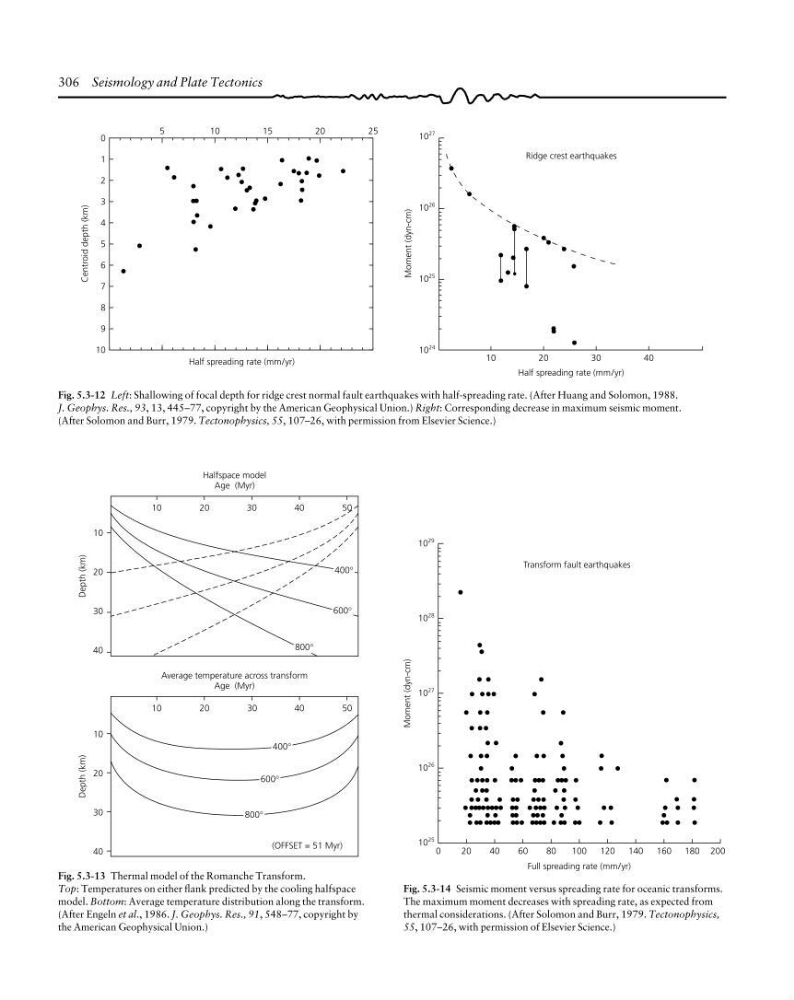
Fig. 5.3-12 Left: Shallowing of focal depth for ridge crest normal fault earthquakes with half-spreading rate. (After Huang and Solomon, 1988.
J. Geophys. Res., 93, 13, 445–77, copyright by the American Geophysical Union.) Right: Corresponding decrease in maximum seismic moment.
(After Solomon and Burr, 1979. Tectonophysics, 55, 107–26, with permission from Elsevier Science.)
Fig. 5.3-13 Thermal model of the Romanche Transform.
Top: Temperatures on either flank predicted by the cooling halfspace
model. Bottom: Average temperature distribution along the transform.
(After Engeln et al., 1986. J. Geophys. Res., 91, 548–77, copyright by
the American Geophysical Union.)
Fig. 5.3-14 Seismic moment versus spreading rate for oceanic transforms.
The maximum moment decreases with spreading rate, as expected from
thermal considerations. (After Solomon and Burr, 1979. Tectonophysics,
55, 107–26, with permission of Elsevier Science.)
Moment (dyn-cm)
10
29
10
28
10
27
10
26
10
25
0
Full spreading rate (mm/yr)
200
20
40
60
80
100 120 140 160 180
Transform fault earthquakes
Depth (km)
10
20
30
40
(OFFSET = 51 Myr)
10
Average temperature across transform
Age (Myr)
20
40
50
Depth (km)
10
20
30
40
10
Halfspace model
Age (Myr)
20
30
40
50
400°
600°
800°
400°
600°
800°
30
Centroid depth (km)
0
1
2
3
4
5
6
7
8
9
10
5
1 0
1 5
2 0
2 5
Half spreading rate (mm/yr)
Moment (dyn-cm)
10
27
10
26
10
25
10
24
10
20
30
40
Half spreading rate (mm/yr)
Ridge crest earthquakes
Fig. 5.3-12 Left: Shallowing of focal depth for ridge crest normal fault earthquakes with half-spreading rate. (After Huang and Solomon, 1988.
J. Geophys. Res., 93, 13, 445–77, copyright by the American Geophysical Union.) Right: Corresponding decrease in maximum seismic moment.
(After Solomon and Burr, 1979. Tectonophysics, 55, 107–26, with permission from Elsevier Science.)
Fig. 5.3-13 Thermal model of the Romanche Transform.
Top: Temperatures on either flank predicted by the cooling halfspace
model. Bottom: Average temperature distribution along the transform.
(After Engeln et al., 1986. J. Geophys. Res., 91, 548–77, copyright by
the American Geophysical Union.)
Fig. 5.3-14 Seismic moment versus spreading rate for oceanic transforms.
The maximum moment decreases with spreading rate, as expected from
thermal considerations. (After Solomon and Burr, 1979. Tectonophysics,
55, 107–26, with permission of Elsevier Science.)