

1 cm / yr
1100
1185
1000
300
1185
300
Depth (km)
0
5
10
Distance from ridge axis (km)
Large magma chamber
10
5
0
0
Thick sheet dike complex
5
1 0
1000
800
600
1100
Wide conduit
5 cm / yr
Thin sheet
dike complex
Small
magma
chamber
Moho
1185
800
600
100
Narrow
conduit
Moho
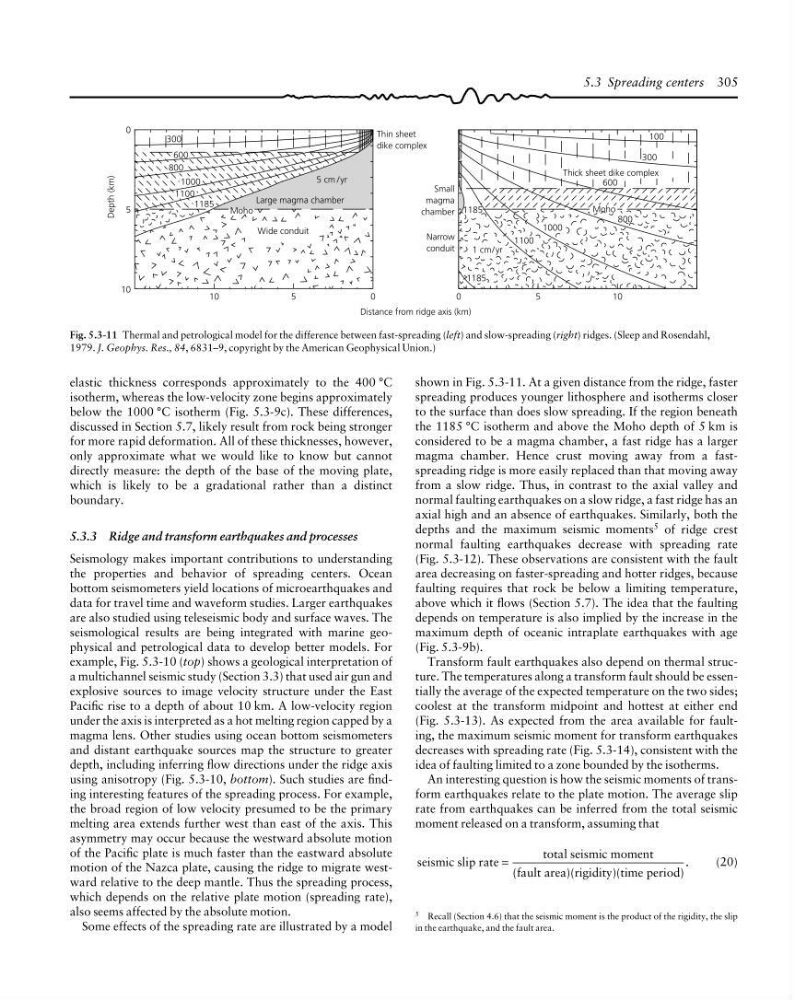
Fig. 5.3-11 Thermal and petrological model for the difference between fast-spreading (left) and slow-spreading (right) ridges. (Sleep and Rosendahl,
1979. J. Geophys. Res., 84, 6831–9, copyright by the American Geophysical Union.)
elastic thickness corresponds approximately to the 400 °C
isotherm, whereas the low-velocity zone begins approximately
below the 1000 °C isotherm (Fig. 5.3-9c). These differences,
discussed in Section 5.7, likely result from rock being stronger
for more rapid deformation. All of these thicknesses, however,
only approximate what we would like to know but cannot
directly measure: the depth of the base of the moving plate,
which is likely to be a gradational rather than a distinct
boundary.
5.3.3 Ridge and transform earthquakes and processes
Seismology makes important contributions to understanding
the properties and behavior of spreading centers. Ocean
bottom seismometers yield locations of microearthquakes and
data for travel time and waveform studies. Larger earthquakes
are also studied using teleseismic body and surface waves. The
seismological results are being integrated with marine geophysical and petrological data to develop better models. For
example, Fig. 5.3-10 (top) shows a geological interpretation of
a multichannel seismic study (Section 3.3) that used air gun and
explosive sources to image velocity structure under the East
Pacific rise to a depth of about 10 km. A low-velocity region
under the axis is interpreted as a hot melting region capped by a
magma lens. Other studies using ocean bottom seismometers
and distant earthquake sources map the structure to greater
depth, including inferring flow directions under the ridge axis
using anisotropy (Fig. 5.3-10, bottom). Such studies are finding interesting features of the spreading process. For example,
the broad region of low velocity presumed to be the primary
melting area extends further west than east of the axis. This
asymmetry may occur because the westward absolute motion
of the Pacific plate is much faster than the eastward absolute
motion of the Nazca plate, causing the ridge to migrate westward relative to the deep mantle. Thus the spreading process,
which depends on the relative plate motion (spreading rate),
also seems affected by the absolute motion.
Some effects of the spreading rate are illustrated by a model
shown in Fig. 5.3-11. At a given distance from the ridge, faster
spreading produces younger lithosphere and isotherms closer
to the surface than does slow spreading. If the region beneath
the 1185 °C isotherm and above the Moho depth of 5 km is
considered to be a magma chamber, a fast ridge has a larger
magma chamber. Hence crust moving away from a fastspreading ridge is more easily replaced than that moving away
from a slow ridge. Thus, in contrast to the axial valley and
normal faulting earthquakes on a slow ridge, a fast ridge has an
axial high and an absence of earthquakes. Similarly, both the
depths and the maximum seismic moments 5 of ridge crest
normal faulting earthquakes decrease with spreading rate
(Fig. 5.3-12). These observations are consistent with the fault
area decreasing on faster-spreading and hotter ridges, because
faulting requires that rock be below a limiting temperature,
above which it flows (Section 5.7). The idea that the faulting
depends on temperature is also implied by the increase in the
maximum depth of oceanic intraplate earthquakes with age
(Fig. 5.3-9b).
Transform fault earthquakes also depend on thermal structure. The temperatures along a transform fault should be essentially the average of the expected temperature on the two sides;
coolest at the transform midpoint and hottest at either end
(Fig. 5.3-13). As expected from the area available for faulting, the maximum seismic moment for transform earthquakes
decreases with spreading rate (Fig. 5.3-14), consistent with the
idea of faulting limited to a zone bounded by the isotherms.
An interesting question is how the seismic moments of transform earthquakes relate to the plate motion. The average slip
rate from earthquakes can be inferred from the total seismic
moment released on a transform, assuming that
seismic slip rate
total seismic moment
(fault area)(rigidity)(time period)
=
.
(20)
5 Recall (Section 4.6) that the seismic moment is the product of the rigidity, the slip
in the earthquake, and the fault area.
5.3 Spreading centers 305
1100
1185
1000
300
1185
300
Depth (km)
0
5
10
Distance from ridge axis (km)
Large magma chamber
10
5
0
0
Thick sheet dike complex
5
1 0
1000
800
600
1100
Wide conduit
5 cm / yr
Thin sheet
dike complex
Small
magma
chamber
Moho
1185
800
600
100
Narrow
conduit
Moho
Fig. 5.3-11 Thermal and petrological model for the difference between fast-spreading (left) and slow-spreading (right) ridges. (Sleep and Rosendahl,
1979. J. Geophys. Res., 84, 6831–9, copyright by the American Geophysical Union.)
elastic thickness corresponds approximately to the 400 °C
isotherm, whereas the low-velocity zone begins approximately
below the 1000 °C isotherm (Fig. 5.3-9c). These differences,
discussed in Section 5.7, likely result from rock being stronger
for more rapid deformation. All of these thicknesses, however,
only approximate what we would like to know but cannot
directly measure: the depth of the base of the moving plate,
which is likely to be a gradational rather than a distinct
boundary.
5.3.3 Ridge and transform earthquakes and processes
Seismology makes important contributions to understanding
the properties and behavior of spreading centers. Ocean
bottom seismometers yield locations of microearthquakes and
data for travel time and waveform studies. Larger earthquakes
are also studied using teleseismic body and surface waves. The
seismological results are being integrated with marine geophysical and petrological data to develop better models. For
example, Fig. 5.3-10 (top) shows a geological interpretation of
a multichannel seismic study (Section 3.3) that used air gun and
explosive sources to image velocity structure under the East
Pacific rise to a depth of about 10 km. A low-velocity region
under the axis is interpreted as a hot melting region capped by a
magma lens. Other studies using ocean bottom seismometers
and distant earthquake sources map the structure to greater
depth, including inferring flow directions under the ridge axis
using anisotropy (Fig. 5.3-10, bottom). Such studies are finding interesting features of the spreading process. For example,
the broad region of low velocity presumed to be the primary
melting area extends further west than east of the axis. This
asymmetry may occur because the westward absolute motion
of the Pacific plate is much faster than the eastward absolute
motion of the Nazca plate, causing the ridge to migrate westward relative to the deep mantle. Thus the spreading process,
which depends on the relative plate motion (spreading rate),
also seems affected by the absolute motion.
Some effects of the spreading rate are illustrated by a model
shown in Fig. 5.3-11. At a given distance from the ridge, faster
spreading produces younger lithosphere and isotherms closer
to the surface than does slow spreading. If the region beneath
the 1185 °C isotherm and above the Moho depth of 5 km is
considered to be a magma chamber, a fast ridge has a larger
magma chamber. Hence crust moving away from a fastspreading ridge is more easily replaced than that moving away
from a slow ridge. Thus, in contrast to the axial valley and
normal faulting earthquakes on a slow ridge, a fast ridge has an
axial high and an absence of earthquakes. Similarly, both the
depths and the maximum seismic moments 5 of ridge crest
normal faulting earthquakes decrease with spreading rate
(Fig. 5.3-12). These observations are consistent with the fault
area decreasing on faster-spreading and hotter ridges, because
faulting requires that rock be below a limiting temperature,
above which it flows (Section 5.7). The idea that the faulting
depends on temperature is also implied by the increase in the
maximum depth of oceanic intraplate earthquakes with age
(Fig. 5.3-9b).
Transform fault earthquakes also depend on thermal structure. The temperatures along a transform fault should be essentially the average of the expected temperature on the two sides;
coolest at the transform midpoint and hottest at either end
(Fig. 5.3-13). As expected from the area available for faulting, the maximum seismic moment for transform earthquakes
decreases with spreading rate (Fig. 5.3-14), consistent with the
idea of faulting limited to a zone bounded by the isotherms.
An interesting question is how the seismic moments of transform earthquakes relate to the plate motion. The average slip
rate from earthquakes can be inferred from the total seismic
moment released on a transform, assuming that
seismic slip rate
total seismic moment
(fault area)(rigidity)(time period)
=
.
(20)
5 Recall (Section 4.6) that the seismic moment is the product of the rigidity, the slip
in the earthquake, and the fault area.
5.3 Spreading centers 305