

302 Seismology and Plate Tectonics
Depth (km)
0
50
100
150
Halfspace model
0°C
400°C
800°C
1200°C
1400°C
Depth (km)
0
50
100
150
Plate model
0°C
400°C
800°C
1200°C
1400°C
km
3
4
5
6
Depth
Plate
Halfspace
mW m
−2
150
100
50
0
Heat flow
m/Myr
−.3
−.2
−.1
0
Geoid slope
Plate
Halfspace
0
50
100
150
Age (Myr)
0
50
100
150
Age (Myr)
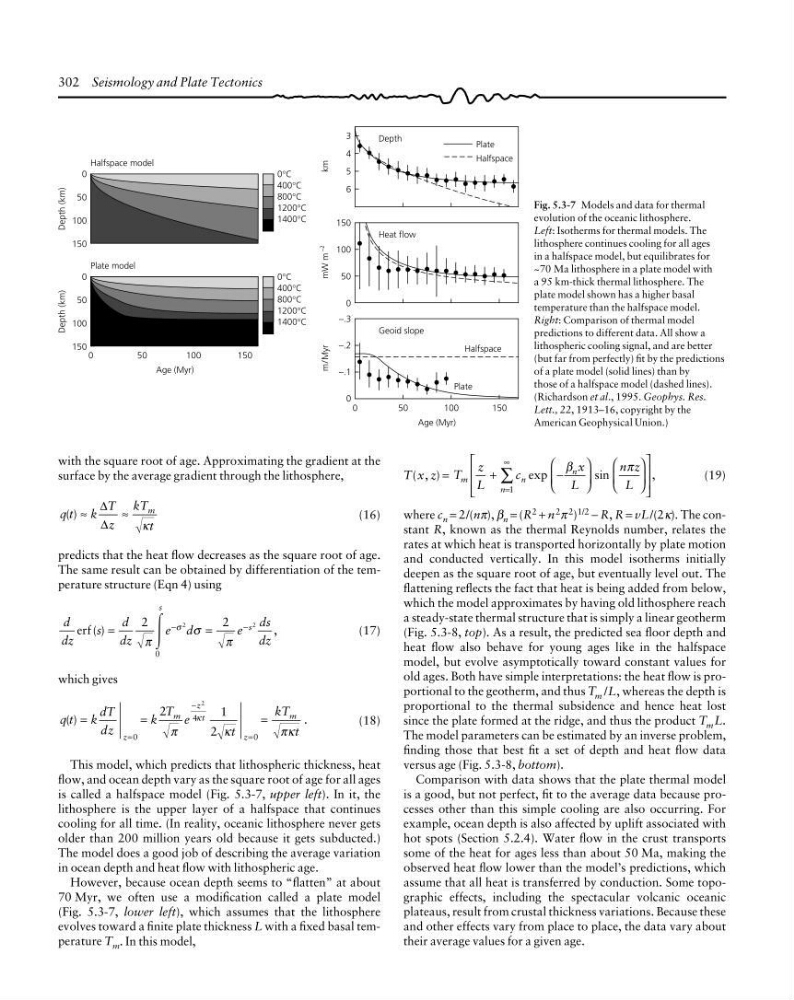
Fig. 5.3-7 Models and data for thermal
evolution of the oceanic lithosphere.
Left: Isotherms for thermal models. The
lithosphere continues cooling for all ages
in a halfspace model, but equilibrates for
~70 Ma lithosphere in a plate model with
a 95 km-thick thermal lithosphere. The
plate model shown has a higher basal
temperature than the halfspace model.
Right: Comparison of thermal model
predictions to different data. All show a
lithospheric cooling signal, and are better
(but far from perfectly) fit by the predictions
of a plate model (solid lines) than by
those of a halfspace model (dashed lines).
(Richardson et al., 1995. Geophys. Res.
Lett., 22, 1913–16, copyright by the
American Geophysical Union.)
T(x, z) = T
z
L
c
x
L
n z
L
m
n
n
n
exp
sin
,
+
−
⎛
⎝
⎜
⎞
⎠
⎟
⎛
⎝
⎜
⎞
⎠
⎟
⎡
⎣
⎢
⎢
⎤
⎦
⎥
⎥
=
∞
∑
β
π
1
(19)
where c n = 2/(nπ), β n = (R 2 + n 2 π 2 ) 1/2 − R, R = vL/(2κ). The constant R, known as the thermal Reynolds number, relates the
rates at which heat is transported horizontally by plate motion
and conducted vertically. In this model isotherms initially
deepen as the square root of age, but eventually level out. The
flattening reflects the fact that heat is being added from below,
which the model approximates by having old lithosphere reach
a steady-state thermal structure that is simply a linear geotherm
(Fig. 5.3-8, top). As a result, the predicted sea floor depth and
heat flow also behave for young ages like in the halfspace
model, but evolve asymptotically toward constant values for
old ages. Both have simple interpretations: the heat flow is proportional to the geotherm, and thus T m /L, whereas the depth is
proportional to the thermal subsidence and hence heat lost
since the plate formed at the ridge, and thus the product T m L.
The model parameters can be estimated by an inverse problem,
finding those that best fit a set of depth and heat flow data
versus age (Fig. 5.3-8, bottom).
Comparison with data shows that the plate thermal model
is a good, but not perfect, fit to the average data because processes other than this simple cooling are also occurring. For
example, ocean depth is also affected by uplift associated with
hot spots (Section 5.2.4). Water flow in the crust transports
some of the heat for ages less than about 50 Ma, making the
observed heat flow lower than the model’s predictions, which
assume that all heat is transferred by conduction. Some topographic effects, including the spectacular volcanic oceanic
plateaus, result from crustal thickness variations. Because these
and other effects vary from place to place, the data vary about
their average values for a given age.
with the square root of age. Approximating the gradient at the
surface by the average gradient through the lithosphere,
q t k
T
z
kT
t
m
( ) ≈
≈
∆
∆
κ
(16)
predicts that the heat flow decreases as the square root of age.
The same result can be obtained by differentiation of the temperature structure (Eqn 4) using
d
dz
s
d
dz
e d
e
ds
dz
s
s
erf ( )
,
=
=
−
−
2
2
0
2
2
π
σ
π
σ
Ύ
(17)
which gives
q t k
dT
dz
k
T e
t
kT
t
z
m
z
t
z
m
( )
.
=
=
=
=
−
=
0
4
0
2
1
2
2
π
κ
π κ
κ
(18)
This model, which predicts that lithospheric thickness, heat
flow, and ocean depth vary as the square root of age for all ages
is called a halfspace model (Fig. 5.3-7, upper left). In it, the
lithosphere is the upper layer of a halfspace that continues
cooling for all time. (In reality, oceanic lithosphere never gets
older than 200 million years old because it gets subducted.)
The model does a good job of describing the average variation
in ocean depth and heat flow with lithospheric age.
However, because ocean depth seems to “flatten” at about
70 Myr, we often use a modification called a plate model
(Fig. 5.3-7, lower left), which assumes that the lithosphere
evolves toward a finite plate thickness L with a fixed basal temperature T m . In this model,
Depth (km)
0
50
100
150
Halfspace model
0°C
400°C
800°C
1200°C
1400°C
Depth (km)
0
50
100
150
Plate model
0°C
400°C
800°C
1200°C
1400°C
km
3
4
5
6
Depth
Plate
Halfspace
mW m
−2
150
100
50
0
Heat flow
m/Myr
−.3
−.2
−.1
0
Geoid slope
Plate
Halfspace
0
50
100
150
Age (Myr)
0
50
100
150
Age (Myr)
Fig. 5.3-7 Models and data for thermal
evolution of the oceanic lithosphere.
Left: Isotherms for thermal models. The
lithosphere continues cooling for all ages
in a halfspace model, but equilibrates for
~70 Ma lithosphere in a plate model with
a 95 km-thick thermal lithosphere. The
plate model shown has a higher basal
temperature than the halfspace model.
Right: Comparison of thermal model
predictions to different data. All show a
lithospheric cooling signal, and are better
(but far from perfectly) fit by the predictions
of a plate model (solid lines) than by
those of a halfspace model (dashed lines).
(Richardson et al., 1995. Geophys. Res.
Lett., 22, 1913–16, copyright by the
American Geophysical Union.)
T(x, z) = T
z
L
c
x
L
n z
L
m
n
n
n
exp
sin
,
+
−
⎛
⎝
⎜
⎞
⎠
⎟
⎛
⎝
⎜
⎞
⎠
⎟
⎡
⎣
⎢
⎢
⎤
⎦
⎥
⎥
=
∞
∑
β
π
1
(19)
where c n = 2/(nπ), β n = (R 2 + n 2 π 2 ) 1/2 − R, R = vL/(2κ). The constant R, known as the thermal Reynolds number, relates the
rates at which heat is transported horizontally by plate motion
and conducted vertically. In this model isotherms initially
deepen as the square root of age, but eventually level out. The
flattening reflects the fact that heat is being added from below,
which the model approximates by having old lithosphere reach
a steady-state thermal structure that is simply a linear geotherm
(Fig. 5.3-8, top). As a result, the predicted sea floor depth and
heat flow also behave for young ages like in the halfspace
model, but evolve asymptotically toward constant values for
old ages. Both have simple interpretations: the heat flow is proportional to the geotherm, and thus T m /L, whereas the depth is
proportional to the thermal subsidence and hence heat lost
since the plate formed at the ridge, and thus the product T m L.
The model parameters can be estimated by an inverse problem,
finding those that best fit a set of depth and heat flow data
versus age (Fig. 5.3-8, bottom).
Comparison with data shows that the plate thermal model
is a good, but not perfect, fit to the average data because processes other than this simple cooling are also occurring. For
example, ocean depth is also affected by uplift associated with
hot spots (Section 5.2.4). Water flow in the crust transports
some of the heat for ages less than about 50 Ma, making the
observed heat flow lower than the model’s predictions, which
assume that all heat is transferred by conduction. Some topographic effects, including the spectacular volcanic oceanic
plateaus, result from crustal thickness variations. Because these
and other effects vary from place to place, the data vary about
their average values for a given age.
with the square root of age. Approximating the gradient at the
surface by the average gradient through the lithosphere,
q t k
T
z
kT
t
m
( ) ≈
≈
∆
∆
κ
(16)
predicts that the heat flow decreases as the square root of age.
The same result can be obtained by differentiation of the temperature structure (Eqn 4) using
d
dz
s
d
dz
e d
e
ds
dz
s
s
erf ( )
,
=
=
−
−
2
2
0
2
2
π
σ
π
σ
Ύ
(17)
which gives
q t k
dT
dz
k
T e
t
kT
t
z
m
z
t
z
m
( )
.
=
=
=
=
−
=
0
4
0
2
1
2
2
π
κ
π κ
κ
(18)
This model, which predicts that lithospheric thickness, heat
flow, and ocean depth vary as the square root of age for all ages
is called a halfspace model (Fig. 5.3-7, upper left). In it, the
lithosphere is the upper layer of a halfspace that continues
cooling for all time. (In reality, oceanic lithosphere never gets
older than 200 million years old because it gets subducted.)
The model does a good job of describing the average variation
in ocean depth and heat flow with lithospheric age.
However, because ocean depth seems to “flatten” at about
70 Myr, we often use a modification called a plate model
(Fig. 5.3-7, lower left), which assumes that the lithosphere
evolves toward a finite plate thickness L with a fixed basal temperature T m . In this model,