

300 Seismology and Plate Tectonics
Ridge
x = 0
x
v
v
Surface
T = T s
Lithosphere
Asthenosphere
T m
Ridge
t = x/v
T = T s
v
T = T m
t = 0
q
v
t = t 1
q
v
t = t 2
q
y
lithosphere. This process can be described using a simple, but
powerful, model for the formation of the lithosphere by hot
material at the ridge, which cools as the plate moves away.
In this model, material at the ridge at a mantle temperature
T m (1300–1400 °C) is brought to the ocean floor, which has a
temperature T s . The material then moves away at a velocity v,
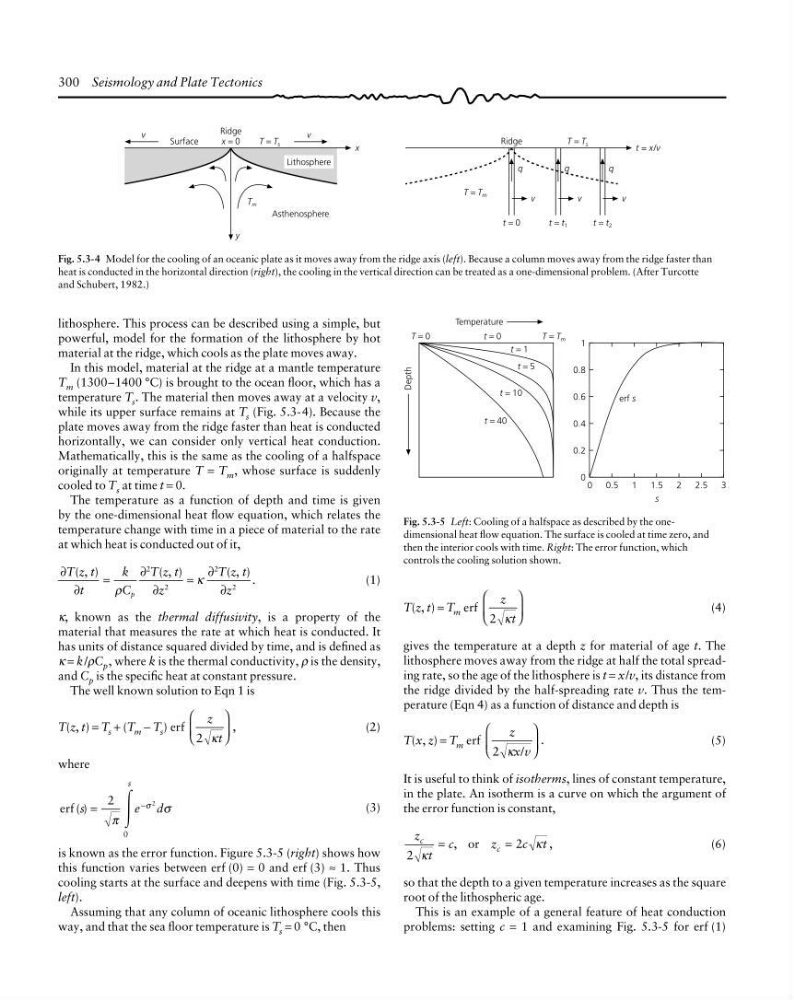
while its upper surface remains at T s (Fig. 5.3-4). Because the
plate moves away from the ridge faster than heat is conducted
horizontally, we can consider only vertical heat conduction.
Mathematically, this is the same as the cooling of a halfspace
originally at temperature T = T m , whose surface is suddenly
cooled to T s at time t = 0.
The temperature as a function of depth and time is given
by the one-dimensional heat flow equation, which relates the
temperature change with time in a piece of material to the rate
at which heat is conducted out of it,
∂
∂
∂
∂
∂
∂
2
2
T z t
t
k
C
T z t
z
T z t
z
p
( , )
( , )
( , ) .
=
=
ρ
κ
2
2
(1)
κ, known as the thermal diffusivity, is a property of the
material that measures the rate at which heat is conducted. It
has units of distance squared divided by time, and is defined as
κ = k/ρC p , where k is the thermal conductivity, ρ is the density,
and C p is the specific heat at constant pressure.
The well known solution to Eqn 1 is
T(z, t) = T s + (T m − T s ) erf
z
t
2 κ
⎛
⎝
⎜
⎞
⎠
⎟ ,
(2)
where
erf ( )
s
e d
s
=
−
2
0
2
π
σ
σ
Ύ
(3)
is known as the error function. Figure 5.3-5 (right) shows how
this function varies between erf (0) = 0 and erf (3) ≈ 1. Thus
cooling starts at the surface and deepens with time (Fig. 5.3-5,
left).
Assuming that any column of oceanic lithosphere cools this
way, and that the sea floor temperature is T s = 0 °C, then
Fig. 5.3-4 Model for the cooling of an oceanic plate as it moves away from the ridge axis (left). Because a column moves away from the ridge faster than
heat is conducted in the horizontal direction (right), the cooling in the vertical direction can be treated as a one-dimensional problem. (After Turcotte
and Schubert, 1982.)
Depth
1
0.8
0.6
0.4
0.2
0
0
t = 0
3
2.5
2
1.5
1
0.5
erf s
t = 1
t = 5
t = 10
t = 40
T = 0
T = T m
Temperature
s
Fig. 5.3-5 Left: Cooling of a halfspace as described by the onedimensional heat flow equation. The surface is cooled at time zero, and
then the interior cools with time. Right: The error function, which
controls the cooling solution shown.
T(z, t) = T m erf
z
t
2 κ
⎛
⎝
⎜
⎞
⎠
⎟
(4)
gives the temperature at a depth z for material of age t. The
lithosphere moves away from the ridge at half the total spreading rate, so the age of the lithosphere is t = x/v, its distance from
the ridge divided by the half-spreading rate v. Thus the temperature (Eqn 4) as a function of distance and depth is
T(x, z) = T m erf
z
x v
2 κ /
.
⎛
⎝
⎜
⎞
⎠
⎟
(5)
It is useful to think of isotherms, lines of constant temperature,
in the plate. An isotherm is a curve on which the argument of
the error function is constant,
z
t
c
z
c t
c
c
2
2
κ
κ
,
,
=
=
or
(6)
so that the depth to a given temperature increases as the square
root of the lithospheric age.
This is an example of a general feature of heat conduction
problems: setting c = 1 and examining Fig. 5.3-5 for erf (1)
Ridge
x = 0
x
v
v
Surface
T = T s
Lithosphere
Asthenosphere
T m
Ridge
t = x/v
T = T s
v
T = T m
t = 0
q
v
t = t 1
q
v
t = t 2
q
y
lithosphere. This process can be described using a simple, but
powerful, model for the formation of the lithosphere by hot
material at the ridge, which cools as the plate moves away.
In this model, material at the ridge at a mantle temperature
T m (1300–1400 °C) is brought to the ocean floor, which has a
temperature T s . The material then moves away at a velocity v,
while its upper surface remains at T s (Fig. 5.3-4). Because the
plate moves away from the ridge faster than heat is conducted
horizontally, we can consider only vertical heat conduction.
Mathematically, this is the same as the cooling of a halfspace
originally at temperature T = T m , whose surface is suddenly
cooled to T s at time t = 0.
The temperature as a function of depth and time is given
by the one-dimensional heat flow equation, which relates the
temperature change with time in a piece of material to the rate
at which heat is conducted out of it,
∂
∂
∂
∂
∂
∂
2
2
T z t
t
k
C
T z t
z
T z t
z
p
( , )
( , )
( , ) .
=
=
ρ
κ
2
2
(1)
κ, known as the thermal diffusivity, is a property of the
material that measures the rate at which heat is conducted. It
has units of distance squared divided by time, and is defined as
κ = k/ρC p , where k is the thermal conductivity, ρ is the density,
and C p is the specific heat at constant pressure.
The well known solution to Eqn 1 is
T(z, t) = T s + (T m − T s ) erf
z
t
2 κ
⎛
⎝
⎜
⎞
⎠
⎟ ,
(2)
where
erf ( )
s
e d
s
=
−
2
0
2
π
σ
σ
Ύ
(3)
is known as the error function. Figure 5.3-5 (right) shows how
this function varies between erf (0) = 0 and erf (3) ≈ 1. Thus
cooling starts at the surface and deepens with time (Fig. 5.3-5,
left).
Assuming that any column of oceanic lithosphere cools this
way, and that the sea floor temperature is T s = 0 °C, then
Fig. 5.3-4 Model for the cooling of an oceanic plate as it moves away from the ridge axis (left). Because a column moves away from the ridge faster than
heat is conducted in the horizontal direction (right), the cooling in the vertical direction can be treated as a one-dimensional problem. (After Turcotte
and Schubert, 1982.)
Depth
1
0.8
0.6
0.4
0.2
0
0
t = 0
3
2.5
2
1.5
1
0.5
erf s
t = 1
t = 5
t = 10
t = 40
T = 0
T = T m
Temperature
s
Fig. 5.3-5 Left: Cooling of a halfspace as described by the onedimensional heat flow equation. The surface is cooled at time zero, and
then the interior cools with time. Right: The error function, which
controls the cooling solution shown.
T(z, t) = T m erf
z
t
2 κ
⎛
⎝
⎜
⎞
⎠
⎟
(4)
gives the temperature at a depth z for material of age t. The
lithosphere moves away from the ridge at half the total spreading rate, so the age of the lithosphere is t = x/v, its distance from
the ridge divided by the half-spreading rate v. Thus the temperature (Eqn 4) as a function of distance and depth is
T(x, z) = T m erf
z
x v
2 κ /
.
⎛
⎝
⎜
⎞
⎠
⎟
(5)
It is useful to think of isotherms, lines of constant temperature,
in the plate. An isotherm is a curve on which the argument of
the error function is constant,
z
t
c
z
c t
c
c
2
2
κ
κ
,
,
=
=
or
(6)
so that the depth to a given temperature increases as the square
root of the lithospheric age.
This is an example of a general feature of heat conduction
problems: setting c = 1 and examining Fig. 5.3-5 for erf (1)