

Vema
Doldrums
Eltanin
Udintsev
15 20′
14°
10°
6°
−50°
−54°
−58°
−45°
− 40°
−145°
− 140°
−135°
Slow ridge (33 mm/yr)
Fast ridge (90 mm/yr)
Depth (km)
0
2
4
6
8
10
0
Distance (km)
25
20
15
10
5
West
East
Fault plane
4.0
5.0
6.0
7.0
? 8.0
?
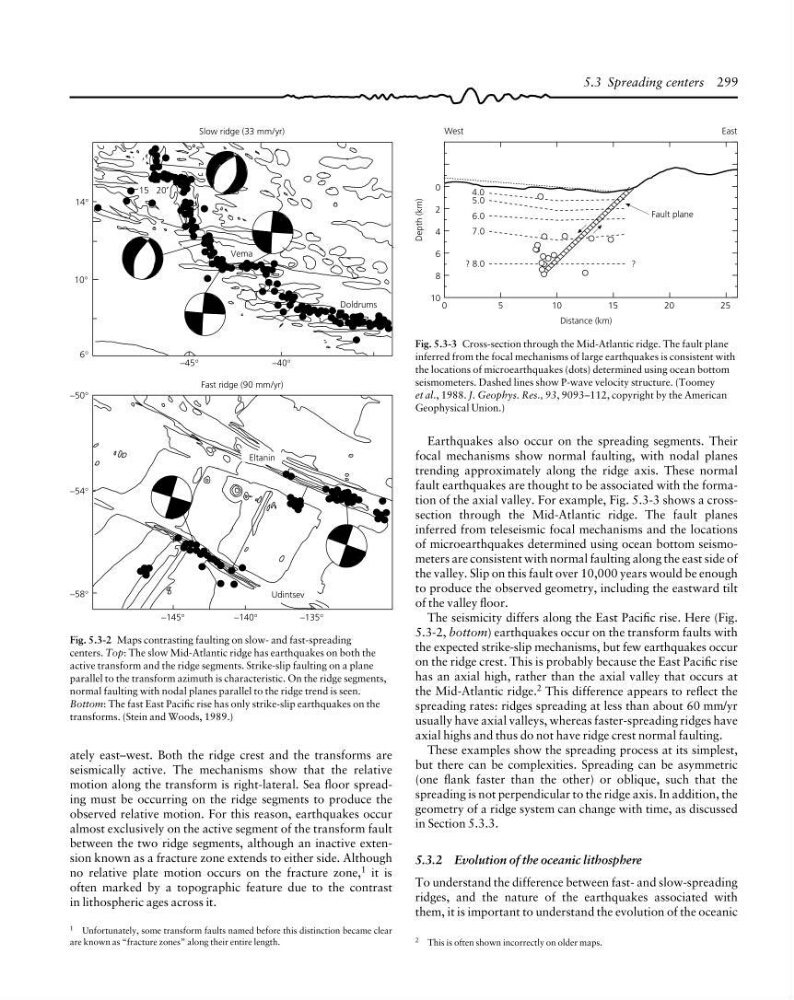
Earthquakes also occur on the spreading segments. Their
focal mechanisms show normal faulting, with nodal planes
trending approximately along the ridge axis. These normal
fault earthquakes are thought to be associated with the formation of the axial valley. For example, Fig. 5.3-3 shows a crosssection through the Mid-Atlantic ridge. The fault planes
inferred from teleseismic focal mechanisms and the locations
of microearthquakes determined using ocean bottom seismometers are consistent with normal faulting along the east side of
the valley. Slip on this fault over 10,000 years would be enough
to produce the observed geometry, including the eastward tilt
of the valley floor.
The seismicity differs along the East Pacific rise. Here (Fig.
5.3-2, bottom) earthquakes occur on the transform faults with
the expected strike-slip mechanisms, but few earthquakes occur
on the ridge crest. This is probably because the East Pacific rise
has an axial high, rather than the axial valley that occurs at
the Mid-Atlantic ridge. 2 This difference appears to reflect the
spreading rates: ridges spreading at less than about 60 mm/yr
usually have axial valleys, whereas faster-spreading ridges have
axial highs and thus do not have ridge crest normal faulting.
These examples show the spreading process at its simplest,
but there can be complexities. Spreading can be asymmetric
(one flank faster than the other) or oblique, such that the
spreading is not perpendicular to the ridge axis. In addition, the
geometry of a ridge system can change with time, as discussed
in Section 5.3.3.
5.3.2 Evolution of the oceanic lithosphere
To understand the difference between fast- and slow-spreading
ridges, and the nature of the earthquakes associated with
them, it is important to understand the evolution of the oceanic
Fig. 5.3-2 Maps contrasting faulting on slow- and fast-spreading
centers. Top: The slow Mid-Atlantic ridge has earthquakes on both the
active transform and the ridge segments. Strike-slip faulting on a plane
parallel to the transform azimuth is characteristic. On the ridge segments,
normal faulting with nodal planes parallel to the ridge trend is seen.
Bottom: The fast East Pacific rise has only strike-slip earthquakes on the
transforms. (Stein and Woods, 1989.)
Fig. 5.3-3 Cross-section through the Mid-Atlantic ridge. The fault plane
inferred from the focal mechanisms of large earthquakes is consistent with
the locations of microearthquakes (dots) determined using ocean bottom
seismometers. Dashed lines show P-wave velocity structure. (Toomey
et al., 1988. J. Geophys. Res., 93, 9093–112, copyright by the American
Geophysical Union.)
5.3 Spreading centers 299
ately east–west. Both the ridge crest and the transforms are
seismically active. The mechanisms show that the relative
motion along the transform is right-lateral. Sea floor spreading must be occurring on the ridge segments to produce the
observed relative motion. For this reason, earthquakes occur
almost exclusively on the active segment of the transform fault
between the two ridge segments, although an inactive extension known as a fracture zone extends to either side. Although
no relative plate motion occurs on the fracture zone, 1 it is
often marked by a topographic feature due to the contrast
in lithospheric ages across it.
1 Unfortunately, some transform faults named before this distinction became clear
are known as “fracture zones” along their entire length.
2 This is often shown incorrectly on older maps.
Doldrums
Eltanin
Udintsev
15 20′
14°
10°
6°
−50°
−54°
−58°
−45°
− 40°
−145°
− 140°
−135°
Slow ridge (33 mm/yr)
Fast ridge (90 mm/yr)
Depth (km)
0
2
4
6
8
10
0
Distance (km)
25
20
15
10
5
West
East
Fault plane
4.0
5.0
6.0
7.0
? 8.0
?
Earthquakes also occur on the spreading segments. Their
focal mechanisms show normal faulting, with nodal planes
trending approximately along the ridge axis. These normal
fault earthquakes are thought to be associated with the formation of the axial valley. For example, Fig. 5.3-3 shows a crosssection through the Mid-Atlantic ridge. The fault planes
inferred from teleseismic focal mechanisms and the locations
of microearthquakes determined using ocean bottom seismometers are consistent with normal faulting along the east side of
the valley. Slip on this fault over 10,000 years would be enough
to produce the observed geometry, including the eastward tilt
of the valley floor.
The seismicity differs along the East Pacific rise. Here (Fig.
5.3-2, bottom) earthquakes occur on the transform faults with
the expected strike-slip mechanisms, but few earthquakes occur
on the ridge crest. This is probably because the East Pacific rise
has an axial high, rather than the axial valley that occurs at
the Mid-Atlantic ridge. 2 This difference appears to reflect the
spreading rates: ridges spreading at less than about 60 mm/yr
usually have axial valleys, whereas faster-spreading ridges have
axial highs and thus do not have ridge crest normal faulting.
These examples show the spreading process at its simplest,
but there can be complexities. Spreading can be asymmetric
(one flank faster than the other) or oblique, such that the
spreading is not perpendicular to the ridge axis. In addition, the
geometry of a ridge system can change with time, as discussed
in Section 5.3.3.
5.3.2 Evolution of the oceanic lithosphere
To understand the difference between fast- and slow-spreading
ridges, and the nature of the earthquakes associated with
them, it is important to understand the evolution of the oceanic
Fig. 5.3-2 Maps contrasting faulting on slow- and fast-spreading
centers. Top: The slow Mid-Atlantic ridge has earthquakes on both the
active transform and the ridge segments. Strike-slip faulting on a plane
parallel to the transform azimuth is characteristic. On the ridge segments,
normal faulting with nodal planes parallel to the ridge trend is seen.
Bottom: The fast East Pacific rise has only strike-slip earthquakes on the
transforms. (Stein and Woods, 1989.)
Fig. 5.3-3 Cross-section through the Mid-Atlantic ridge. The fault plane
inferred from the focal mechanisms of large earthquakes is consistent with
the locations of microearthquakes (dots) determined using ocean bottom
seismometers. Dashed lines show P-wave velocity structure. (Toomey
et al., 1988. J. Geophys. Res., 93, 9093–112, copyright by the American
Geophysical Union.)
5.3 Spreading centers 299
ately east–west. Both the ridge crest and the transforms are
seismically active. The mechanisms show that the relative
motion along the transform is right-lateral. Sea floor spreading must be occurring on the ridge segments to produce the
observed relative motion. For this reason, earthquakes occur
almost exclusively on the active segment of the transform fault
between the two ridge segments, although an inactive extension known as a fracture zone extends to either side. Although
no relative plate motion occurs on the fracture zone, 1 it is
often marked by a topographic feature due to the contrast
in lithospheric ages across it.
1 Unfortunately, some transform faults named before this distinction became clear
are known as “fracture zones” along their entire length.
2 This is often shown incorrectly on older maps.