

Latitude (°)
Progressively older
165
170
175
180
185
190
195
200
205
Longitude (°)
H a w a ii a n R id g e
43 Ma
20 Ma
30 Ma
10 Ma
< 2Ma
50 Ma
70 Ma
Em
per
or
sea
mo
unt
s
Aleutian Islands
Pacific
Ocean
55
15
20
25
30
35
40
45
50
Hawaii
the overriding plate is oceanic, its motion causes a progression
from active volcanism that builds the islands, to older islands,
to underwater seamounts as the sea floor moves away from
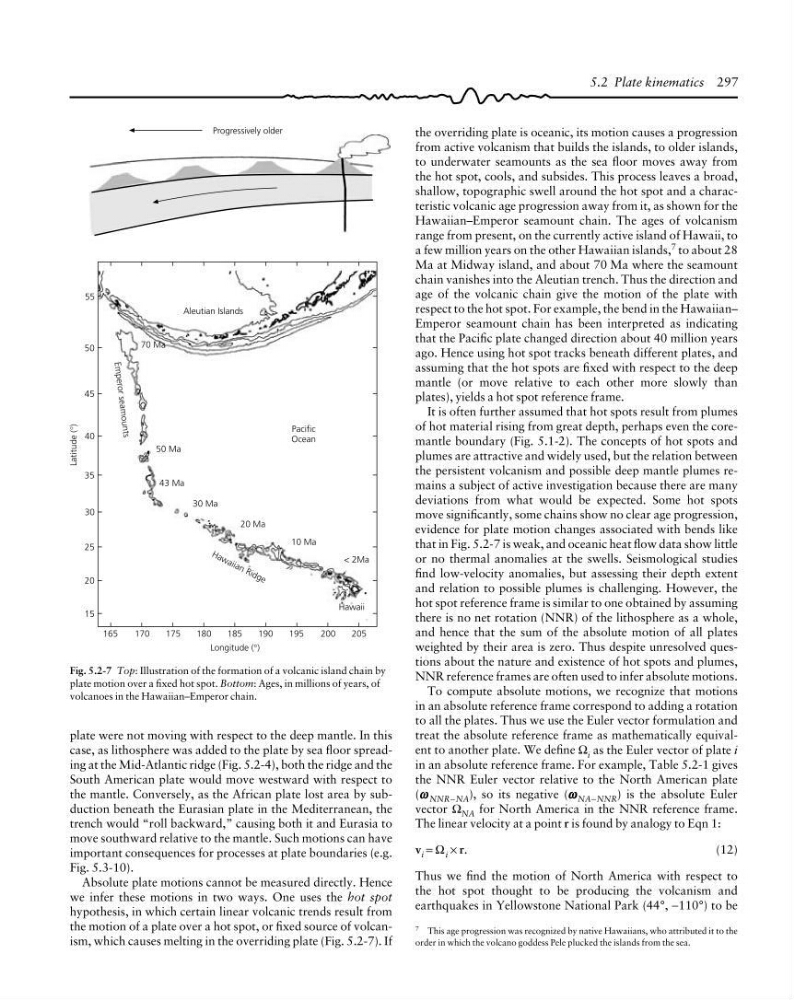
the hot spot, cools, and subsides. This process leaves a broad,
shallow, topographic swell around the hot spot and a characteristic volcanic age progression away from it, as shown for the
Hawaiian–Emperor seamount chain. The ages of volcanism
range from present, on the currently active island of Hawaii, to
a few million years on the other Hawaiian islands, 7 to about 28
Ma at Midway island, and about 70 Ma where the seamount
chain vanishes into the Aleutian trench. Thus the direction and
age of the volcanic chain give the motion of the plate with
respect to the hot spot. For example, the bend in the Hawaiian–
Emperor seamount chain has been interpreted as indicating
that the Pacific plate changed direction about 40 million years
ago. Hence using hot spot tracks beneath different plates, and
assuming that the hot spots are fixed with respect to the deep
mantle (or move relative to each other more slowly than
plates), yields a hot spot reference frame.
It is often further assumed that hot spots result from plumes
of hot material rising from great depth, perhaps even the coremantle boundary (Fig. 5.1-2). The concepts of hot spots and
plumes are attractive and widely used, but the relation between
the persistent volcanism and possible deep mantle plumes remains a subject of active investigation because there are many
deviations from what would be expected. Some hot spots
move significantly, some chains show no clear age progression,
evidence for plate motion changes associated with bends like
that in Fig. 5.2-7 is weak, and oceanic heat flow data show little
or no thermal anomalies at the swells. Seismological studies
find low-velocity anomalies, but assessing their depth extent
and relation to possible plumes is challenging. However, the
hot spot reference frame is similar to one obtained by assuming
there is no net rotation (NNR) of the lithosphere as a whole,
and hence that the sum of the absolute motion of all plates
weighted by their area is zero. Thus despite unresolved questions about the nature and existence of hot spots and plumes,
NNR reference frames are often used to infer absolute motions.
To compute absolute motions, we recognize that motions
in an absolute reference frame correspond to adding a rotation
to all the plates. Thus we use the Euler vector formulation and
treat the absolute reference frame as mathematically equivalent to another plate. We define Ω i as the Euler vector of plate i
in an absolute reference frame. For example, Table 5.2-1 gives
the NNR Euler vector relative to the North American plate
(ω ω ω
ω ω NNR−NA ), so its negative (ω ω ω
ω ω NA−NNR ) is the absolute Euler
vector Ω NA for North America in the NNR reference frame.
The linear velocity at a point r is found by analogy to Eqn 1:
v i = Ω i × r.
(12)
Thus we find the motion of North America with respect to
the hot spot thought to be producing the volcanism and
earthquakes in Yellowstone National Park (44°, −110°) to be
Fig. 5.2-7 Top: Illustration of the formation of a volcanic island chain by
plate motion over a fixed hot spot. Bottom: Ages, in millions of years, of
volcanoes in the Hawaiian–Emperor chain.
5.2 Plate kinematics 297
plate were not moving with respect to the deep mantle. In this
case, as lithosphere was added to the plate by sea floor spreading at the Mid-Atlantic ridge (Fig. 5.2-4), both the ridge and the
South American plate would move westward with respect to
the mantle. Conversely, as the African plate lost area by subduction beneath the Eurasian plate in the Mediterranean, the
trench would “roll backward,” causing both it and Eurasia to
move southward relative to the mantle. Such motions can have
important consequences for processes at plate boundaries (e.g.
Fig. 5.3-10).
Absolute plate motions cannot be measured directly. Hence
we infer these motions in two ways. One uses the hot spot
hypothesis, in which certain linear volcanic trends result from
the motion of a plate over a hot spot, or fixed source of volcanism, which causes melting in the overriding plate (Fig. 5.2-7). If
7 This age progression was recognized by native Hawaiians, who attributed it to the
order in which the volcano goddess Pele plucked the islands from the sea.
Progressively older
165
170
175
180
185
190
195
200
205
Longitude (°)
H a w a ii a n R id g e
43 Ma
20 Ma
30 Ma
10 Ma
< 2Ma
50 Ma
70 Ma
Em
per
or
sea
mo
unt
s
Aleutian Islands
Pacific
Ocean
55
15
20
25
30
35
40
45
50
Hawaii
the overriding plate is oceanic, its motion causes a progression
from active volcanism that builds the islands, to older islands,
to underwater seamounts as the sea floor moves away from
the hot spot, cools, and subsides. This process leaves a broad,
shallow, topographic swell around the hot spot and a characteristic volcanic age progression away from it, as shown for the
Hawaiian–Emperor seamount chain. The ages of volcanism
range from present, on the currently active island of Hawaii, to
a few million years on the other Hawaiian islands, 7 to about 28
Ma at Midway island, and about 70 Ma where the seamount
chain vanishes into the Aleutian trench. Thus the direction and
age of the volcanic chain give the motion of the plate with
respect to the hot spot. For example, the bend in the Hawaiian–
Emperor seamount chain has been interpreted as indicating
that the Pacific plate changed direction about 40 million years
ago. Hence using hot spot tracks beneath different plates, and
assuming that the hot spots are fixed with respect to the deep
mantle (or move relative to each other more slowly than
plates), yields a hot spot reference frame.
It is often further assumed that hot spots result from plumes
of hot material rising from great depth, perhaps even the coremantle boundary (Fig. 5.1-2). The concepts of hot spots and
plumes are attractive and widely used, but the relation between
the persistent volcanism and possible deep mantle plumes remains a subject of active investigation because there are many
deviations from what would be expected. Some hot spots
move significantly, some chains show no clear age progression,
evidence for plate motion changes associated with bends like
that in Fig. 5.2-7 is weak, and oceanic heat flow data show little
or no thermal anomalies at the swells. Seismological studies
find low-velocity anomalies, but assessing their depth extent
and relation to possible plumes is challenging. However, the
hot spot reference frame is similar to one obtained by assuming
there is no net rotation (NNR) of the lithosphere as a whole,
and hence that the sum of the absolute motion of all plates
weighted by their area is zero. Thus despite unresolved questions about the nature and existence of hot spots and plumes,
NNR reference frames are often used to infer absolute motions.
To compute absolute motions, we recognize that motions
in an absolute reference frame correspond to adding a rotation
to all the plates. Thus we use the Euler vector formulation and
treat the absolute reference frame as mathematically equivalent to another plate. We define Ω i as the Euler vector of plate i
in an absolute reference frame. For example, Table 5.2-1 gives
the NNR Euler vector relative to the North American plate
(ω ω ω
ω ω NNR−NA ), so its negative (ω ω ω
ω ω NA−NNR ) is the absolute Euler
vector Ω NA for North America in the NNR reference frame.
The linear velocity at a point r is found by analogy to Eqn 1:
v i = Ω i × r.
(12)
Thus we find the motion of North America with respect to
the hot spot thought to be producing the volcanism and
earthquakes in Yellowstone National Park (44°, −110°) to be
Fig. 5.2-7 Top: Illustration of the formation of a volcanic island chain by
plate motion over a fixed hot spot. Bottom: Ages, in millions of years, of
volcanoes in the Hawaiian–Emperor chain.
5.2 Plate kinematics 297
plate were not moving with respect to the deep mantle. In this
case, as lithosphere was added to the plate by sea floor spreading at the Mid-Atlantic ridge (Fig. 5.2-4), both the ridge and the
South American plate would move westward with respect to
the mantle. Conversely, as the African plate lost area by subduction beneath the Eurasian plate in the Mediterranean, the
trench would “roll backward,” causing both it and Eurasia to
move southward relative to the mantle. Such motions can have
important consequences for processes at plate boundaries (e.g.
Fig. 5.3-10).
Absolute plate motions cannot be measured directly. Hence
we infer these motions in two ways. One uses the hot spot
hypothesis, in which certain linear volcanic trends result from
the motion of a plate over a hot spot, or fixed source of volcanism, which causes melting in the overriding plate (Fig. 5.2-7). If
7 This age progression was recognized by native Hawaiians, who attributed it to the
order in which the volcano goddess Pele plucked the islands from the sea.