

Rotation pole
Transform
Spreading
ridge
Plate 1
Plate 2
21
ω
Rotation pole
Transform
Subduction
zone
Plate 1
Plate 2
12
ω
v y = a | ω
ω ω
ω ω | (sin θ cos λ cos µ − cos θ cos φ sin λ)
v z = a | ω
ω ω
ω ω | cos θ cos λ sin (µ − φ).
(5)
At the point r, the north–south and east–west unit vectors
can be written in terms of their Cartesian components using
Eqn A.7.4,
ê NS = (−sin λ cos µ, −sin λ sin µ, cos λ),
ê
EW
= (−sin µ, cos µ, 0),
(6)
so we find the north–south and east–west components of v by
taking dot products of its Cartesian components (Eqns 5) with
the unit vectors (Eqns 6), and obtain
v NS = a | ω
ω ω
ω ω | cos θ sin (µ − φ),
v EW = a | ω
ω ω
ω ω | [sin θ cos λ − cos θ sin λ cos (µ − φ)].
(7)
We can then find the rate and direction of plate motion,
rate = | v | =
+
( )
(
)
v
v
NS
EW
2
2
azimuth = 90° − tan −1 [(v NS )/(v EW )],
(8)
such that azimuth is measured in the usual convention, degrees
clockwise from North.
In evaluating these expressions, it is important to be careful
with dimensions. Although rotation rates are typically reported
in degrees per million years, they should be converted to
radians per year. The resulting linear velocity will have the
same dimensions as Earth’s radius. By serendipity, converting
radius in km to mm and Myr to years cancel out, so only the
degrees to radians (× π /180°) conversion actually needs to be
done to obtain a linear velocity in mm/yr. Plate motions are
often quoted as mm/yr, because a year is a comfortable unit
of time for humans and 1 mm/yr corresponds to 1 km/Myr,
making it easy to visualize what seemingly slow plate motion
accomplishes over geologic time.
To see how this works, consider Fig. 5.2-3, which shows the
North America–Pacific boundary zone. The map is drawn in a
projection about the Euler pole, so the expected relative motion
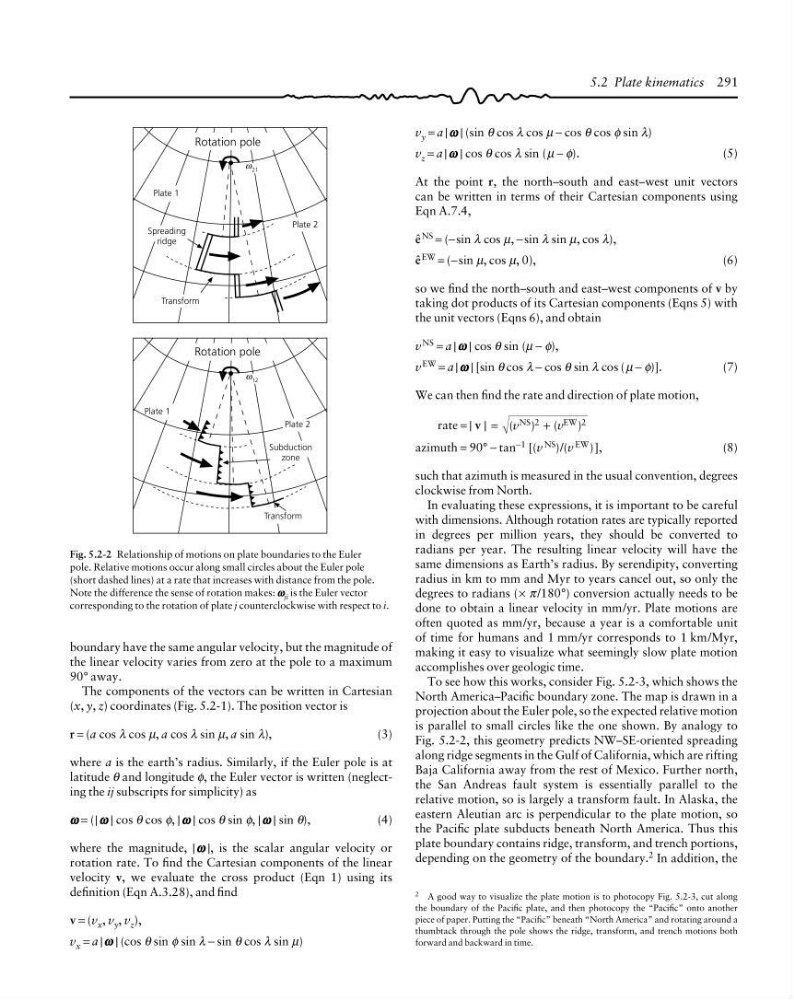
is parallel to small circles like the one shown. By analogy to
Fig. 5.2-2, this geometry predicts NW–SE-oriented spreading
along ridge segments in the Gulf of California, which are rifting
Baja California away from the rest of Mexico. Further north,
the San Andreas fault system is essentially parallel to the
relative motion, so is largely a transform fault. In Alaska, the
eastern Aleutian arc is perpendicular to the plate motion, so
the Pacific plate subducts beneath North America. Thus this
plate boundary contains ridge, transform, and trench portions,
depending on the geometry of the boundary. 2 In addition, the
Fig. 5.2-2 Relationship of motions on plate boundaries to the Euler
pole. Relative motions occur along small circles about the Euler pole
(short dashed lines) at a rate that increases with distance from the pole.
Note the difference the sense of rotation makes: ω
ω ω
ω ω ji is the Euler vector
corresponding to the rotation of plate j counterclockwise with respect to i.
5.2 Plate kinematics 291
boundary have the same angular velocity, but the magnitude of
the linear velocity varies from zero at the pole to a maximum
90° away.
The components of the vectors can be written in Cartesian
(x, y, z) coordinates (Fig. 5.2-1). The position vector is
r = (a cos λ cos µ, a cos λ sin µ, a sin λ),
(3)
where a is the earth’s radius. Similarly, if the Euler pole is at
latitude θ and longitude φ, the Euler vector is written (neglecting the ij subscripts for simplicity) as
ω
ω ω
ω ω = (| ω
ω ω
ω ω | cos θ cos φ, | ω
ω ω
ω ω | cos θ sin φ, | ω
ω ω
ω ω | sin θ),
(4)
where the magnitude, | ω
ω ω
ω ω |, is the scalar angular velocity or
rotation rate. To find the Cartesian components of the linear
velocity v, we evaluate the cross product (Eqn 1) using its
definition (Eqn A.3.28), and find
v = (v x , v y , v z ),
v x = a | ω
ω ω
ω ω | (cos θ sin φ sin λ − sin θ cos λ sin µ)
2 A good way to visualize the plate motion is to photocopy Fig. 5.2-3, cut along
the boundary of the Pacific plate, and then photocopy the “Pacific” onto another
piece of paper. Putting the “Pacific” beneath “North America” and rotating around a
thumbtack through the pole shows the ridge, transform, and trench motions both
forward and backward in time.
Transform
Spreading
ridge
Plate 1
Plate 2
21
ω
Rotation pole
Transform
Subduction
zone
Plate 1
Plate 2
12
ω
v y = a | ω
ω ω
ω ω | (sin θ cos λ cos µ − cos θ cos φ sin λ)
v z = a | ω
ω ω
ω ω | cos θ cos λ sin (µ − φ).
(5)
At the point r, the north–south and east–west unit vectors
can be written in terms of their Cartesian components using
Eqn A.7.4,
ê NS = (−sin λ cos µ, −sin λ sin µ, cos λ),
ê
EW
= (−sin µ, cos µ, 0),
(6)
so we find the north–south and east–west components of v by
taking dot products of its Cartesian components (Eqns 5) with
the unit vectors (Eqns 6), and obtain
v NS = a | ω
ω ω
ω ω | cos θ sin (µ − φ),
v EW = a | ω
ω ω
ω ω | [sin θ cos λ − cos θ sin λ cos (µ − φ)].
(7)
We can then find the rate and direction of plate motion,
rate = | v | =
+
( )
(
)
v
v
NS
EW
2
2
azimuth = 90° − tan −1 [(v NS )/(v EW )],
(8)
such that azimuth is measured in the usual convention, degrees
clockwise from North.
In evaluating these expressions, it is important to be careful
with dimensions. Although rotation rates are typically reported
in degrees per million years, they should be converted to
radians per year. The resulting linear velocity will have the
same dimensions as Earth’s radius. By serendipity, converting
radius in km to mm and Myr to years cancel out, so only the
degrees to radians (× π /180°) conversion actually needs to be
done to obtain a linear velocity in mm/yr. Plate motions are
often quoted as mm/yr, because a year is a comfortable unit
of time for humans and 1 mm/yr corresponds to 1 km/Myr,
making it easy to visualize what seemingly slow plate motion
accomplishes over geologic time.
To see how this works, consider Fig. 5.2-3, which shows the
North America–Pacific boundary zone. The map is drawn in a
projection about the Euler pole, so the expected relative motion
is parallel to small circles like the one shown. By analogy to
Fig. 5.2-2, this geometry predicts NW–SE-oriented spreading
along ridge segments in the Gulf of California, which are rifting
Baja California away from the rest of Mexico. Further north,
the San Andreas fault system is essentially parallel to the
relative motion, so is largely a transform fault. In Alaska, the
eastern Aleutian arc is perpendicular to the plate motion, so
the Pacific plate subducts beneath North America. Thus this
plate boundary contains ridge, transform, and trench portions,
depending on the geometry of the boundary. 2 In addition, the
Fig. 5.2-2 Relationship of motions on plate boundaries to the Euler
pole. Relative motions occur along small circles about the Euler pole
(short dashed lines) at a rate that increases with distance from the pole.
Note the difference the sense of rotation makes: ω
ω ω
ω ω ji is the Euler vector
corresponding to the rotation of plate j counterclockwise with respect to i.
5.2 Plate kinematics 291
boundary have the same angular velocity, but the magnitude of
the linear velocity varies from zero at the pole to a maximum
90° away.
The components of the vectors can be written in Cartesian
(x, y, z) coordinates (Fig. 5.2-1). The position vector is
r = (a cos λ cos µ, a cos λ sin µ, a sin λ),
(3)
where a is the earth’s radius. Similarly, if the Euler pole is at
latitude θ and longitude φ, the Euler vector is written (neglecting the ij subscripts for simplicity) as
ω
ω ω
ω ω = (| ω
ω ω
ω ω | cos θ cos φ, | ω
ω ω
ω ω | cos θ sin φ, | ω
ω ω
ω ω | sin θ),
(4)
where the magnitude, | ω
ω ω
ω ω |, is the scalar angular velocity or
rotation rate. To find the Cartesian components of the linear
velocity v, we evaluate the cross product (Eqn 1) using its
definition (Eqn A.3.28), and find
v = (v x , v y , v z ),
v x = a | ω
ω ω
ω ω | (cos θ sin φ sin λ − sin θ cos λ sin µ)
2 A good way to visualize the plate motion is to photocopy Fig. 5.2-3, cut along
the boundary of the Pacific plate, and then photocopy the “Pacific” onto another
piece of paper. Putting the “Pacific” beneath “North America” and rotating around a
thumbtack through the pole shows the ridge, transform, and trench motions both
forward and backward in time.