

290 Seismology and Plate Tectonics
Greenwich
meridian
X
N
Z
Euler vector
ji
ω
Euler pole
θ
λ
µ
φ
v ji
~
Y
r
Depth (km)
200
New Hebrides
200
Trench axes
Volcanic line
0
Fig. 5.1-5 Seismicity cross-section perpendicular to the New Hebrides
trench showing the Wadati–Benioff zone. This dipping plane of
earthquakes indicates the position of the subducting plate. (Isacks and
Barazangi, 1977. Island Arcs, Deep Sea Trenches and Back Arc Basins,
99–114, copyright by the American Geophysical Union.)
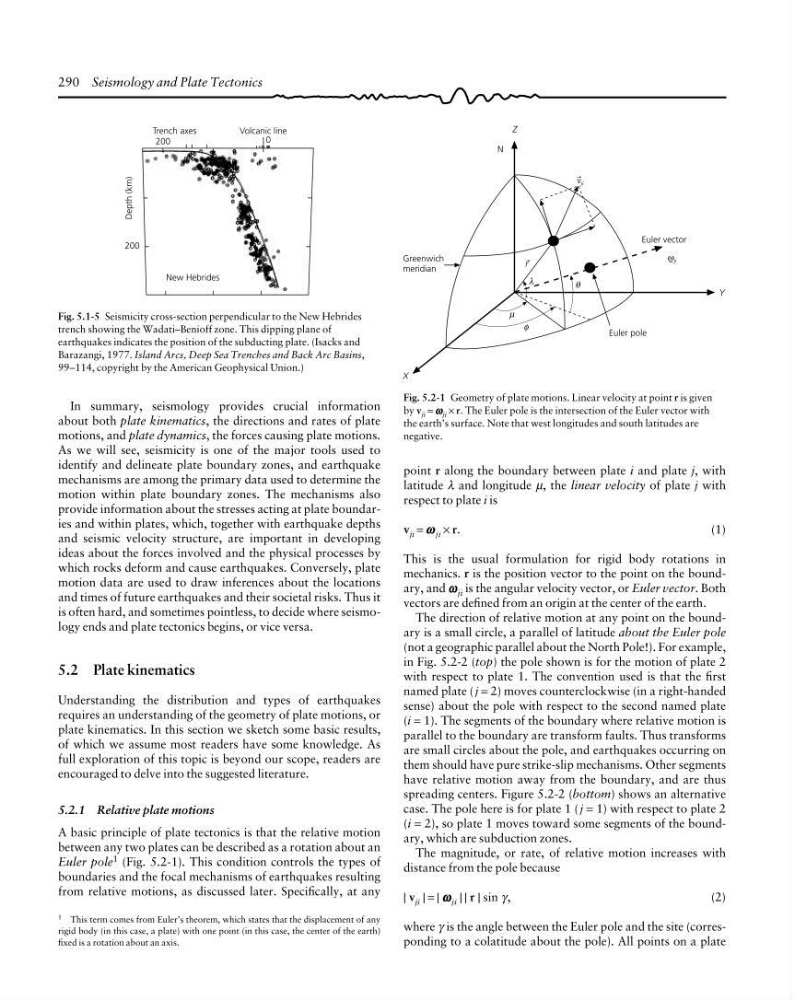
Fig. 5.2-1 Geometry of plate motions. Linear velocity at point r is given
by v ji = ω
ω ω
ω ω ji × r. The Euler pole is the intersection of the Euler vector with
the earth’s surface. Note that west longitudes and south latitudes are
negative.
point r along the boundary between plate i and plate j, with
latitude λ and longitude µ, the linear velocity of plate j with
respect to plate i is
v ji = ω
ω ω
ω ω ji × r.
(1)
This is the usual formulation for rigid body rotations in
mechanics. r is the position vector to the point on the boundary, and ω
ω ω
ω ω ji is the angular velocity vector, or Euler vector. Both
vectors are defined from an origin at the center of the earth.
The direction of relative motion at any point on the boundary is a small circle, a parallel of latitude about the Euler pole
(not a geographic parallel about the North Pole!). For example,
in Fig. 5.2-2 (top) the pole shown is for the motion of plate 2
with respect to plate 1. The convention used is that the first
named plate ( j = 2) moves counterclockwise (in a right-handed
sense) about the pole with respect to the second named plate
(i = 1). The segments of the boundary where relative motion is
parallel to the boundary are transform faults. Thus transforms
are small circles about the pole, and earthquakes occurring on
them should have pure strike-slip mechanisms. Other segments
have relative motion away from the boundary, and are thus
spreading centers. Figure 5.2-2 (bottom) shows an alternative
case. The pole here is for plate 1 ( j = 1) with respect to plate 2
(i = 2), so plate 1 moves toward some segments of the boundary, which are subduction zones.
The magnitude, or rate, of relative motion increases with
distance from the pole because
| v ji | = | ω
ω ω
ω ω ji | | r | sin γ ,
(2)
where γ is the angle between the Euler pole and the site (corresponding to a colatitude about the pole). All points on a plate
1 This term comes from Euler’s theorem, which states that the displacement of any
rigid body (in this case, a plate) with one point (in this case, the center of the earth)
fixed is a rotation about an axis.
In summary, seismology provides crucial information
about both plate kinematics, the directions and rates of plate
motions, and plate dynamics, the forces causing plate motions.
As we will see, seismicity is one of the major tools used to
identify and delineate plate boundary zones, and earthquake
mechanisms are among the primary data used to determine the
motion within plate boundary zones. The mechanisms also
provide information about the stresses acting at plate boundaries and within plates, which, together with earthquake depths
and seismic velocity structure, are important in developing
ideas about the forces involved and the physical processes by
which rocks deform and cause earthquakes. Conversely, plate
motion data are used to draw inferences about the locations
and times of future earthquakes and their societal risks. Thus it
is often hard, and sometimes pointless, to decide where seismology ends and plate tectonics begins, or vice versa.
5.2 Plate kinematics
Understanding the distribution and types of earthquakes
requires an understanding of the geometry of plate motions, or
plate kinematics. In this section we sketch some basic results,
of which we assume most readers have some knowledge. As
full exploration of this topic is beyond our scope, readers are
encouraged to delve into the suggested literature.
5.2.1 Relative plate motions
A basic principle of plate tectonics is that the relative motion
between any two plates can be described as a rotation about an
Euler pole 1 (Fig. 5.2-1). This condition controls the types of
boundaries and the focal mechanisms of earthquakes resulting
from relative motions, as discussed later. Specifically, at any
Greenwich
meridian
X
N
Z
Euler vector
ji
ω
Euler pole
θ
λ
µ
φ
v ji
~
Y
r
Depth (km)
200
New Hebrides
200
Trench axes
Volcanic line
0
Fig. 5.1-5 Seismicity cross-section perpendicular to the New Hebrides
trench showing the Wadati–Benioff zone. This dipping plane of
earthquakes indicates the position of the subducting plate. (Isacks and
Barazangi, 1977. Island Arcs, Deep Sea Trenches and Back Arc Basins,
99–114, copyright by the American Geophysical Union.)
Fig. 5.2-1 Geometry of plate motions. Linear velocity at point r is given
by v ji = ω
ω ω
ω ω ji × r. The Euler pole is the intersection of the Euler vector with
the earth’s surface. Note that west longitudes and south latitudes are
negative.
point r along the boundary between plate i and plate j, with
latitude λ and longitude µ, the linear velocity of plate j with
respect to plate i is
v ji = ω
ω ω
ω ω ji × r.
(1)
This is the usual formulation for rigid body rotations in
mechanics. r is the position vector to the point on the boundary, and ω
ω ω
ω ω ji is the angular velocity vector, or Euler vector. Both
vectors are defined from an origin at the center of the earth.
The direction of relative motion at any point on the boundary is a small circle, a parallel of latitude about the Euler pole
(not a geographic parallel about the North Pole!). For example,
in Fig. 5.2-2 (top) the pole shown is for the motion of plate 2
with respect to plate 1. The convention used is that the first
named plate ( j = 2) moves counterclockwise (in a right-handed
sense) about the pole with respect to the second named plate
(i = 1). The segments of the boundary where relative motion is
parallel to the boundary are transform faults. Thus transforms
are small circles about the pole, and earthquakes occurring on
them should have pure strike-slip mechanisms. Other segments
have relative motion away from the boundary, and are thus
spreading centers. Figure 5.2-2 (bottom) shows an alternative
case. The pole here is for plate 1 ( j = 1) with respect to plate 2
(i = 2), so plate 1 moves toward some segments of the boundary, which are subduction zones.
The magnitude, or rate, of relative motion increases with
distance from the pole because
| v ji | = | ω
ω ω
ω ω ji | | r | sin γ ,
(2)
where γ is the angle between the Euler pole and the site (corresponding to a colatitude about the pole). All points on a plate
1 This term comes from Euler’s theorem, which states that the displacement of any
rigid body (in this case, a plate) with one point (in this case, the center of the earth)
fixed is a rotation about an axis.
In summary, seismology provides crucial information
about both plate kinematics, the directions and rates of plate
motions, and plate dynamics, the forces causing plate motions.
As we will see, seismicity is one of the major tools used to
identify and delineate plate boundary zones, and earthquake
mechanisms are among the primary data used to determine the
motion within plate boundary zones. The mechanisms also
provide information about the stresses acting at plate boundaries and within plates, which, together with earthquake depths
and seismic velocity structure, are important in developing
ideas about the forces involved and the physical processes by
which rocks deform and cause earthquakes. Conversely, plate
motion data are used to draw inferences about the locations
and times of future earthquakes and their societal risks. Thus it
is often hard, and sometimes pointless, to decide where seismology ends and plate tectonics begins, or vice versa.
5.2 Plate kinematics
Understanding the distribution and types of earthquakes
requires an understanding of the geometry of plate motions, or
plate kinematics. In this section we sketch some basic results,
of which we assume most readers have some knowledge. As
full exploration of this topic is beyond our scope, readers are
encouraged to delve into the suggested literature.
5.2.1 Relative plate motions
A basic principle of plate tectonics is that the relative motion
between any two plates can be described as a rotation about an
Euler pole 1 (Fig. 5.2-1). This condition controls the types of
boundaries and the focal mechanisms of earthquakes resulting
from relative motions, as discussed later. Specifically, at any