

rock found in laboratory friction experiments. One possibility
is that the low stress drop reflects the average of highly variable
slip over a fault plane, whereas strength is much higher in
strong patches (sometimes called asperities) where the largest
slip occurs. However, other data, such as the absence of heat
flow anomalies at faults, also imply that faults are weaker than
expected from the laboratory results. As a result, it is not clear
whether earthquakes release most of the stress built up on a
fault or only a small fraction of it. It is similarly unclear how
to interpret the possible variations in energy release as a function of period, and perhaps stress drop, in different tectonic
environments. Intuitively, they might reflect interplate earthquakes occurring more frequently than intraplate events on
better-established, and perhaps thus weaker, faults. Similarly,
established transforms may be weaker than newly formed
near-ridge crust.
This discussion leads naturally to the question of how the
seismic wave energy radiated by an earthquake is related to its
moment and magnitude. To address this, recall that work
equals force times distance, so the strain energy released is the
product of the average stress during faulting, O, the average
slip, and the fault area,
W = OCS.
(25)
If the stresses before and after faulting are σ 0 and σ 1 , then
∆σ = σ 0 − σ 1 , and O = σ 1 + (∆σ)/2. Some of this energy, H, is lost
to friction, so the radiated seismic energy is
E = W − H = OCS − σ f CS,
(26)
where σ f is the frictional stress, or
E = (∆σ /2)CS + (σ 1 − σ f )CS = E 0 + (σ 1 − σ f )CS.
(27)
Thus the quantity
E 0 = (∆σ /2)CS = (∆σ /2µ)M 0
(28)
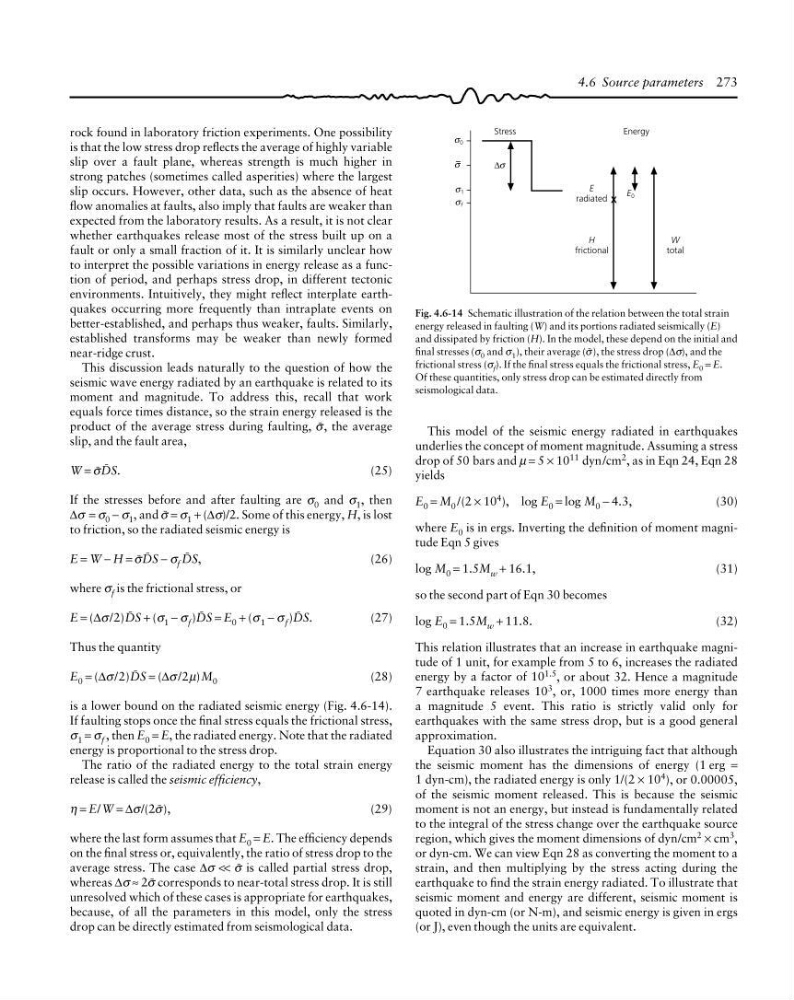
is a lower bound on the radiated seismic energy (Fig. 4.6-14).
If faulting stops once the final stress equals the frictional stress,
σ 1 = σ f , then E 0 = E, the radiated energy. Note that the radiated
energy is proportional to the stress drop.
The ratio of the radiated energy to the total strain energy
release is called the seismic efficiency,
η = E/W = ∆σ/(2O),
(29)
where the last form assumes that E 0 = E. The efficiency depends
on the final stress or, equivalently, the ratio of stress drop to the
average stress. The case ∆σ << O is called partial stress drop,
whereas ∆σ ≈ 2O corresponds to near-total stress drop. It is still
unresolved which of these cases is appropriate for earthquakes,
because, of all the parameters in this model, only the stress
drop can be directly estimated from seismological data.
Fig. 4.6-14 Schematic illustration of the relation between the total strain
energy released in faulting (W) and its portions radiated seismically (E)
and dissipated by friction (H). In the model, these depend on the initial and
final stresses (σ 0 and σ 1 ), their average (O), the stress drop (∆σ), and the
frictional stress (σ f ). If the final stress equals the frictional stress, E 0 = E.
Of these quantities, only stress drop can be estimated directly from
seismological data.
σ
0
σ
1
σ
f
σ
∆σ
Stress
Energy
E 0
E
radiated
H
frictional
W
total
X
4.6 Source parameters 273
This model of the seismic energy radiated in earthquakes
underlies the concept of moment magnitude. Assuming a stress
drop of 50 bars and µ = 5 × 10 11 dyn/cm 2 , as in Eqn 24, Eqn 28
yields
E 0 = M 0 /(2 × 10
4 ), log E 0 = log M 0 − 4.3,
(30)
where E 0 is in ergs. Inverting the definition of moment magnitude Eqn 5 gives
log M 0 = 1.5M w + 16.1,
(31)
so the second part of Eqn 30 becomes
log E 0 = 1.5M w + 11.8.
(32)
This relation illustrates that an increase in earthquake magnitude of 1 unit, for example from 5 to 6, increases the radiated
energy by a factor of 10
1.5
, or about 32. Hence a magnitude
7 earthquake releases 10 3 , or, 1000 times more energy than
a magnitude 5 event. This ratio is strictly valid only for
earthquakes with the same stress drop, but is a good general
approximation.
Equation 30 also illustrates the intriguing fact that although
the seismic moment has the dimensions of energy (1 erg =
1 dyn-cm), the radiated energy is only 1/(2 × 10 4 ), or 0.00005,
of the seismic moment released. This is because the seismic
moment is not an energy, but instead is fundamentally related
to the integral of the stress change over the earthquake source
region, which gives the moment dimensions of dyn/cm 2 × cm 3 ,
or dyn-cm. We can view Eqn 28 as converting the moment to a
strain, and then multiplying by the stress acting during the
earthquake to find the strain energy radiated. To illustrate that
seismic moment and energy are different, seismic moment is
quoted in dyn-cm (or N-m), and seismic energy is given in ergs
(or J), even though the units are equivalent.
is that the low stress drop reflects the average of highly variable
slip over a fault plane, whereas strength is much higher in
strong patches (sometimes called asperities) where the largest
slip occurs. However, other data, such as the absence of heat
flow anomalies at faults, also imply that faults are weaker than
expected from the laboratory results. As a result, it is not clear
whether earthquakes release most of the stress built up on a
fault or only a small fraction of it. It is similarly unclear how
to interpret the possible variations in energy release as a function of period, and perhaps stress drop, in different tectonic
environments. Intuitively, they might reflect interplate earthquakes occurring more frequently than intraplate events on
better-established, and perhaps thus weaker, faults. Similarly,
established transforms may be weaker than newly formed
near-ridge crust.
This discussion leads naturally to the question of how the
seismic wave energy radiated by an earthquake is related to its
moment and magnitude. To address this, recall that work
equals force times distance, so the strain energy released is the
product of the average stress during faulting, O, the average
slip, and the fault area,
W = OCS.
(25)
If the stresses before and after faulting are σ 0 and σ 1 , then
∆σ = σ 0 − σ 1 , and O = σ 1 + (∆σ)/2. Some of this energy, H, is lost
to friction, so the radiated seismic energy is
E = W − H = OCS − σ f CS,
(26)
where σ f is the frictional stress, or
E = (∆σ /2)CS + (σ 1 − σ f )CS = E 0 + (σ 1 − σ f )CS.
(27)
Thus the quantity
E 0 = (∆σ /2)CS = (∆σ /2µ)M 0
(28)
is a lower bound on the radiated seismic energy (Fig. 4.6-14).
If faulting stops once the final stress equals the frictional stress,
σ 1 = σ f , then E 0 = E, the radiated energy. Note that the radiated
energy is proportional to the stress drop.
The ratio of the radiated energy to the total strain energy
release is called the seismic efficiency,
η = E/W = ∆σ/(2O),
(29)
where the last form assumes that E 0 = E. The efficiency depends
on the final stress or, equivalently, the ratio of stress drop to the
average stress. The case ∆σ << O is called partial stress drop,
whereas ∆σ ≈ 2O corresponds to near-total stress drop. It is still
unresolved which of these cases is appropriate for earthquakes,
because, of all the parameters in this model, only the stress
drop can be directly estimated from seismological data.
Fig. 4.6-14 Schematic illustration of the relation between the total strain
energy released in faulting (W) and its portions radiated seismically (E)
and dissipated by friction (H). In the model, these depend on the initial and
final stresses (σ 0 and σ 1 ), their average (O), the stress drop (∆σ), and the
frictional stress (σ f ). If the final stress equals the frictional stress, E 0 = E.
Of these quantities, only stress drop can be estimated directly from
seismological data.
σ
0
σ
1
σ
f
σ
∆σ
Stress
Energy
E 0
E
radiated
H
frictional
W
total
X
4.6 Source parameters 273
This model of the seismic energy radiated in earthquakes
underlies the concept of moment magnitude. Assuming a stress
drop of 50 bars and µ = 5 × 10 11 dyn/cm 2 , as in Eqn 24, Eqn 28
yields
E 0 = M 0 /(2 × 10
4 ), log E 0 = log M 0 − 4.3,
(30)
where E 0 is in ergs. Inverting the definition of moment magnitude Eqn 5 gives
log M 0 = 1.5M w + 16.1,
(31)
so the second part of Eqn 30 becomes
log E 0 = 1.5M w + 11.8.
(32)
This relation illustrates that an increase in earthquake magnitude of 1 unit, for example from 5 to 6, increases the radiated
energy by a factor of 10
1.5
, or about 32. Hence a magnitude
7 earthquake releases 10 3 , or, 1000 times more energy than
a magnitude 5 event. This ratio is strictly valid only for
earthquakes with the same stress drop, but is a good general
approximation.
Equation 30 also illustrates the intriguing fact that although
the seismic moment has the dimensions of energy (1 erg =
1 dyn-cm), the radiated energy is only 1/(2 × 10 4 ), or 0.00005,
of the seismic moment released. This is because the seismic
moment is not an energy, but instead is fundamentally related
to the integral of the stress change over the earthquake source
region, which gives the moment dimensions of dyn/cm 2 × cm 3 ,
or dyn-cm. We can view Eqn 28 as converting the moment to a
strain, and then multiplying by the stress acting during the
earthquake to find the strain energy radiated. To illustrate that
seismic moment and energy are different, seismic moment is
quoted in dyn-cm (or N-m), and seismic energy is given in ergs
(or J), even though the units are equivalent.