

Normalized slip
1.5
1
0.5
0
−0.5
Interseismic
Coseismic
Total
Strike-slip fault
−200
0
200
−200
0
200
1
0.5
0
Interseismic
strain
Distance (km)
5
7.5
10
12.5
15
17.5
20
0
5
10
15
0–1 s
0
.
5
*
5
7.5
10
12.5
15
17.5
20
0
5
10
15
4–5 s
0 . 5
5
7.5
10
12.5
15
17.5
20
0
5
10
15
1–2 s
0 . 5
5
7.5
10
12.5
15
17.5
20
0
5
10
15
5–6 s
0 .5
5
7.5
10
12.5
15
17.5
20
0
5
10
15
2–3 s
0 .5
5
7.5
10
12.5
15
17.5
20
0
5
10
15
6–7 s
5
7.5
10
12.5
15
17.5
20
0
5
10
15
3–4 s
5
7.5
10
12.5
15
17.5
20
0
5
10
15
7–8 s
1
1
1.5
1
1
0 . 5
1
Depth (km)
Depth (km)
Depth (km)
Depth (km)
Distance along strike (km)
Distance along strike (km)
4.5 Earthquake geodesy 259
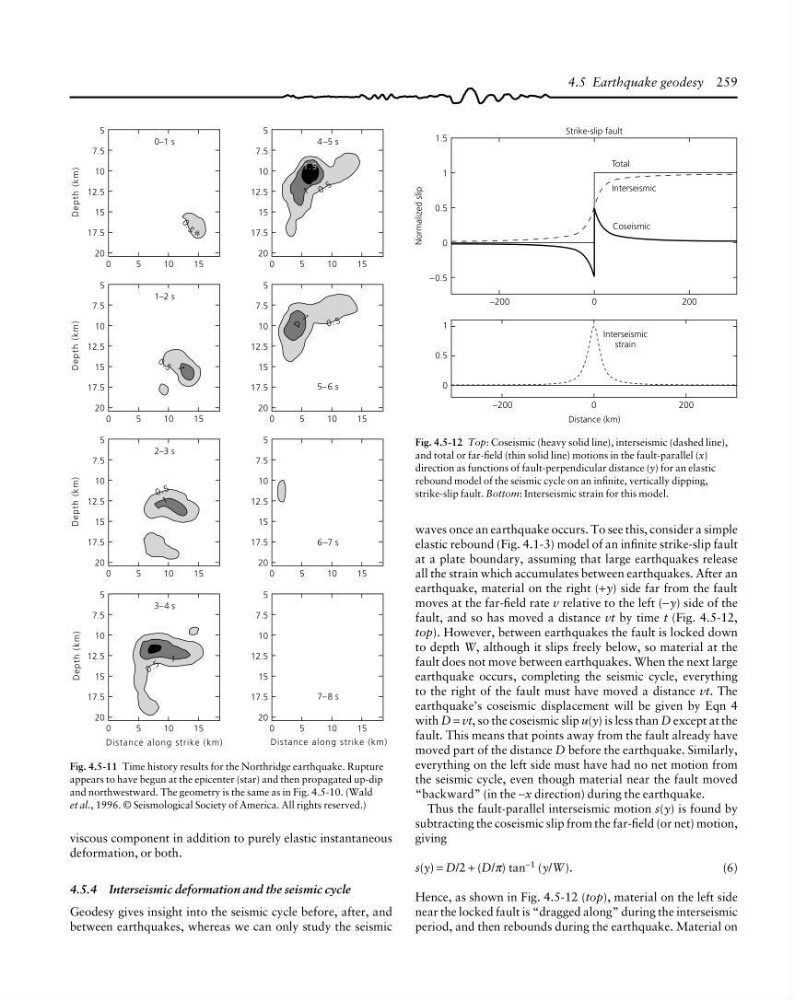
Fig. 4.5-12 Top: Coseismic (heavy solid line), interseismic (dashed line),
and total or far-field (thin solid line) motions in the fault-parallel (x)
direction as functions of fault-perpendicular distance (y) for an elastic
rebound model of the seismic cycle on an infinite, vertically dipping,
strike-slip fault. Bottom: Interseismic strain for this model.
waves once an earthquake occurs. To see this, consider a simple
elastic rebound (Fig. 4.1-3) model of an infinite strike-slip fault
at a plate boundary, assuming that large earthquakes release
all the strain which accumulates between earthquakes. After an
earthquake, material on the right (+y) side far from the fault
moves at the far-field rate v relative to the left (−y) side of the
fault, and so has moved a distance vt by time t (Fig. 4.5-12,
top). However, between earthquakes the fault is locked down
to depth W, although it slips freely below, so material at the
fault does not move between earthquakes. When the next large
earthquake occurs, completing the seismic cycle, everything
to the right of the fault must have moved a distance vt. The
earthquake’s coseismic displacement will be given by Eqn 4
with D = vt, so the coseismic slip u(y) is less than D except at the
fault. This means that points away from the fault already have
moved part of the distance D before the earthquake. Similarly,
everything on the left side must have had no net motion from
the seismic cycle, even though material near the fault moved
“backward” (in the −x direction) during the earthquake.
Thus the fault-parallel interseismic motion s(y) is found by
subtracting the coseismic slip from the far-field (or net) motion,
giving
s(y) = D/2 + (D/π) tan −1 (y/W).
(6)
Hence, as shown in Fig. 4.5-12 (top), material on the left side
near the locked fault is “dragged along” during the interseismic
period, and then rebounds during the earthquake. Material on
Fig. 4.5-11 Time history results for the Northridge earthquake. Rupture
appears to have begun at the epicenter (star) and then propagated up-dip
and northwestward. The geometry is the same as in Fig. 4.5-10. (Wald
et al., 1996. © Seismological Society of America. All rights reserved.)
viscous component in addition to purely elastic instantaneous
deformation, or both.
4.5.4 Interseismic deformation and the seismic cycle
Geodesy gives insight into the seismic cycle before, after, and
between earthquakes, whereas we can only study the seismic
1.5
1
0.5
0
−0.5
Interseismic
Coseismic
Total
Strike-slip fault
−200
0
200
−200
0
200
1
0.5
0
Interseismic
strain
Distance (km)
5
7.5
10
12.5
15
17.5
20
0
5
10
15
0–1 s
0
.
5
*
5
7.5
10
12.5
15
17.5
20
0
5
10
15
4–5 s
0 . 5
5
7.5
10
12.5
15
17.5
20
0
5
10
15
1–2 s
0 . 5
5
7.5
10
12.5
15
17.5
20
0
5
10
15
5–6 s
0 .5
5
7.5
10
12.5
15
17.5
20
0
5
10
15
2–3 s
0 .5
5
7.5
10
12.5
15
17.5
20
0
5
10
15
6–7 s
5
7.5
10
12.5
15
17.5
20
0
5
10
15
3–4 s
5
7.5
10
12.5
15
17.5
20
0
5
10
15
7–8 s
1
1
1.5
1
1
0 . 5
1
Depth (km)
Depth (km)
Depth (km)
Depth (km)
Distance along strike (km)
Distance along strike (km)
4.5 Earthquake geodesy 259
Fig. 4.5-12 Top: Coseismic (heavy solid line), interseismic (dashed line),
and total or far-field (thin solid line) motions in the fault-parallel (x)
direction as functions of fault-perpendicular distance (y) for an elastic
rebound model of the seismic cycle on an infinite, vertically dipping,
strike-slip fault. Bottom: Interseismic strain for this model.
waves once an earthquake occurs. To see this, consider a simple
elastic rebound (Fig. 4.1-3) model of an infinite strike-slip fault
at a plate boundary, assuming that large earthquakes release
all the strain which accumulates between earthquakes. After an
earthquake, material on the right (+y) side far from the fault
moves at the far-field rate v relative to the left (−y) side of the
fault, and so has moved a distance vt by time t (Fig. 4.5-12,
top). However, between earthquakes the fault is locked down
to depth W, although it slips freely below, so material at the
fault does not move between earthquakes. When the next large
earthquake occurs, completing the seismic cycle, everything
to the right of the fault must have moved a distance vt. The
earthquake’s coseismic displacement will be given by Eqn 4
with D = vt, so the coseismic slip u(y) is less than D except at the
fault. This means that points away from the fault already have
moved part of the distance D before the earthquake. Similarly,
everything on the left side must have had no net motion from
the seismic cycle, even though material near the fault moved
“backward” (in the −x direction) during the earthquake.
Thus the fault-parallel interseismic motion s(y) is found by
subtracting the coseismic slip from the far-field (or net) motion,
giving
s(y) = D/2 + (D/π) tan −1 (y/W).
(6)
Hence, as shown in Fig. 4.5-12 (top), material on the left side
near the locked fault is “dragged along” during the interseismic
period, and then rebounds during the earthquake. Material on
Fig. 4.5-11 Time history results for the Northridge earthquake. Rupture
appears to have begun at the epicenter (star) and then propagated up-dip
and northwestward. The geometry is the same as in Fig. 4.5-10. (Wald
et al., 1996. © Seismological Society of America. All rights reserved.)
viscous component in addition to purely elastic instantaneous
deformation, or both.
4.5.4 Interseismic deformation and the seismic cycle
Geodesy gives insight into the seismic cycle before, after, and
between earthquakes, whereas we can only study the seismic