

Displacement
0.50
0.25
0
−0.25
−0.50
Fault width (km)
Z
L
y
w
x
5
20
35
Strike-slip fault
−200
0
200
Distance (km)
4.5 Earthquake geodesy 255
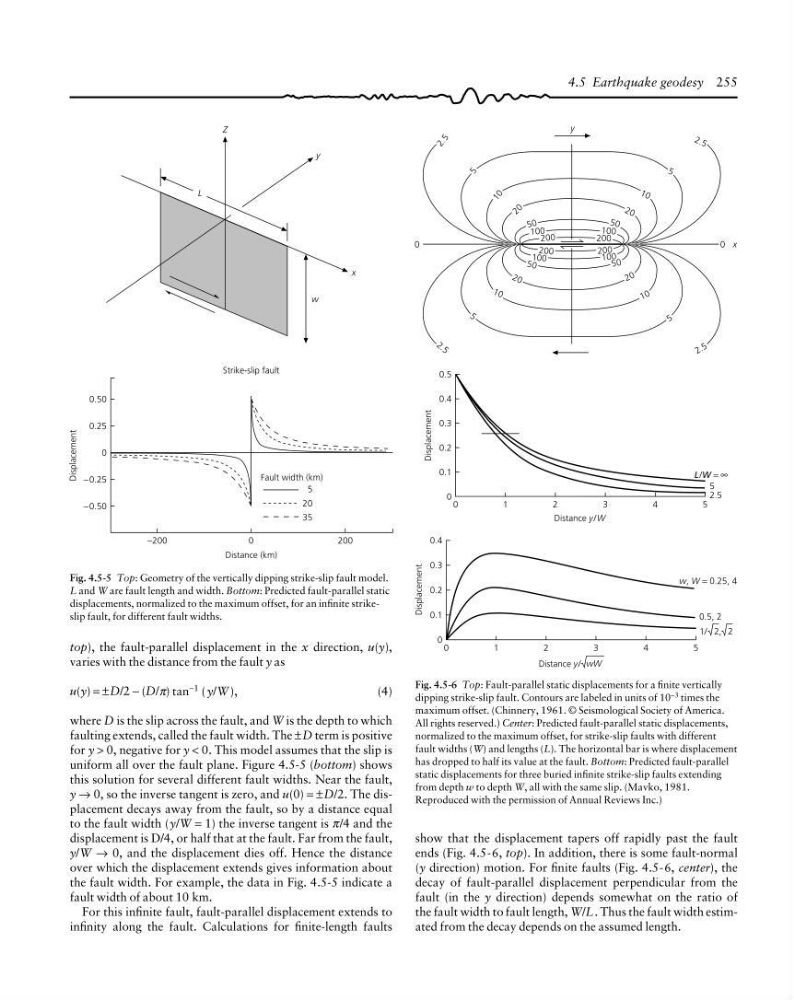
Fig. 4.5-5 Top: Geometry of the vertically dipping strike-slip fault model.
L and W are fault length and width. Bottom: Predicted fault-parallel static
displacements, normalized to the maximum offset, for an infinite strikeslip fault, for different fault widths.
top), the fault-parallel displacement in the x direction, u(y),
varies with the distance from the fault y as
u(y) = ±D/2 − (D/π) tan −1 ( y/W ),
(4)
where D is the slip across the fault, and W is the depth to which
faulting extends, called the fault width. The ±D term is positive
for y > 0, negative for y < 0. This model assumes that the slip is
uniform all over the fault plane. Figure 4.5-5 (bottom) shows
this solution for several different fault widths. Near the fault,
y → 0, so the inverse tangent is zero, and u(0) = ±D/2. The displacement decays away from the fault, so by a distance equal
to the fault width (y/W = 1) the inverse tangent is π/4 and the
displacement is D/4, or half that at the fault. Far from the fault,
y/W → 0, and the displacement dies off. Hence the distance
over which the displacement extends gives information about
the fault width. For example, the data in Fig. 4.5-5 indicate a
fault width of about 10 km.
For this infinite fault, fault-parallel displacement extends to
infinity along the fault. Calculations for finite-length faults
Fig. 4.5-6 Top: Fault-parallel static displacements for a finite vertically
dipping strike-slip fault. Contours are labeled in units of 10
−3 times the
maximum offset. (Chinnery, 1961. © Seismological Society of America.
All rights reserved.) Center: Predicted fault-parallel static displacements,
normalized to the maximum offset, for strike-slip faults with different
fault widths (W) and lengths (L). The horizontal bar is where displacement
has dropped to half its value at the fault. Bottom: Predicted fault-parallel
static displacements for three buried infinite strike-slip faults extending
from depth w to depth W, all with the same slip. (Mavko, 1981.
Reproduced with the permission of Annual Reviews Inc.)
0
0 x
Displacement
0.5
0.4
0.3
0.2
0.1
0
2 . 5
5
1 0
2 0
5 0
100
200
5 0
2 0
1 0
5
2 .5
200
100
5 0
2 0
1 0
5
2 . 5
200
100
50
2 0
1 0
5
2 .5
100
200
y
0
1
2
3
4
5
2.5
5
L/W = ∞
Distance y/W
Displacement
0.4
0.3
0.2
0.1
0
0
1
2
3
4
5
Distance y/
w, W = 0.25, 4
0.5, 2
wW
1/ ,
2 2
show that the displacement tapers off rapidly past the fault
ends (Fig. 4.5-6, top). In addition, there is some fault-normal
(y direction) motion. For finite faults (Fig. 4.5-6, center), the
decay of fault-parallel displacement perpendicular from the
fault (in the y direction) depends somewhat on the ratio of
the fault width to fault length, W/L. Thus the fault width estimated from the decay depends on the assumed length.
0.50
0.25
0
−0.25
−0.50
Fault width (km)
Z
L
y
w
x
5
20
35
Strike-slip fault
−200
0
200
Distance (km)
4.5 Earthquake geodesy 255
Fig. 4.5-5 Top: Geometry of the vertically dipping strike-slip fault model.
L and W are fault length and width. Bottom: Predicted fault-parallel static
displacements, normalized to the maximum offset, for an infinite strikeslip fault, for different fault widths.
top), the fault-parallel displacement in the x direction, u(y),
varies with the distance from the fault y as
u(y) = ±D/2 − (D/π) tan −1 ( y/W ),
(4)
where D is the slip across the fault, and W is the depth to which
faulting extends, called the fault width. The ±D term is positive
for y > 0, negative for y < 0. This model assumes that the slip is
uniform all over the fault plane. Figure 4.5-5 (bottom) shows
this solution for several different fault widths. Near the fault,
y → 0, so the inverse tangent is zero, and u(0) = ±D/2. The displacement decays away from the fault, so by a distance equal
to the fault width (y/W = 1) the inverse tangent is π/4 and the
displacement is D/4, or half that at the fault. Far from the fault,
y/W → 0, and the displacement dies off. Hence the distance
over which the displacement extends gives information about
the fault width. For example, the data in Fig. 4.5-5 indicate a
fault width of about 10 km.
For this infinite fault, fault-parallel displacement extends to
infinity along the fault. Calculations for finite-length faults
Fig. 4.5-6 Top: Fault-parallel static displacements for a finite vertically
dipping strike-slip fault. Contours are labeled in units of 10
−3 times the
maximum offset. (Chinnery, 1961. © Seismological Society of America.
All rights reserved.) Center: Predicted fault-parallel static displacements,
normalized to the maximum offset, for strike-slip faults with different
fault widths (W) and lengths (L). The horizontal bar is where displacement
has dropped to half its value at the fault. Bottom: Predicted fault-parallel
static displacements for three buried infinite strike-slip faults extending
from depth w to depth W, all with the same slip. (Mavko, 1981.
Reproduced with the permission of Annual Reviews Inc.)
0
0 x
Displacement
0.5
0.4
0.3
0.2
0.1
0
2 . 5
5
1 0
2 0
5 0
100
200
5 0
2 0
1 0
5
2 .5
200
100
5 0
2 0
1 0
5
2 . 5
200
100
50
2 0
1 0
5
2 .5
100
200
y
0
1
2
3
4
5
2.5
5
L/W = ∞
Distance y/W
Displacement
0.4
0.3
0.2
0.1
0
0
1
2
3
4
5
Distance y/
w, W = 0.25, 4
0.5, 2
wW
1/ ,
2 2
show that the displacement tapers off rapidly past the fault
ends (Fig. 4.5-6, top). In addition, there is some fault-normal
(y direction) motion. For finite faults (Fig. 4.5-6, center), the
decay of fault-parallel displacement perpendicular from the
fault (in the y direction) depends somewhat on the ratio of
the fault width to fault length, W/L. Thus the fault width estimated from the decay depends on the assumed length.