

242 Earthquakes
M = ∫
A
D(A)dA
µ
D
W
L
M = fd
f
d
f
f
f
d
≈
≈
M = DLW
µ
M xx
x
y
z
x
y
z
M xy
x
y
z
M xz
M yx
x
y
z
x
y
z
M yy
x
y
z
M yz
M zx
x
y
z
x
y
z
M zy
x
y
z
M zz
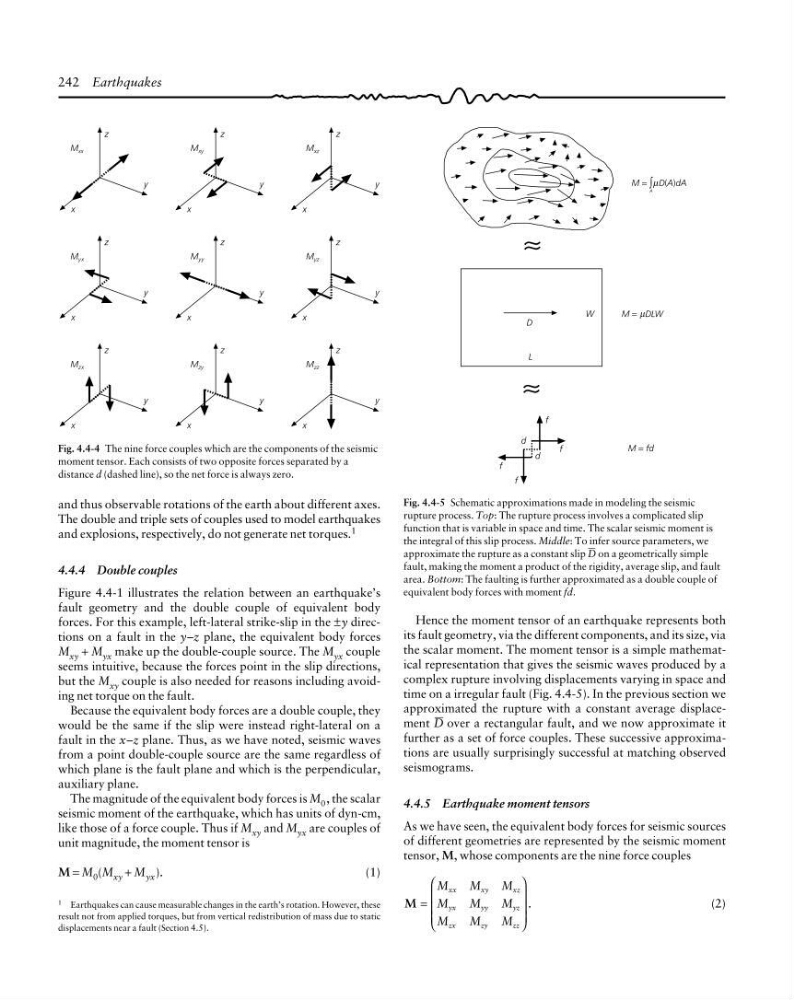
Fig. 4.4-4 The nine force couples which are the components of the seismic
moment tensor. Each consists of two opposite forces separated by a
distance d (dashed line), so the net force is always zero.
1 Earthquakes can cause measurable changes in the earth’s rotation. However, these
result not from applied torques, but from vertical redistribution of mass due to static
displacements near a fault (Section 4.5).
Fig. 4.4-5 Schematic approximations made in modeling the seismic
rupture process. Top: The rupture process involves a complicated slip
function that is variable in space and time. The scalar seismic moment is
the integral of this slip process. Middle: To infer source parameters, we
approximate the rupture as a constant slip D
— on a geometrically simple
fault, making the moment a product of the rigidity, average slip, and fault
area. Bottom: The faulting is further approximated as a double couple of
equivalent body forces with moment fd.
Hence the moment tensor of an earthquake represents both
its fault geometry, via the different components, and its size, via
the scalar moment. The moment tensor is a simple mathematical representation that gives the seismic waves produced by a
complex rupture involving displacements varying in space and
time on a irregular fault (Fig. 4.4-5). In the previous section we
approximated the rupture with a constant average displacement D
— over a rectangular fault, and we now approximate it
further as a set of force couples. These successive approximations are usually surprisingly successful at matching observed
seismograms.
4.4.5 Earthquake moment tensors
As we have seen, the equivalent body forces for seismic sources
of different geometries are represented by the seismic moment
tensor, M, whose components are the nine force couples
M
.
=
⎛
⎝
⎜
⎜
⎜
⎞
⎠
⎟
⎟
⎟
M
M
M
M
M
M
M
M
M
xx
xy
xz
yx
yy
yz
zx
zy
zz
(2)
and thus observable rotations of the earth about different axes.
The double and triple sets of couples used to model earthquakes
and explosions, respectively, do not generate net torques. 1
4.4.4 Double couples
Figure 4.4-1 illustrates the relation between an earthquake’s
fault geometry and the double couple of equivalent body
forces. For this example, left-lateral strike-slip in the ±y directions on a fault in the y–z plane, the equivalent body forces
M xy + M yx make up the double-couple source. The M yx couple
seems intuitive, because the forces point in the slip directions,
but the M xy couple is also needed for reasons including avoiding net torque on the fault.
Because the equivalent body forces are a double couple, they
would be the same if the slip were instead right-lateral on a
fault in the x–z plane. Thus, as we have noted, seismic waves
from a point double-couple source are the same regardless of
which plane is the fault plane and which is the perpendicular,
auxiliary plane.
The magnitude of the equivalent body forces is M 0 , the scalar
seismic moment of the earthquake, which has units of dyn-cm,
like those of a force couple. Thus if M xy and M yx are couples of
unit magnitude, the moment tensor is
M = M 0 (M xy + M yx ).
(1)
M = ∫
A
D(A)dA
µ
D
W
L
M = fd
f
d
f
f
f
d
≈
≈
M = DLW
µ
M xx
x
y
z
x
y
z
M xy
x
y
z
M xz
M yx
x
y
z
x
y
z
M yy
x
y
z
M yz
M zx
x
y
z
x
y
z
M zy
x
y
z
M zz
Fig. 4.4-4 The nine force couples which are the components of the seismic
moment tensor. Each consists of two opposite forces separated by a
distance d (dashed line), so the net force is always zero.
1 Earthquakes can cause measurable changes in the earth’s rotation. However, these
result not from applied torques, but from vertical redistribution of mass due to static
displacements near a fault (Section 4.5).
Fig. 4.4-5 Schematic approximations made in modeling the seismic
rupture process. Top: The rupture process involves a complicated slip
function that is variable in space and time. The scalar seismic moment is
the integral of this slip process. Middle: To infer source parameters, we
approximate the rupture as a constant slip D
— on a geometrically simple
fault, making the moment a product of the rigidity, average slip, and fault
area. Bottom: The faulting is further approximated as a double couple of
equivalent body forces with moment fd.
Hence the moment tensor of an earthquake represents both
its fault geometry, via the different components, and its size, via
the scalar moment. The moment tensor is a simple mathematical representation that gives the seismic waves produced by a
complex rupture involving displacements varying in space and
time on a irregular fault (Fig. 4.4-5). In the previous section we
approximated the rupture with a constant average displacement D
— over a rectangular fault, and we now approximate it
further as a set of force couples. These successive approximations are usually surprisingly successful at matching observed
seismograms.
4.4.5 Earthquake moment tensors
As we have seen, the equivalent body forces for seismic sources
of different geometries are represented by the seismic moment
tensor, M, whose components are the nine force couples
M
.
=
⎛
⎝
⎜
⎜
⎜
⎞
⎠
⎟
⎟
⎟
M
M
M
M
M
M
M
M
M
xx
xy
xz
yx
yy
yz
zx
zy
zz
(2)
and thus observable rotations of the earth about different axes.
The double and triple sets of couples used to model earthquakes
and explosions, respectively, do not generate net torques. 1
4.4.4 Double couples
Figure 4.4-1 illustrates the relation between an earthquake’s
fault geometry and the double couple of equivalent body
forces. For this example, left-lateral strike-slip in the ±y directions on a fault in the y–z plane, the equivalent body forces
M xy + M yx make up the double-couple source. The M yx couple
seems intuitive, because the forces point in the slip directions,
but the M xy couple is also needed for reasons including avoiding net torque on the fault.
Because the equivalent body forces are a double couple, they
would be the same if the slip were instead right-lateral on a
fault in the x–z plane. Thus, as we have noted, seismic waves
from a point double-couple source are the same regardless of
which plane is the fault plane and which is the perpendicular,
auxiliary plane.
The magnitude of the equivalent body forces is M 0 , the scalar
seismic moment of the earthquake, which has units of dyn-cm,
like those of a force couple. Thus if M xy and M yx are couples of
unit magnitude, the moment tensor is
M = M 0 (M xy + M yx ).
(1)