

Observed
Synthetic
1 min
10 s
0.5 × 10
20 dyne
Time
1 0 0
10 0
50 0
1 0 0 0
1500
2 0 0 0
2 4 0 0
25 00
2 4 0 0 Fa th om s
250 0
20 00
100
5 0 0
S l u m p
58°W
5 6 °
54°
46°N
45°
44°
43°
42°
4.4 Moment tensors 241
Meteor impacts should, in principle, generate significant
seismic waves. Impacts have been detected seismologically on
the moon, but not on earth, where only large meteorites survive
passage through the atmosphere. Although it might seem that a
meteor impact should be modeled as a vertical force, this would
probably not be correct, because the impact’s energy would
vaporize rock and cause a spherically symmetric explosion
similar to an underground nuclear detonation. This idea is supported by the observation that craters produced by meteorites,
which are believed to have impacted at very oblique angles, are
essentially symmetrical. As we will see, spherically symmetric
explosions can be modeled by a set of three orthogonal force
couples.
4.4.3 Force couples
A force couple consists of two forces acting together. These are
similar in concept to electromagnetic dipoles, like that used to
model the earth’s magnetic field. Two basic couples are shown
in Fig. 4.4-1. One consists of a pair of forces offset in a direction normal to the force. The couple M xy consists of two forces
of magnitude f, separated by a distance d along the y axis, that
act in opposite (±x) directions. The magnitude of M xy is fd,
which in seismology is given in dyn-cm or N-m. To model a
couple acting at a point, the limit is taken as d goes to zero such
that the product fd stays constant.
The other type of couple, a vector dipole, consists of forces
offset in the direction of the force. M xx consists of two forces of
magnitude f acting in the ±x directions, separated by d along
the x axis. The magnitude is fd, and the limit is taken in the
same way. The difference between the two couple types is that
the second exerts no torque.
Combining force couples of different orientations into the
seismic moment tensor M (Fig. 4.4-4) gives a general description
that can represent various seismic sources. No geophysical processes have been found that are best modeled as single couples,
probably because such couples would generate large torques
Of the likely non-double-couple sources, both a vertical force
and an explosion would produce no Love waves and a circular
(rather than lobed) Rayleigh wave radiation pattern. However, a horizontal force can reproduce the observed radiation
patterns. The seismic source has thus been modeled with a
southward-pointing single force, opposite the direction of the
north-directed explosion and northward-flowing landslide.
The modeling gives estimates of the force involved in the landslide and explosion, which devastated more than 250 square
miles (640 km 2 ) on the north side of the mountain. This explosion is equivalent to an M s 5.2 earthquake, significantly bigger
than the smaller earthquakes often associated with magma
movements within volcanoes.
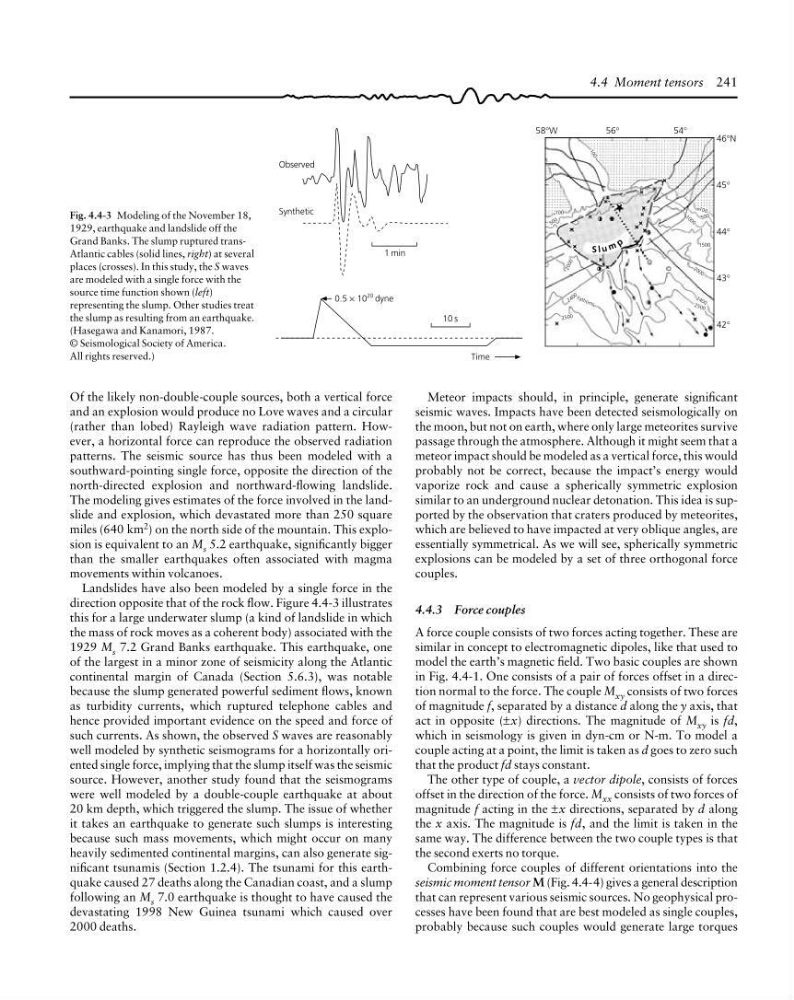
Landslides have also been modeled by a single force in the
direction opposite that of the rock flow. Figure 4.4-3 illustrates
this for a large underwater slump (a kind of landslide in which
the mass of rock moves as a coherent body) associated with the
1929 M s 7.2 Grand Banks earthquake. This earthquake, one
of the largest in a minor zone of seismicity along the Atlantic
continental margin of Canada (Section 5.6.3), was notable
because the slump generated powerful sediment flows, known
as turbidity currents, which ruptured telephone cables and
hence provided important evidence on the speed and force of
such currents. As shown, the observed S waves are reasonably
well modeled by synthetic seismograms for a horizontally oriented single force, implying that the slump itself was the seismic
source. However, another study found that the seismograms
were well modeled by a double-couple earthquake at about
20 km depth, which triggered the slump. The issue of whether
it takes an earthquake to generate such slumps is interesting
because such mass movements, which might occur on many
heavily sedimented continental margins, can also generate significant tsunamis (Section 1.2.4). The tsunami for this earthquake caused 27 deaths along the Canadian coast, and a slump
following an M s 7.0 earthquake is thought to have caused the
devastating 1998 New Guinea tsunami which caused over
2000 deaths.
Fig. 4.4-3 Modeling of the November 18,
1929, earthquake and landslide off the
Grand Banks. The slump ruptured transAtlantic cables (solid lines, right) at several
places (crosses). In this study, the S waves
are modeled with a single force with the
source time function shown (left)
representing the slump. Other studies treat
the slump as resulting from an earthquake.
(Hasegawa and Kanamori, 1987.
© Seismological Society of America.
All rights reserved.)
Synthetic
1 min
10 s
0.5 × 10
20 dyne
Time
1 0 0
10 0
50 0
1 0 0 0
1500
2 0 0 0
2 4 0 0
25 00
2 4 0 0 Fa th om s
250 0
20 00
100
5 0 0
S l u m p
58°W
5 6 °
54°
46°N
45°
44°
43°
42°
4.4 Moment tensors 241
Meteor impacts should, in principle, generate significant
seismic waves. Impacts have been detected seismologically on
the moon, but not on earth, where only large meteorites survive
passage through the atmosphere. Although it might seem that a
meteor impact should be modeled as a vertical force, this would
probably not be correct, because the impact’s energy would
vaporize rock and cause a spherically symmetric explosion
similar to an underground nuclear detonation. This idea is supported by the observation that craters produced by meteorites,
which are believed to have impacted at very oblique angles, are
essentially symmetrical. As we will see, spherically symmetric
explosions can be modeled by a set of three orthogonal force
couples.
4.4.3 Force couples
A force couple consists of two forces acting together. These are
similar in concept to electromagnetic dipoles, like that used to
model the earth’s magnetic field. Two basic couples are shown
in Fig. 4.4-1. One consists of a pair of forces offset in a direction normal to the force. The couple M xy consists of two forces
of magnitude f, separated by a distance d along the y axis, that
act in opposite (±x) directions. The magnitude of M xy is fd,
which in seismology is given in dyn-cm or N-m. To model a
couple acting at a point, the limit is taken as d goes to zero such
that the product fd stays constant.
The other type of couple, a vector dipole, consists of forces
offset in the direction of the force. M xx consists of two forces of
magnitude f acting in the ±x directions, separated by d along
the x axis. The magnitude is fd, and the limit is taken in the
same way. The difference between the two couple types is that
the second exerts no torque.
Combining force couples of different orientations into the
seismic moment tensor M (Fig. 4.4-4) gives a general description
that can represent various seismic sources. No geophysical processes have been found that are best modeled as single couples,
probably because such couples would generate large torques
Of the likely non-double-couple sources, both a vertical force
and an explosion would produce no Love waves and a circular
(rather than lobed) Rayleigh wave radiation pattern. However, a horizontal force can reproduce the observed radiation
patterns. The seismic source has thus been modeled with a
southward-pointing single force, opposite the direction of the
north-directed explosion and northward-flowing landslide.
The modeling gives estimates of the force involved in the landslide and explosion, which devastated more than 250 square
miles (640 km 2 ) on the north side of the mountain. This explosion is equivalent to an M s 5.2 earthquake, significantly bigger
than the smaller earthquakes often associated with magma
movements within volcanoes.
Landslides have also been modeled by a single force in the
direction opposite that of the rock flow. Figure 4.4-3 illustrates
this for a large underwater slump (a kind of landslide in which
the mass of rock moves as a coherent body) associated with the
1929 M s 7.2 Grand Banks earthquake. This earthquake, one
of the largest in a minor zone of seismicity along the Atlantic
continental margin of Canada (Section 5.6.3), was notable
because the slump generated powerful sediment flows, known
as turbidity currents, which ruptured telephone cables and
hence provided important evidence on the speed and force of
such currents. As shown, the observed S waves are reasonably
well modeled by synthetic seismograms for a horizontally oriented single force, implying that the slump itself was the seismic
source. However, another study found that the seismograms
were well modeled by a double-couple earthquake at about
20 km depth, which triggered the slump. The issue of whether
it takes an earthquake to generate such slumps is interesting
because such mass movements, which might occur on many
heavily sedimented continental margins, can also generate significant tsunamis (Section 1.2.4). The tsunami for this earthquake caused 27 deaths along the Canadian coast, and a slump
following an M s 7.0 earthquake is thought to have caused the
devastating 1998 New Guinea tsunami which caused over
2000 deaths.
Fig. 4.4-3 Modeling of the November 18,
1929, earthquake and landslide off the
Grand Banks. The slump ruptured transAtlantic cables (solid lines, right) at several
places (crosses). In this study, the S waves
are modeled with a single force with the
source time function shown (left)
representing the slump. Other studies treat
the slump as resulting from an earthquake.
(Hasegawa and Kanamori, 1987.
© Seismological Society of America.
All rights reserved.)