

240 Earthquakes
Love wave
0.1
0
360
N
0
60
120
S
180
240
300
N
Rayleigh wave
0.1
0
360
N
0
60
120
S
180
240
300
N
Amplitude radiation pattern
Horizontal force
0
L
R
N
N
S
0
180
360
No L
R
No L
R
Vertical force
Isotropic source
R
cm-s
cm-s
seismic radiation. Although these forces are a seismic source
equivalent to the fault motion, they do not describe the actual
fracture process. Equivalent body forces can also be derived
for other seismic sources, such as explosions, landslides, or
impacts on the earth’s surface. These phenomena can generate
observable seismic waves when they occur rapidly enough
(over times less than about an hour) that they release energy
into the earth in the seismic wave frequency band (Fig. 2.4-7).
If the energy is released more slowly, propagating seismic
waves are not excited, although slower crustal deformation can
be recorded using geodetic methods (Section 4.5.1).
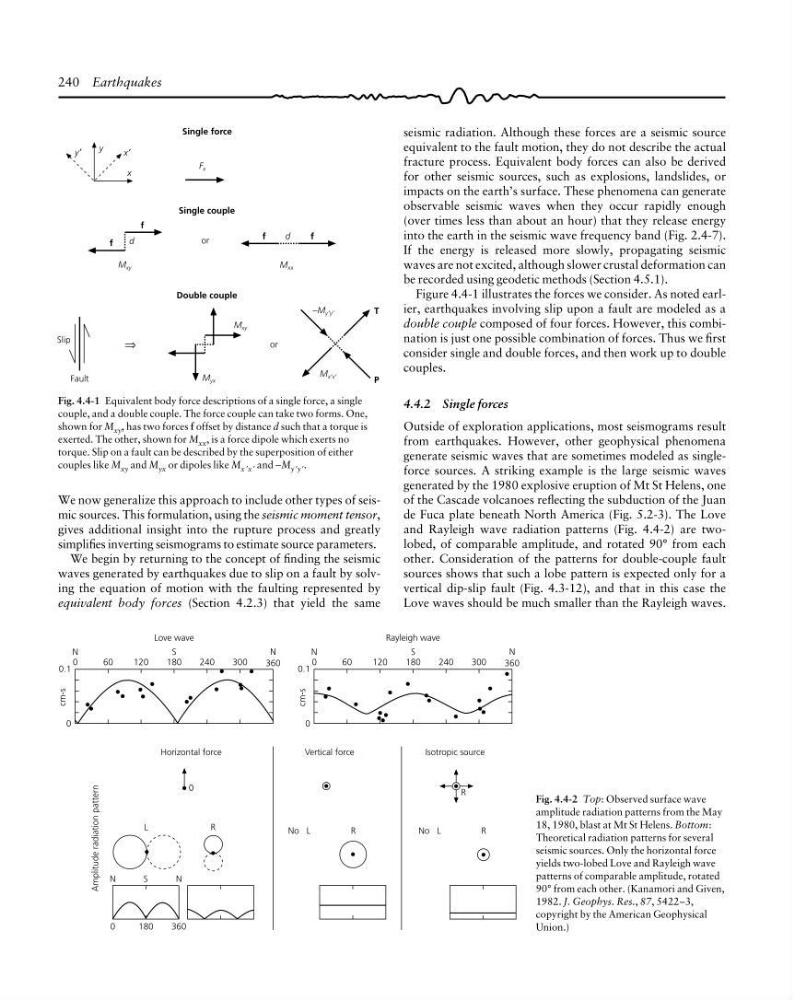
Figure 4.4-1 illustrates the forces we consider. As noted earlier, earthquakes involving slip upon a fault are modeled as a
double couple composed of four forces. However, this combination is just one possible combination of forces. Thus we first
consider single and double forces, and then work up to double
couples.
4.4.2 Single forces
Outside of exploration applications, most seismograms result
from earthquakes. However, other geophysical phenomena
generate seismic waves that are sometimes modeled as singleforce sources. A striking example is the large seismic waves
generated by the 1980 explosive eruption of Mt St Helens, one
of the Cascade volcanoes reflecting the subduction of the Juan
de Fuca plate beneath North America (Fig. 5.2-3). The Love
and Rayleigh wave radiation patterns (Fig. 4.4-2) are twolobed, of comparable amplitude, and rotated 90° from each
other. Consideration of the patterns for double-couple fault
sources shows that such a lobe pattern is expected only for a
vertical dip-slip fault (Fig. 4.3-12), and that in this case the
Love waves should be much smaller than the Rayleigh waves.
Slip
y′
y
x′
x
Single force
F x
Single couple
d
f
f
M xy
or
f
f
d
M xx
Double couple
⇒
M xy
M yx
or
Fault
−M y′y′
M x′x′
T
P
Fig. 4.4-1 Equivalent body force descriptions of a single force, a single
couple, and a double couple. The force couple can take two forms. One,
shown for M xy , has two forces f offset by distance d such that a torque is
exerted. The other, shown for M xx , is a force dipole which exerts no
torque. Slip on a fault can be described by the superposition of either
couples like M xy and M yx or dipoles like M x ′x ′ and −M y ′y ′ .
We now generalize this approach to include other types of seismic sources. This formulation, using the seismic moment tensor,
gives additional insight into the rupture process and greatly
simplifies inverting seismograms to estimate source parameters.
We begin by returning to the concept of finding the seismic
waves generated by earthquakes due to slip on a fault by solving the equation of motion with the faulting represented by
equivalent body forces (Section 4.2.3) that yield the same
Fig. 4.4-2 Top: Observed surface wave
amplitude radiation patterns from the May
18, 1980, blast at Mt St Helens. Bottom:
Theoretical radiation patterns for several
seismic sources. Only the horizontal force
yields two-lobed Love and Rayleigh wave
patterns of comparable amplitude, rotated
90° from each other. (Kanamori and Given,
1982. J. Geophys. Res., 87, 5422–3,
copyright by the American Geophysical
Union.)
Love wave
0.1
0
360
N
0
60
120
S
180
240
300
N
Rayleigh wave
0.1
0
360
N
0
60
120
S
180
240
300
N
Amplitude radiation pattern
Horizontal force
0
L
R
N
N
S
0
180
360
No L
R
No L
R
Vertical force
Isotropic source
R
cm-s
cm-s
seismic radiation. Although these forces are a seismic source
equivalent to the fault motion, they do not describe the actual
fracture process. Equivalent body forces can also be derived
for other seismic sources, such as explosions, landslides, or
impacts on the earth’s surface. These phenomena can generate
observable seismic waves when they occur rapidly enough
(over times less than about an hour) that they release energy
into the earth in the seismic wave frequency band (Fig. 2.4-7).
If the energy is released more slowly, propagating seismic
waves are not excited, although slower crustal deformation can
be recorded using geodetic methods (Section 4.5.1).
Figure 4.4-1 illustrates the forces we consider. As noted earlier, earthquakes involving slip upon a fault are modeled as a
double couple composed of four forces. However, this combination is just one possible combination of forces. Thus we first
consider single and double forces, and then work up to double
couples.
4.4.2 Single forces
Outside of exploration applications, most seismograms result
from earthquakes. However, other geophysical phenomena
generate seismic waves that are sometimes modeled as singleforce sources. A striking example is the large seismic waves
generated by the 1980 explosive eruption of Mt St Helens, one
of the Cascade volcanoes reflecting the subduction of the Juan
de Fuca plate beneath North America (Fig. 5.2-3). The Love
and Rayleigh wave radiation patterns (Fig. 4.4-2) are twolobed, of comparable amplitude, and rotated 90° from each
other. Consideration of the patterns for double-couple fault
sources shows that such a lobe pattern is expected only for a
vertical dip-slip fault (Fig. 4.3-12), and that in this case the
Love waves should be much smaller than the Rayleigh waves.
Slip
y′
y
x′
x
Single force
F x
Single couple
d
f
f
M xy
or
f
f
d
M xx
Double couple
⇒
M xy
M yx
or
Fault
−M y′y′
M x′x′
T
P
Fig. 4.4-1 Equivalent body force descriptions of a single force, a single
couple, and a double couple. The force couple can take two forms. One,
shown for M xy , has two forces f offset by distance d such that a torque is
exerted. The other, shown for M xx , is a force dipole which exerts no
torque. Slip on a fault can be described by the superposition of either
couples like M xy and M yx or dipoles like M x ′x ′ and −M y ′y ′ .
We now generalize this approach to include other types of seismic sources. This formulation, using the seismic moment tensor,
gives additional insight into the rupture process and greatly
simplifies inverting seismograms to estimate source parameters.
We begin by returning to the concept of finding the seismic
waves generated by earthquakes due to slip on a fault by solving the equation of motion with the faulting represented by
equivalent body forces (Section 4.2.3) that yield the same
Fig. 4.4-2 Top: Observed surface wave
amplitude radiation patterns from the May
18, 1980, blast at Mt St Helens. Bottom:
Theoretical radiation patterns for several
seismic sources. Only the horizontal force
yields two-lobed Love and Rayleigh wave
patterns of comparable amplitude, rotated
90° from each other. (Kanamori and Given,
1982. J. Geophys. Res., 87, 5422–3,
copyright by the American Geophysical
Union.)