

the earth’s surface, where data are relatively easy to gather.
These issues are important for society because, as discussed in
Chapter 1, knowledge of where and when earthquakes are
likely, and of the expected ground motion during them, can
help mitigate the risk they pose.
The largest earthquakes typically occur at plate boundaries.
Using elastic rebound theory, we think of them as reflecting the
most dramatic part of a process called the seismic cycle, which
takes place on segments of the plate boundary over hundreds to
thousands of years. During the interseismic stage, which makes
up most of the cycle, steady motion occurs away from the fault
but the fault itself is “locked,” although some aseismic creep
can also occur on it. Immediately prior to rupture there is the
preseismic stage that can be associated with small earthquakes
(foreshocks) or other possible precursory effects. The earthquake itself marks the coseismic phase during which rapid
motion on the fault generates seismic waves. During these few
seconds, meters of slip on the fault “catch up” with the few
mm/yr of motion that occurred over hundreds of years away
from the fault. Finally, a postseismic phase occurs after the
earthquake, and aftershocks and transient afterslip occur for a
period of years before the fault settles into its steady interseismic behavior again.
Studying this cycle is difficult because it extends for hundreds
of years, so we do not have observations of it in any one place.
Instead, we have observations from different places, which we
assume can be combined to give a complete view of the process.
It is far from clear how good that view is and how well our
models represent its complexity. As a result, earthquake physics
remains an active research area that integrates a variety of
techniques. Most faults are identified from the earthquakes on
them, and seismology is the primary tool used to study the
motion during the earthquakes and infer the long-term nature
of motion on the faults. Moreover, because earthquakes are
such dramatic events, historical records of earthquakes are
often available and provide data on the earthquake cycle for
a given fault or fault segment. Field studies, both on land and
under water, also provide information about the location,
geometry, and history of faults. Geodetic measurements are
used to study ground deformation before, during, and after
earthquakes, and thus the processes associated with fault locking and afterslip. For oceanic regions and deep earthquakes,
where geodetic and geological observations are not available,
almost all of what we know about the earthquakes themselves
comes from seismology. The results for individual earthquakes
are then combined and integrated with those from other techniques, as discussed in the next chapter, to better understand
how earthquakes in a given region reflect the large-scale tectonic
processes that cause them.
Of these approaches, our primary focus in this book is the
information that seismology provides about earthquakes. The
arrival time of seismic waves at seismometers at different sites
is first used to find the location of an earthquake, known as the
focus, or hypocenter, using techniques discussed in Chapter 7.
Next, as discussed in this chapter, the amplitudes and shapes of
the radiated seismic waves are used to study the size of the
earthquake, the geometry of the fault on which it occurred,
and the direction and amount of slip. We introduce these
techniques and discuss their applications, while leaving their
derivation and details for more advanced treatments listed at
the chapter’s end.
It is worth bearing in mind that learning about earthquake
faulting from the seismic waves that are generated is an inverse
problem, like learning about earth structure from seismic
waves. As discussed in Section 1.1.2, this means that studying
seismic waves alone is limited in what it can tell about the
earthquake process. We will see that the seismic waves radiated
from an earthquake reflect the geometry of the fault and the
motion on it, and so can give an excellent picture of the kinematics of faulting. However, they contain much less information about the actual physics, or dynamics, of faulting. In the
next chapter, we discuss how seismological results are being
combined with experimental and theoretical studies of rock
friction and fracture to explore the physics of earthquakes.
4.2 Focal mechanisms
4.2.1 Fault geometry
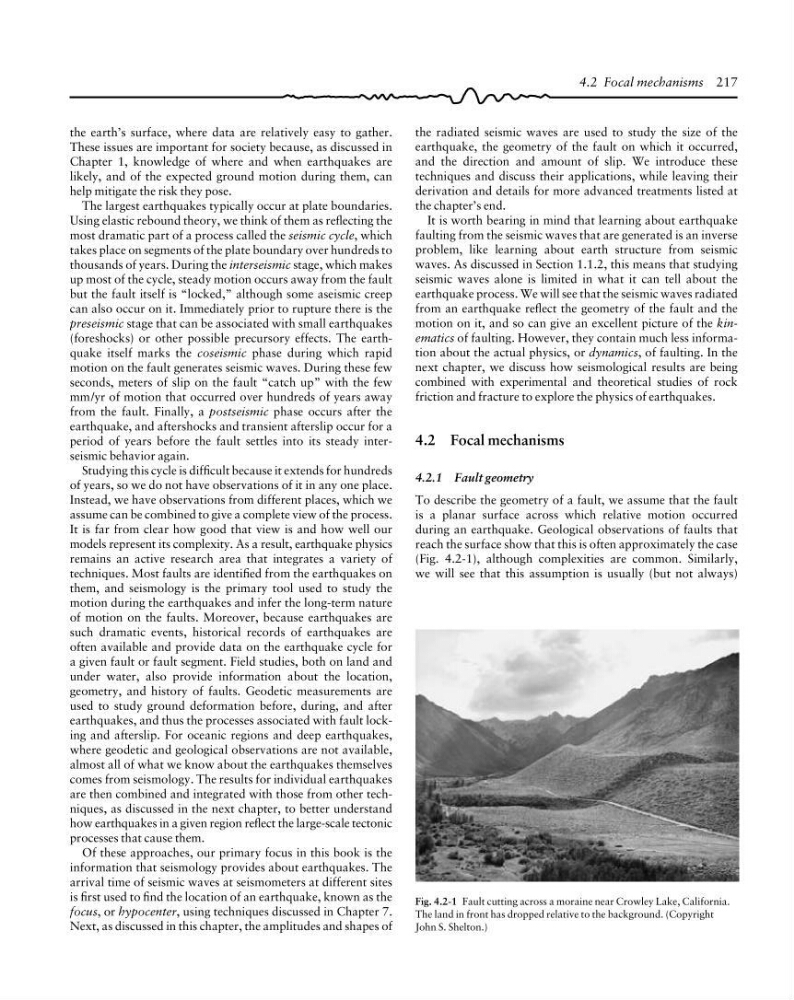
To describe the geometry of a fault, we assume that the fault
is a planar surface across which relative motion occurred
during an earthquake. Geological observations of faults that
reach the surface show that this is often approximately the case
(Fig. 4.2-1), although complexities are common. Similarly,
we will see that this assumption is usually (but not always)
4.2 Focal mechanisms 217
Fig. 4.2-1 Fault cutting across a moraine near Crowley Lake, California.
The land in front has dropped relative to the background. (Copyright
John S. Shelton.)
These issues are important for society because, as discussed in
Chapter 1, knowledge of where and when earthquakes are
likely, and of the expected ground motion during them, can
help mitigate the risk they pose.
The largest earthquakes typically occur at plate boundaries.
Using elastic rebound theory, we think of them as reflecting the
most dramatic part of a process called the seismic cycle, which
takes place on segments of the plate boundary over hundreds to
thousands of years. During the interseismic stage, which makes
up most of the cycle, steady motion occurs away from the fault
but the fault itself is “locked,” although some aseismic creep
can also occur on it. Immediately prior to rupture there is the
preseismic stage that can be associated with small earthquakes
(foreshocks) or other possible precursory effects. The earthquake itself marks the coseismic phase during which rapid
motion on the fault generates seismic waves. During these few
seconds, meters of slip on the fault “catch up” with the few
mm/yr of motion that occurred over hundreds of years away
from the fault. Finally, a postseismic phase occurs after the
earthquake, and aftershocks and transient afterslip occur for a
period of years before the fault settles into its steady interseismic behavior again.
Studying this cycle is difficult because it extends for hundreds
of years, so we do not have observations of it in any one place.
Instead, we have observations from different places, which we
assume can be combined to give a complete view of the process.
It is far from clear how good that view is and how well our
models represent its complexity. As a result, earthquake physics
remains an active research area that integrates a variety of
techniques. Most faults are identified from the earthquakes on
them, and seismology is the primary tool used to study the
motion during the earthquakes and infer the long-term nature
of motion on the faults. Moreover, because earthquakes are
such dramatic events, historical records of earthquakes are
often available and provide data on the earthquake cycle for
a given fault or fault segment. Field studies, both on land and
under water, also provide information about the location,
geometry, and history of faults. Geodetic measurements are
used to study ground deformation before, during, and after
earthquakes, and thus the processes associated with fault locking and afterslip. For oceanic regions and deep earthquakes,
where geodetic and geological observations are not available,
almost all of what we know about the earthquakes themselves
comes from seismology. The results for individual earthquakes
are then combined and integrated with those from other techniques, as discussed in the next chapter, to better understand
how earthquakes in a given region reflect the large-scale tectonic
processes that cause them.
Of these approaches, our primary focus in this book is the
information that seismology provides about earthquakes. The
arrival time of seismic waves at seismometers at different sites
is first used to find the location of an earthquake, known as the
focus, or hypocenter, using techniques discussed in Chapter 7.
Next, as discussed in this chapter, the amplitudes and shapes of
the radiated seismic waves are used to study the size of the
earthquake, the geometry of the fault on which it occurred,
and the direction and amount of slip. We introduce these
techniques and discuss their applications, while leaving their
derivation and details for more advanced treatments listed at
the chapter’s end.
It is worth bearing in mind that learning about earthquake
faulting from the seismic waves that are generated is an inverse
problem, like learning about earth structure from seismic
waves. As discussed in Section 1.1.2, this means that studying
seismic waves alone is limited in what it can tell about the
earthquake process. We will see that the seismic waves radiated
from an earthquake reflect the geometry of the fault and the
motion on it, and so can give an excellent picture of the kinematics of faulting. However, they contain much less information about the actual physics, or dynamics, of faulting. In the
next chapter, we discuss how seismological results are being
combined with experimental and theoretical studies of rock
friction and fracture to explore the physics of earthquakes.
4.2 Focal mechanisms
4.2.1 Fault geometry
To describe the geometry of a fault, we assume that the fault
is a planar surface across which relative motion occurred
during an earthquake. Geological observations of faults that
reach the surface show that this is often approximately the case
(Fig. 4.2-1), although complexities are common. Similarly,
we will see that this assumption is usually (but not always)
4.2 Focal mechanisms 217
Fig. 4.2-1 Fault cutting across a moraine near Crowley Lake, California.
The land in front has dropped relative to the background. (Copyright
John S. Shelton.)