

4.1 Introduction
Seismology deals with the generation and propagation of seismic waves. Our initial focus has been on the propagation of
seismic waves and how they can be used to study the interior of
the earth. We now turn to the generation of seismic waves and
how they are used to study earthquakes. This association is so
strong that seismology is sometimes viewed as the science of
earthquakes, rather than of elastic waves in the earth. Both
definitions are used, but the latter has become more common
because seismology is the primary tool used to investigate earth
structure as well as earthquakes, whereas techniques other
than elastic waves are also used to investigate earthquakes.
Earthquakes almost invariably occur on faults, surfaces in
the earth on which one side moves with respect to the other.
Typically, earthquakes occur on faults previously identified by
geological mapping, which shows that motion across the fault
has occurred in the past. Earthquakes that occur on land and
close enough to the surface often leave visible ground breakage
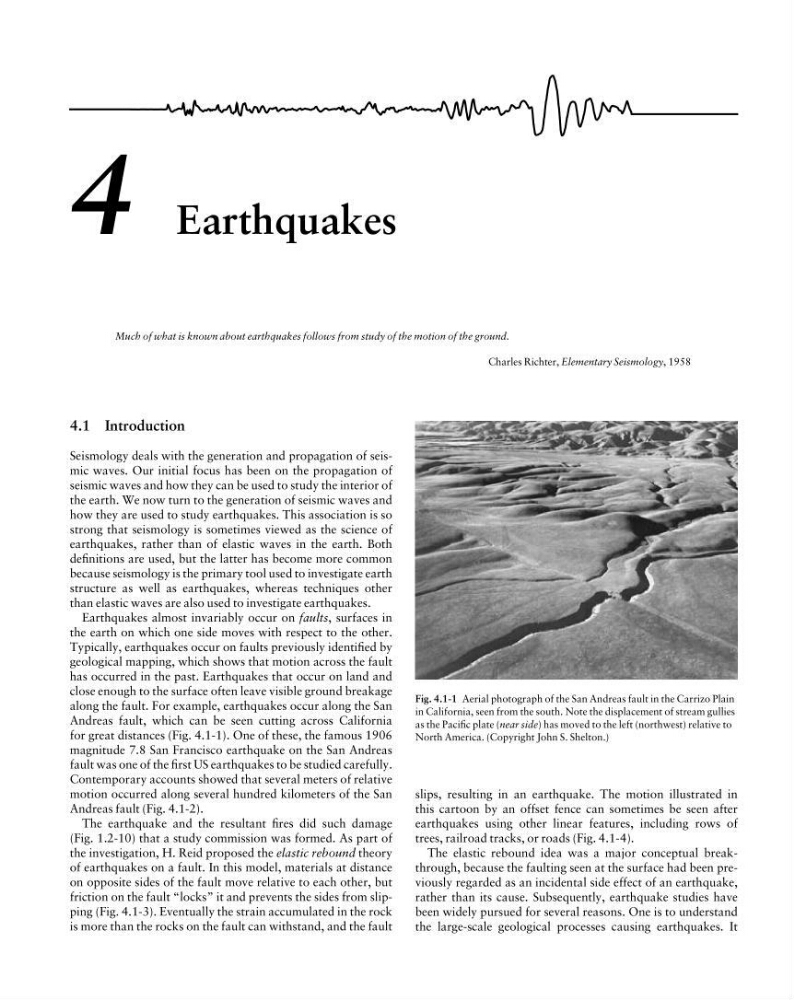
along the fault. For example, earthquakes occur along the San
Andreas fault, which can be seen cutting across California
for great distances (Fig. 4.1-1). One of these, the famous 1906
magnitude 7.8 San Francisco earthquake on the San Andreas
fault was one of the first US earthquakes to be studied carefully.
Contemporary accounts showed that several meters of relative
motion occurred along several hundred kilometers of the San
Andreas fault (Fig. 4.1-2).
The earthquake and the resultant fires did such damage
(Fig. 1.2-10) that a study commission was formed. As part of
the investigation, H. Reid proposed the elastic rebound theory
of earthquakes on a fault. In this model, materials at distance
on opposite sides of the fault move relative to each other, but
friction on the fault “locks” it and prevents the sides from slipping (Fig. 4.1-3). Eventually the strain accumulated in the rock
is more than the rocks on the fault can withstand, and the fault
4 Earthquakes
Much of what is known about earthquakes follows from study of the motion of the ground.
Charles Richter, Elementary Seismology, 1958
Fig. 4.1-1 Aerial photograph of the San Andreas fault in the Carrizo Plain
in California, seen from the south. Note the displacement of stream gullies
as the Pacific plate (near side) has moved to the left (northwest) relative to
North America. (Copyright John S. Shelton.)
slips, resulting in an earthquake. The motion illustrated in
this cartoon by an offset fence can sometimes be seen after
earthquakes using other linear features, including rows of
trees, railroad tracks, or roads (Fig. 4.1-4).
The elastic rebound idea was a major conceptual breakthrough, because the faulting seen at the surface had been previously regarded as an incidental side effect of an earthquake,
rather than its cause. Subsequently, earthquake studies have
been widely pursued for several reasons. One is to understand
the large-scale geological processes causing earthquakes. It
Seismology deals with the generation and propagation of seismic waves. Our initial focus has been on the propagation of
seismic waves and how they can be used to study the interior of
the earth. We now turn to the generation of seismic waves and
how they are used to study earthquakes. This association is so
strong that seismology is sometimes viewed as the science of
earthquakes, rather than of elastic waves in the earth. Both
definitions are used, but the latter has become more common
because seismology is the primary tool used to investigate earth
structure as well as earthquakes, whereas techniques other
than elastic waves are also used to investigate earthquakes.
Earthquakes almost invariably occur on faults, surfaces in
the earth on which one side moves with respect to the other.
Typically, earthquakes occur on faults previously identified by
geological mapping, which shows that motion across the fault
has occurred in the past. Earthquakes that occur on land and
close enough to the surface often leave visible ground breakage
along the fault. For example, earthquakes occur along the San
Andreas fault, which can be seen cutting across California
for great distances (Fig. 4.1-1). One of these, the famous 1906
magnitude 7.8 San Francisco earthquake on the San Andreas
fault was one of the first US earthquakes to be studied carefully.
Contemporary accounts showed that several meters of relative
motion occurred along several hundred kilometers of the San
Andreas fault (Fig. 4.1-2).
The earthquake and the resultant fires did such damage
(Fig. 1.2-10) that a study commission was formed. As part of
the investigation, H. Reid proposed the elastic rebound theory
of earthquakes on a fault. In this model, materials at distance
on opposite sides of the fault move relative to each other, but
friction on the fault “locks” it and prevents the sides from slipping (Fig. 4.1-3). Eventually the strain accumulated in the rock
is more than the rocks on the fault can withstand, and the fault
4 Earthquakes
Much of what is known about earthquakes follows from study of the motion of the ground.
Charles Richter, Elementary Seismology, 1958
Fig. 4.1-1 Aerial photograph of the San Andreas fault in the Carrizo Plain
in California, seen from the south. Note the displacement of stream gullies
as the Pacific plate (near side) has moved to the left (northwest) relative to
North America. (Copyright John S. Shelton.)
slips, resulting in an earthquake. The motion illustrated in
this cartoon by an offset fence can sometimes be seen after
earthquakes using other linear features, including rows of
trees, railroad tracks, or roads (Fig. 4.1-4).
The elastic rebound idea was a major conceptual breakthrough, because the faulting seen at the surface had been previously regarded as an incidental side effect of an earthquake,
rather than its cause. Subsequently, earthquake studies have
been widely pursued for several reasons. One is to understand
the large-scale geological processes causing earthquakes. It