

210 Seismology and Earth Structure
Temperature (K)
5000
4500
4000
3500
3000
Present geotherm
“Original” geotherm
Inner core
0
500
1000
1500
2000
2500
3000
3485
3800
Radius (km)
Outer core
Mantle
Melting point for
fixed composition
(“solidus”)
D″
ICB
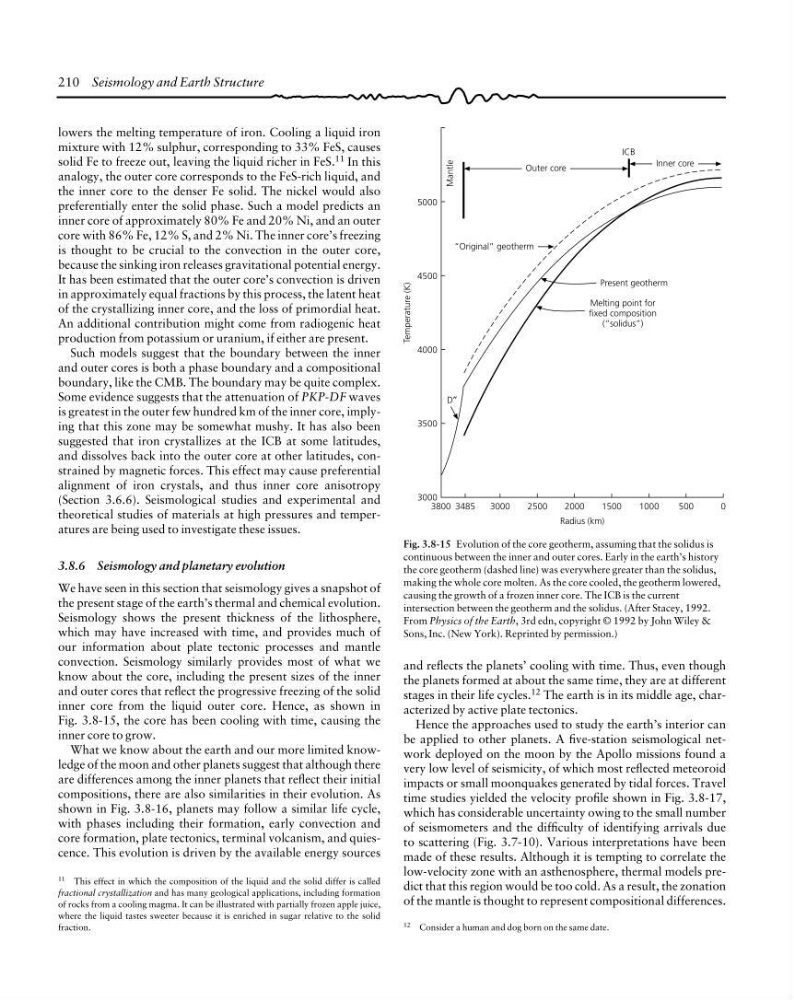
Fig. 3.8-15 Evolution of the core geotherm, assuming that the solidus is
continuous between the inner and outer cores. Early in the earth’s history
the core geotherm (dashed line) was everywhere greater than the solidus,
making the whole core molten. As the core cooled, the geotherm lowered,
causing the growth of a frozen inner core. The ICB is the current
intersection between the geotherm and the solidus. (After Stacey, 1992.
From Physics of the Earth, 3rd edn, copyright © 1992 by John Wiley &
Sons, Inc. (New York). Reprinted by permission.)
lowers the melting temperature of iron. Cooling a liquid iron
mixture with 12% sulphur, corresponding to 33% FeS, causes
solid Fe to freeze out, leaving the liquid richer in FeS. 11 In this
analogy, the outer core corresponds to the FeS-rich liquid, and
the inner core to the denser Fe solid. The nickel would also
preferentially enter the solid phase. Such a model predicts an
inner core of approximately 80% Fe and 20% Ni, and an outer
core with 86% Fe, 12% S, and 2% Ni. The inner core’s freezing
is thought to be crucial to the convection in the outer core,
because the sinking iron releases gravitational potential energy.
It has been estimated that the outer core’s convection is driven
in approximately equal fractions by this process, the latent heat
of the crystallizing inner core, and the loss of primordial heat.
An additional contribution might come from radiogenic heat
production from potassium or uranium, if either are present.
Such models suggest that the boundary between the inner
and outer cores is both a phase boundary and a compositional
boundary, like the CMB. The boundary may be quite complex.
Some evidence suggests that the attenuation of PKP-DF waves
is greatest in the outer few hundred km of the inner core, implying that this zone may be somewhat mushy. It has also been
suggested that iron crystallizes at the ICB at some latitudes,
and dissolves back into the outer core at other latitudes, constrained by magnetic forces. This effect may cause preferential
alignment of iron crystals, and thus inner core anisotropy
(Section 3.6.6). Seismological studies and experimental and
theoretical studies of materials at high pressures and temperatures are being used to investigate these issues.
3.8.6 Seismology and planetary evolution
We have seen in this section that seismology gives a snapshot of
the present stage of the earth’s thermal and chemical evolution.
Seismology shows the present thickness of the lithosphere,
which may have increased with time, and provides much of
our information about plate tectonic processes and mantle
convection. Seismology similarly provides most of what we
know about the core, including the present sizes of the inner
and outer cores that reflect the progressive freezing of the solid
inner core from the liquid outer core. Hence, as shown in
Fig. 3.8-15, the core has been cooling with time, causing the
inner core to grow.
What we know about the earth and our more limited knowledge of the moon and other planets suggest that although there
are differences among the inner planets that reflect their initial
compositions, there are also similarities in their evolution. As
shown in Fig. 3.8-16, planets may follow a similar life cycle,
with phases including their formation, early convection and
core formation, plate tectonics, terminal volcanism, and quiescence. This evolution is driven by the available energy sources
11 This effect in which the composition of the liquid and the solid differ is called
fractional crystallization and has many geological applications, including formation
of rocks from a cooling magma. It can be illustrated with partially frozen apple juice,
where the liquid tastes sweeter because it is enriched in sugar relative to the solid
fraction.
12 Consider a human and dog born on the same date.
and reflects the planets’ cooling with time. Thus, even though
the planets formed at about the same time, they are at different
stages in their life cycles. 12 The earth is in its middle age, characterized by active plate tectonics.
Hence the approaches used to study the earth’s interior can
be applied to other planets. A five-station seismological network deployed on the moon by the Apollo missions found a
very low level of seismicity, of which most reflected meteoroid
impacts or small moonquakes generated by tidal forces. Travel
time studies yielded the velocity profile shown in Fig. 3.8-17,
which has considerable uncertainty owing to the small number
of seismometers and the difficulty of identifying arrivals due
to scattering (Fig. 3.7-10). Various interpretations have been
made of these results. Although it is tempting to correlate the
low-velocity zone with an asthenosphere, thermal models predict that this region would be too cold. As a result, the zonation
of the mantle is thought to represent compositional differences.
Temperature (K)
5000
4500
4000
3500
3000
Present geotherm
“Original” geotherm
Inner core
0
500
1000
1500
2000
2500
3000
3485
3800
Radius (km)
Outer core
Mantle
Melting point for
fixed composition
(“solidus”)
D″
ICB
Fig. 3.8-15 Evolution of the core geotherm, assuming that the solidus is
continuous between the inner and outer cores. Early in the earth’s history
the core geotherm (dashed line) was everywhere greater than the solidus,
making the whole core molten. As the core cooled, the geotherm lowered,
causing the growth of a frozen inner core. The ICB is the current
intersection between the geotherm and the solidus. (After Stacey, 1992.
From Physics of the Earth, 3rd edn, copyright © 1992 by John Wiley &
Sons, Inc. (New York). Reprinted by permission.)
lowers the melting temperature of iron. Cooling a liquid iron
mixture with 12% sulphur, corresponding to 33% FeS, causes
solid Fe to freeze out, leaving the liquid richer in FeS. 11 In this
analogy, the outer core corresponds to the FeS-rich liquid, and
the inner core to the denser Fe solid. The nickel would also
preferentially enter the solid phase. Such a model predicts an
inner core of approximately 80% Fe and 20% Ni, and an outer
core with 86% Fe, 12% S, and 2% Ni. The inner core’s freezing
is thought to be crucial to the convection in the outer core,
because the sinking iron releases gravitational potential energy.
It has been estimated that the outer core’s convection is driven
in approximately equal fractions by this process, the latent heat
of the crystallizing inner core, and the loss of primordial heat.
An additional contribution might come from radiogenic heat
production from potassium or uranium, if either are present.
Such models suggest that the boundary between the inner
and outer cores is both a phase boundary and a compositional
boundary, like the CMB. The boundary may be quite complex.
Some evidence suggests that the attenuation of PKP-DF waves
is greatest in the outer few hundred km of the inner core, implying that this zone may be somewhat mushy. It has also been
suggested that iron crystallizes at the ICB at some latitudes,
and dissolves back into the outer core at other latitudes, constrained by magnetic forces. This effect may cause preferential
alignment of iron crystals, and thus inner core anisotropy
(Section 3.6.6). Seismological studies and experimental and
theoretical studies of materials at high pressures and temperatures are being used to investigate these issues.
3.8.6 Seismology and planetary evolution
We have seen in this section that seismology gives a snapshot of
the present stage of the earth’s thermal and chemical evolution.
Seismology shows the present thickness of the lithosphere,
which may have increased with time, and provides much of
our information about plate tectonic processes and mantle
convection. Seismology similarly provides most of what we
know about the core, including the present sizes of the inner
and outer cores that reflect the progressive freezing of the solid
inner core from the liquid outer core. Hence, as shown in
Fig. 3.8-15, the core has been cooling with time, causing the
inner core to grow.
What we know about the earth and our more limited knowledge of the moon and other planets suggest that although there
are differences among the inner planets that reflect their initial
compositions, there are also similarities in their evolution. As
shown in Fig. 3.8-16, planets may follow a similar life cycle,
with phases including their formation, early convection and
core formation, plate tectonics, terminal volcanism, and quiescence. This evolution is driven by the available energy sources
11 This effect in which the composition of the liquid and the solid differ is called
fractional crystallization and has many geological applications, including formation
of rocks from a cooling magma. It can be illustrated with partially frozen apple juice,
where the liquid tastes sweeter because it is enriched in sugar relative to the solid
fraction.
12 Consider a human and dog born on the same date.
and reflects the planets’ cooling with time. Thus, even though
the planets formed at about the same time, they are at different
stages in their life cycles. 12 The earth is in its middle age, characterized by active plate tectonics.
Hence the approaches used to study the earth’s interior can
be applied to other planets. A five-station seismological network deployed on the moon by the Apollo missions found a
very low level of seismicity, of which most reflected meteoroid
impacts or small moonquakes generated by tidal forces. Travel
time studies yielded the velocity profile shown in Fig. 3.8-17,
which has considerable uncertainty owing to the small number
of seismometers and the difficulty of identifying arrivals due
to scattering (Fig. 3.7-10). Various interpretations have been
made of these results. Although it is tempting to correlate the
low-velocity zone with an asthenosphere, thermal models predict that this region would be too cold. As a result, the zonation
of the mantle is thought to represent compositional differences.